
Development of an Electromagnetic Pollution Rating Index for Buildings
DOI:
https://doi.org/10.46604/emsi.2026.15721Keywords:
electromagnetic radiation, green building, electromagnetic pollution rating index (EPRI), indoor environmental quality, green building certificateAbstract
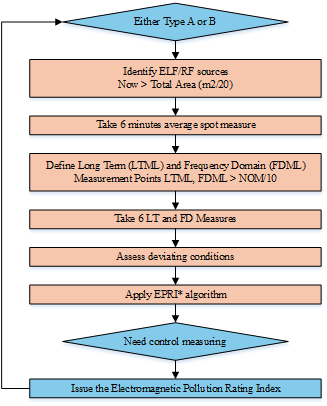
Rapid technological development and the intensive use of electrical energy in buildings create electromagnetic pollution. This pollution is further intensified by external radiation from base stations and transmission lines. The World Health Organization (WHO) classifies electromagnetic field (EMF) exposure as a Class 2B carcinogen. To address this, this study proposes a novel electromagnetic pollution rating index (EPRI). This index integrates into green building certification systems, such as leadership in energy and environmental design (LEED) and building research establishment environmental assessment method (BREEAM). The EPRI methodology applies risk reduction factors (10–1000×) to international commission on non-ionizing radiation protection (ICNIRP) reference limits. A case study conducted in a 7,600 m² municipal building involves 760 measurements at extremely low frequency (ELF) and radio frequency (RF) ranges. Results reveal maximum values of 4.9 V/m and values of 0.43 µT. These qualify for the highest A+++ rating, demonstrating the practical applicability of EPRI in certifying electromagnetically clean indoor environments.
References
J. Berniak-Woźny and M. Rataj, "Towards Green and Sustainable Healthcare: A Literature Review and Research Agenda for Green Leadership in the Healthcare Sector," International Journal of Environmental Research and Public Health, vol. 20, no. 2, article no. 908, 2023.
G. Parise, L. Martirano, and S. Di Ponio, "Energy Performance of Interior Lighting Systems," IEEE Transactions on Industry Applications, vol. 49, no. 6, pp. 2793-2801, 2013.
H. Hu, G. Cohen, B. Sharma, H. Yin, and R. McConnell, "Sustainability in Health Care," Annual Review of Environment and Resources, vol. 47, pp. 173-196, 2022.
L. Ye, M. Su, Z. Cheng, Q. Wang, and Y. Yao, "Application Status and Evaluation Method of Renewable Energy in Green Building in China," Proceedings of International Conference on Materials for Renewable Energy and Environment, pp. 947-950, 2013.
P. C. Rathebe, D. S. Modisane, M. B. Rampedi, S. Biddesay-Manila, and T. P. Mbonane, "A Review on Residential Exposure to Electromagnetic Fields from Overhead Power Lines: Electrification as a Health Burden in Rural Communities," Proceedings of the International Conference on Public Health, pp. 219-221, 2019.
A. Modenese and F. Gobba, "Occupational Exposure to Non-Ionizing Radiation. Main Effects and Criteria for Health Surveillance of Workers According to the European Directives," Proceedings of IEEE International Conference on Environment and Electrical Engineering and IEEE Industrial and Commercial Power Systems Europe (EEEIC / I&CPS Europe), pp. 1-6, 2020.
O. Cerezci, B. Kanberoglu, and C. Yener, "Assessment of Occupational Exposure Levels of Cleaning Product Manufacturing Factory Workers to Electromagnetic Fields," Radiation Protection Dosimetry, vol. 198, no. 4, pp. 197-207, 2022.
P.C. Rathebe, "Shielding as an Effective Engineering Control for Occupational Exposure to MRI-Related Electromagnetic Fields: A Brief Review," Proceedings of Ural Symposium on Biomedical Engineering, Radioelectronics and Information Technology, pp. 147-151, 2020.
M. Carlberg, T. Koppel, M. Ahonen, and L. Hardell, "Case-Control Study on Occupational Exposure to Extremely Low Frequency Electromagnetic Fields and Glioma Risk," American Journal of Industrial Medicine, vol. 60, no. 5, pp. 494-503, 2017.
A. A. H. P. Feizi and M. A. A, Arabi, "Acute Childhood Leukemias and Exposure to Magnetic Fields Generated by High Voltage Overhead Power Lines - A Risk Factor in Iran," Asian Pacific Journal of Cancer Prevention, vol. 8, no. 1, pp. 69-72, 2007.
N. Schreier, A. Huss, and M. Röösli, "The Prevalence of Symptoms Attributed to Electromagnetic Field Exposure: A Cross-Sectional Representative Survey in Switzerland," Sozial-und Präventivmedizin, vol. 51, no. 4, pp. 202-209, 2006.
International Commission on Non-Ionizing Radiation Protection (ICNIRP), "Guidelines for Limiting Exposure to Time-Varying Electric, Magnetic and Electromagnetic Fields (Up to 300 GHz)," Health Physics, vol.74, no.4, pp. 494-522, 1998
International Commission on Non-Ionizing Radiation Protection (ICNIRP), "Guidelines for Limiting Exposure to Time-Varying Electric and Magnetic Fields (1 Hz to 100 kHz)," Health Physics, vol. 99, no. 6, pp. 818-836, 2010.
International Commission on Non-Ionizing Radiation Protection (ICNIRP), "Guidelines for Limiting Exposure to Electromagnetic Fields (100 kHz to 300 GHz)," Health Physics, vol. 118, no. 5, pp. 483-524, 2020.
Directive 2013/35/EU of the European Parliament and of the Council of 26 June 2013 on the Minimum Health and Safety Requirements Regarding the Exposure of Workers to the Risks Arising from Physical Agents (Electromagnetic Fields)," Official Journal of the European Union, L 179, pp. 1-21, 2013.
Standard for Limiting Exposure to Radiofrequency Fields–100 kHz to 300 GHz, Radiation Protection Series S-1 (RPS S-1), 2021.
C. Sage and D. O. Carpenter, "Biolnitiative Report 2012: A Rationale for a Biologically-Based Public Exposure Standard for Electromagnetic Radiation," Biolnitiative Working Group, Technical Report, 2012.
H. Lai, "Biolnitiative Report: Henry Lai's Research Summaries," Biolnitiative Working Group, Technical Report, 2022.
H. Lai and N. P. Singh, "Magnetic-Field-Induced DNA Strand Breaks in Brain Cells of the Rat," Environmental Health Perspectives, vol. 112, no. 6, pp. 687-694, 2004.
C. T. Mihai, P. Rotinberg, F. Brinza, and G. Vochita, "Extremely Low-Frequency Electromagnetic Fields Cause DNA Strand Breaks in Normal Cells," Journal of Environmental Health Science and Engineering, vol. 12, article no.15, 2014.
M. M. Samy, A. M. El-Zein, and M. Abdel-Salam, "Electric Field Profiles and Right-of-Way Widths as Influenced by Grounded Shield Wires Underneath EHV Direct Current Transmission Lines," Proceedings of the 6th International Conference on Electrical Engineering (ICEENG), 2008.
M. E. Maffei, "Magnetic Fields and Cancer: Epidemiology, Cellular Biology, and Theranostics," International Journal of Molecular Sciences, vol. 23, no. 3, article no. 1339, 2022.
G. C. Jagetia, "Genotoxic Effects of Electromagnetic Field Radiations from Mobile Phones," Environmental Research, vol. 212, part D, article no. 113321, 2022.
B. B. Levitt, H. C. Lai, and A. M. Manville, "Effects of Non-Ionizing Electromagnetic Fields on Flora and Fauna, Part 1. Rising Ambient EMF Levels in the Environment," Reviews on Environmental Health, vol. 37, no. 1, pp. 81-122, 2021.
B. B. Levitt, H. C. Lai, and A. M. Manville, "Effects of Non-Ionizing Electromagnetic Fields on Flora and Fauna, Part 2 Impacts: How Species Interact with Natural and Man-Made EMF," Reviews on Environmental Health, vol. 37, no. 3, pp. 327-406, 2021.
J. Dyche, A. M. Anch, K. A. J. Fogler, D. W. Barnett, and C. Thomas, "Effects of Power Frequency Electromagnetic Fields on Melatonin and Sleep in the Rat," Emerging Health Threats Journal, vol. 5, article no.10941, 2012.
M. R. Monazzam, M. Hosseini, L. F. Matin, H. A. Aghaei, H. Khosroabadi, and A. Hesami, "Sleep Quality and General Health Status of Employees Exposed to Extremely Low Frequency Magnetic Fields in a Petrochemical Complex," Journal of Environmental Health Science and Engineering, vol. 12, article no.78, 2014.
T. Barsam, M. R. Monazzam, A. A. Haghdoost, M. R. Ghotbi, S. F. Dehghan, "Effect of Extremely Low Frequency Electromagnetic Field Exposure on Sleep Quality in High Voltage Substations," Journal of Environmental Health Science and Engineering, vol. 9, no. 1, article no.15, pp. 1-7, 2012.
Published
Issue
Section
License
Copyright (c) 2026 Serap Duman, Osman Cerezci, Suayb Cagri Yener, Baha Kanberoglu, Feyza Selamet

This work is licensed under a Creative Commons Attribution-NonCommercial 4.0 International License.
Copyright Notice
Submission of a manuscript implies: that the work described has not been published before that it is not under consideration for publication elsewhere; that if and when the manuscript is accepted for publication. Authors can retain copyright in their articles with no restrictions. Also, author can post the final, peer-reviewed manuscript version (postprint) to any repository or website.
Since Sep. 01, 2023, EMSI will publish new articles with Creative Commons Attribution Non-Commercial License, under Creative Commons Attribution Non-Commercial 4.0 International (CC BY-NC 4.0) License.
The Creative Commons Attribution Non-Commercial (CC-BY-NC) License permits use, distribution and reproduction in any medium, provided the original work is properly cited and is not used for commercial purposes.
How to Cite