
Automated Lung Sound-Based Disease Classification Using a Multi-Model Pre-Trained CNN Framework
DOI:
https://doi.org/10.46604/emsi.2026.16374Keywords:
lung sound classification, deep learning, convolutional neural networks, pre-trained models, computer-aided diagnosisAbstract
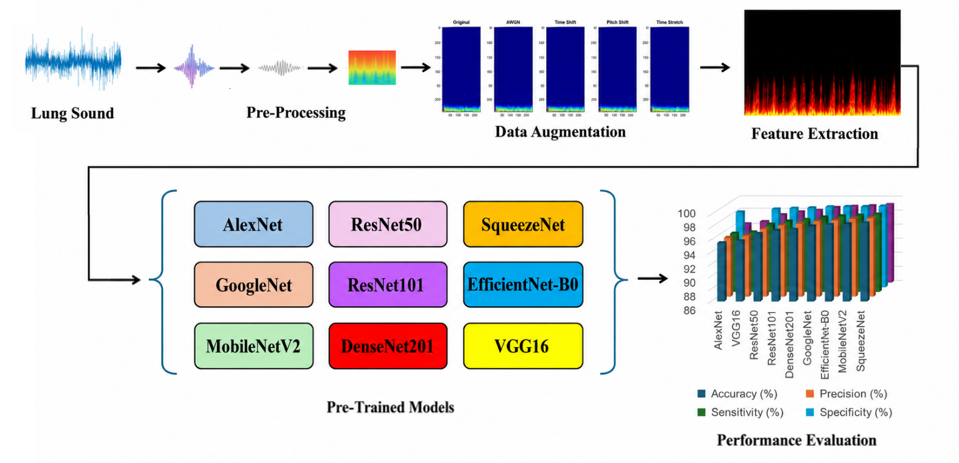
The early identification of pulmonary diseases is essential for timely treatment and better patient care. This study presents a deep learning framework for automated classification of lung sound based diseases using nine pre-trained convolutional neural networks (CNNs). The lung sounds are filtered using a sixth-order Butterworth bandpass filter and converted into log-Mel spectrograms before training. Evaluations of the candidate models include to ensure the reliability and clinical relevance of the diagnostic results. EfficientNet-B0 achieves the highest accuracy of 99.20%, precision of 99.20%, sensitivity of 99.20%, specificity of 99.73%, and F1-score of 99.22%, followed by DenseNet201 (99.00%) and ResNet101 (98.90%). These results demonstrate that pre-trained CNNs can learn effective, discriminative features from lung sounds, leading to precise and efficient classification of respiratory diseases.
References
A. Yorgancioglu, N. Khaltaev, J. Bousquet, and C. Varghese, “The Global Alliance Against Chronic Respiratory Diseases: Journey So Far and Way Ahead,” Chinese Medical Journal, vol. 133, no. 13, pp. 1513-1515, 2020.
J. Torre-Cruza, F. Canadas-Quesada, R. Cortina-Parajon, J. Ranilla-Pastor, N. Ruiz-Reyes, P. Vera-Candeas, et al., “A Novel Data Augmentation Technique Based on Wheezing Physiological Modeling Applied to Asthma Severity Management in Respiratory Sounds,” Computers in Biology and Medicine, vol. 196, part C, article no. 119010, 2025.
R. Lang, Y. Fan, G. Liu, and G. Liu, “Analysis of Unlabeled Lung Sound Samples Using Semi-Supervised Convolutional Neural Networks,” Applied Mathematics and Computation, vol. 411, article no. 126511, 2021.
A. H. Sfayyih, N. Sulaiman, and A. H. Sabry, “A Review on Lung Disease Recognition by Acoustic Signal Analysis with Deep Learning Networks,” Journal of Big Data, vol. 10, article no. 101, 2023.
B. A. Tessema, H. D. Nemomssa, and G. L. Simegn, “Acquisition and Classification of Lung Sounds for Improving the Efficacy of Auscultation Diagnosis of Pulmonary Diseases,” Medical Devices: Evidence and Research, vol. 15, pp. 89-102, 2022.
G. Perera and H. C. Pathmakumara, “Advanced Deep Learning Techniques for Lung Sound Classification: Binary, Multi-Class, and Ensemble Approach,” Proceedings of 2025 7th International Conference on Software Engineering and Computer Science (CSECS), IEEE Xplore, pp. 21-23, 2025.
Q. Chen, W. Zhang, X. Tian, X. Zhang, S. Chen, and W. Lei, “Automatic Heart and Lung Sounds Classification Using Convolutional Neural Networks,” Proceedings of 2016 Asia-Pacific Signal and Information Processing Association Annual Summit and Conference (APSIPA), IEEE Xplore, pp. 13-16, 2017.
A. Joshi, T. Kumar, and C. Tiwari, “Enhanced Exploration of Chronic Cough Using Improved Convolutional Neural Networks and Remote Monitoring Harnessing Internet of Things (IoT),” Materials Today: Proceedings, vol.46, part 15, pp. 6465-6473, 2021.
T. T. Oishee, J. Anjom, U. Mohammed, and M. I. A. Hossain, “Leveraging Deep Edge Intelligence for Real-Time Respiratory Disease Detection,” Clinical eHealth, vol. 7, pp. 207-220, 2024.
Y. Zhang, Q. Huang, W. Sun, F. Chen, D. Lin, and F. Chen, “Research on Lung Sound Classification Model Based on Dual-Channel CNN-LSTM Algorithm,” Biomedical Signal Processing and Control, vol. 94, article no. 106257, 2024.
I. A. P. A. Crisdayanti, S. W. Nam, S. K. Jung, and S.-E. Kim, “Attention Feature Fusion Network via Knowledge Propagation for Automated Respiratory Sound Classification,” IEEE Open Journal of Engineering in Medicine and Biology, vol. 5, pp. 383-392, 2024.
C. Wu, N. Ye, and J. Jiang, “Classification and Recognition of Lung Sounds Based on Improved Bi-ResNet Model,” IEEE Access, vol. 12, pp. 73079-73094, 2024.
F. Demir, A. M. Ismael, and A. Sengur, “Classification of Lung Sounds with CNN Model Using Parallel Pooling Structure,” IEEE Access, vol. 8, pp. 105376-105383, 2020.
L. Pham, H. Phan, R. Palaniappan, A. Mertins, and I. McLoughlin, “CNN-MoE Based Framework for Classification of Respiratory Anomalies and Lung Disease Detection,” IEEE Journal of Biomedical and Health Informatics, vol. 25, no. 8, pp. 2938-2947, 2021.
P. Bhushan, M. S. Fahad, S. Agrawal, K. S. D. Kamesh, G. Singh, P. Tripathi, et al., “A Self-Attention Based Hybrid CNN-LSTM Architecture for Respiratory Sound Classification,” GMSARN International Journal, vol 18, pp. 54–61, 2024,
T. Aptekarev, V. Sokolovsky, E. Furman, N. Kalinina, and G. Furman, “Application of Deep Learning for Bronchial Asthma Diagnostics Using Respiratory Sound Recordings,” PeerJ Computer Science, vol. 9, article no. e1173, 2023.
J. Li, J. Yuan, H. Wang, S. Liu, Q. Guo, Y. Ma, et al., “LungAttn: Advanced Lung Sound Classification Using Attention Mechanism with Dual TQWT and Triple STFT Spectrogram,” Physiological Measurement, vol. 42, article no. 10, 2021.
J. Acharya and A. Basu, “Deep Neural Network for Respiratory Sound Classification in Wearable Devices Enabled by Patient Specific Model Tuning,” IEEE Transactions on Biomedical Circuits and Systems, vol. 14, no. 3, pp. 535-544, 2020.
B. TaghiBeyglou, A. Assadi, A. Elwali, and A. Yadollahi, “TRespNET: A Dual-Route Exploratory CNN Model for Pediatric Adventitious Respiratory Sound Identification,” Biomedical Signal Processing and Control, vol. 93, article no. 106170, 2024.
A. Roy and U. Satija, “RDLINet: A Novel Lightweight Inception Network for Respiratory Disease Classification Using Lung Sounds,” IEEE Transactions on Instrumentation and Measurement, vol. 72, article no. 4008813, 2023.
S. Kumar, A. V. Shvetsov, and S. H. Alsamhi, “Empowering Remote Healthcare with Federated Learning for Early Diagnosis of Pulmonary Disease,” IEEE Internet of Things Journal, vol. 12, no. 13, pp. 23288-23296, 2025.
Downloads
Published
Issue
Section
License
Copyright (c) 2026 Nisha Palanisamy, Vijayakumar Jeganathan

This work is licensed under a Creative Commons Attribution-NonCommercial 4.0 International License.
Copyright Notice
Submission of a manuscript implies: that the work described has not been published before that it is not under consideration for publication elsewhere; that if and when the manuscript is accepted for publication. Authors can retain copyright in their articles with no restrictions. Also, author can post the final, peer-reviewed manuscript version (postprint) to any repository or website.
Since Sep. 01, 2023, EMSI will publish new articles with Creative Commons Attribution Non-Commercial License, under Creative Commons Attribution Non-Commercial 4.0 International (CC BY-NC 4.0) License.
The Creative Commons Attribution Non-Commercial (CC-BY-NC) License permits use, distribution and reproduction in any medium, provided the original work is properly cited and is not used for commercial purposes.
How to Cite