
Design and Experimental Validation of a Voice Controlled 3D-Printed Dental Chair Model
DOI:
https://doi.org/10.46604/emsi.2026.16594Keywords:
Accuracy, Medical dental chair, Servomotor;, 3D PrinterAbstract
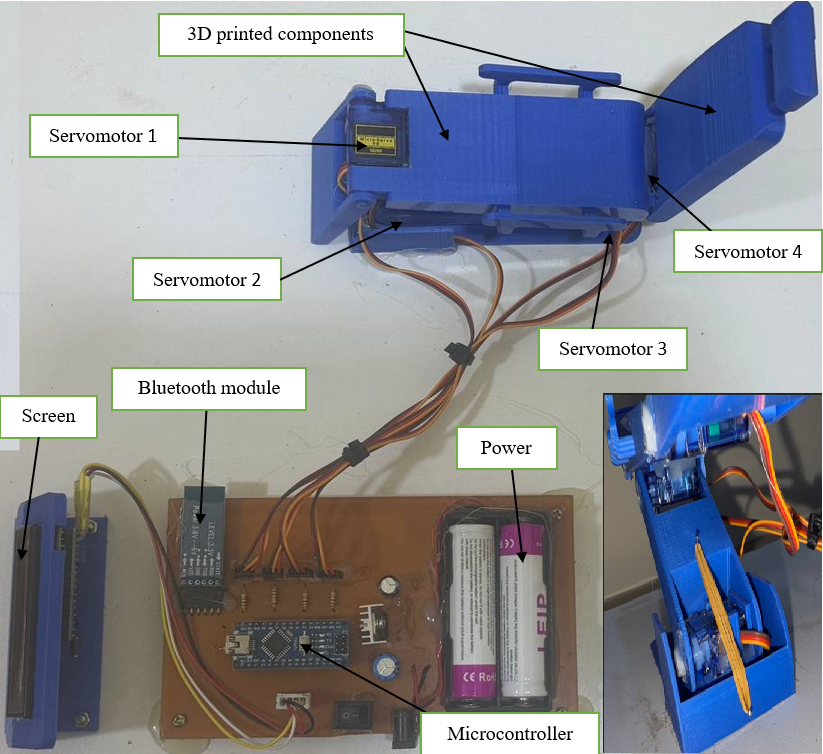
This research presents a small-scale, desktop educational proof-of-concept prototype of a voice-controlled and 3D (three-dimensional)-printed dental chair model designed to improve the clinical work environment by reducing direct manual interaction. The system integrates a microcontroller, four servo motors, and a smartphone application, enabling touchless chair position changes via predefined voice commands. Ten functional chair positions are developed, ranging from 0° to 90° for four chair situations. The mechanical model is designed in SolidWorks, and a 3D-printed model is generated to visualize the actual chair. The system is evaluated through practical tests, which demonstrate an average execution accuracy of 84% across all voice commands. The system is under development and operates in both Arabic and English, making it available to local and international users. Future proposals include advanced voice recognition models and noise-filtering techniques, with the scope of application expanding to encompass variations in voice tone and accents across users.
References
G. Bergreen, Revolutionary Technologies: Educational Perspectives of Technology History. Rowman & Littlefield, 2023.
S. A. Kingaby, Voice User Interfaces. In: Data-Driven Alexa Skills: Voice Access to Rich Data Sources for Enterprise Applications, pp. 3-14, 2022.
W. Vickers, S. Reddivari, and K. Reddivari, “Evaluating Audio-to-Text Utilizing Dragon in the Context of Just-in-Time Requirements,” Proceedings of the IEEE 23rd International Conference on Information Reuse and Integration for Data Science (IRI), pp. 124-125, 2022.
R. Hasan, R. Shams, and M. Rahman, “Consumer Trust and Perceived Risk for Voice-Controlled Artificial Intelligence: The Case of Siri,” Journal of Business Research, vol. 131, pp. 591-597, 2021.
D. S. Zwakman, D. Pal, and C. Arpnikanondt, “Usability Evaluation of Artificial Intelligence-Based Voice Assistants: The Case of Amazon Alexa,” SN Computer Science, vol. 2, article no. 28, 2021.
H. Isyanto, A. S. Arifin, and M. Suryanegara, “Design and Implementation of IoT-Based Smart Home Voice Commands for Disabled People Using Google Assistant,” Proceedings of 2020 International Conference on Smart Technology and Applications (ICoSTA), pp. 1-6, 2020.
V. Teeda, K. Sujatha, and R. Mutukuru, “Robot Voice: A Voice Controlled Robot Using Arduino,” arXiv preprint, arXiv:2402.03803, 2024.
M. N. Abdulridah, H. N. Abdulridah, and A. S. Mohammed, “Voice Controlled System by Using Bluetooth and Wi-Fi Technique,” Journal of Global Scientific Research in Electrical and Electronic Engineering, vol. 7, no. 9, pp. 2659-2667, 2022.
K. Karan, J. Amit, and I. Roshani, “Voice Control Armed Robot Assistant Using Arduino Uno,” International Journal of Innovative Science and Research Technology, vol. 9, no. 3, 2024.
P. P. Dutta, A. Kumar, A. Singh, K. Saha, B. Hazarika, A. Narzary, et al., “Design and Development of Voice Controllable Wheelchair,” Proceedings of the 8th International Conference on Reliability, Infocom Technologies and Optimization (ICRITO), pp. 1004-1008, 2020.
D. M. Mathkor, N. Mathkor, Z. Bassfar, F. Bantun, P. Slama, F. Ahmad, et al., “Multirole of The Internet of Medical Things (IoMT) in Biomedical Systems For Managing Smart Healthcare Systems: An Overview of Current and Future Innovative Trends,” Journal of infection and public health, vol.17, no.4, pp.559-572, 2024.
P. Ahmad, M. K. Alam, A. Aldajani, A. Alahmari, A. Alanazi, M. Stoddart, et al., “Dental Robotics: A Disruptive Technology,” Sensors, vol. 21, no. 10, article no. 3308, 2021.
A. Elhadad, S. Hamad, N. Elfiky, F. Alanazi, A. I. Taloba, and R. M. A. El-Aziz, “Advancing Healthcare: Intelligent Speech Technology for Transcription, Disease Diagnosis, and Interactive Control of Medical Equipment in Smart Hospitals,” AI, vol. 5, no.4, pp.2497-2517, 2024.
Z. Zhang, E. Bai, Y. Xu, A. Stepanian, and S. Y. Park, “Designing Hands-Free Technology to Support Real-Time Patient Data Collection and Documentation for Emergency Care Settings,” International Journal of Human–Computer Interaction, vol. 42, no. 10, pp.7161-7184, 2026.
A. Catalfamo, A. Celesti, M. Fazio, A. S. Saif, Y. S. Lin, E. F. Silva, et al., “An Approach to Enable Human–3D Object Interaction Through Voice Commands in an Immersive Virtual Environment,” Big Data and Cognitive Computing, vol. 9, no. 7, article no. 188, 2025.
A. Arora, A. Pathak, A. Juneja, P. Shakkarwal, and R. Kumar, “Design & Analysis of Progressive Die Using SOLIDWORKS,” Materials Today: Proceedings, vol. 51, part 1, pp. 956-960, 2022.
C. M. Thakar, S. S. Parkhe, A. Jain, K. Phasinam, G. Murugesan, and R. J. M. Ventayen, “3D Printing: Basic Principles and Applications,” Materials Today: Proceedings, vol. 51 part 1, pp. 842-849, 2022.
G. Palmara, F. Frascella, I. Roppolo, A. Chiappone, and A. Chiadò, “Functional 3D Printing: Approaches and Bioapplications,” Biosensors and Bioelectronics, vol. 175, article no. 112849, 2021.
S. Shujaat and R. Jacobs, “From Blueprints to Reality: A Narrative Review of Evidence-Based 3D Printers in Dentistry,” Journal of Dentistry, vol. 164, article no. 106174, 2025.
S. Monalisa, M. Alipuor, D. Paul, M. A. Rahman, N. Siddika, E. H. Apu, and R. B. Mostafiz, “Transforming Dental Care, Practice and Education with Additive Manufacturing and 3D Printing: Innovations in Materials, Technologies, and Future Pathways,” Dentistry Journal, vol. 13, no. 12, article no. 555, 2025.
A. A. Sulayman, D. O. Araromi, O. E. Ayodele, H. O. Araromi, and F. N. Osuolale, “Arduino Microcontroller Based Real-Time Monitoring of Haemodialysis Process for Patients with Kidney Disease,” e-Prime – Advances in Electrical Engineering, Electronics and Energy, vol. 7, article no. 100403, 2024.
S. Autsou, K. Kudelina, T. Vaimann, A. Rassõlkin, and A. Kallaste, “Principles and Methods of Servomotor Control: Comparative Analysis and Applications,” Applied Sciences, vol. 14, no. 6, article no. 2579, 2024.
A. R. S. Arif, A. Nuriyanis, A. Hendartono, E. Sirait, F. S. Kurniawan, and C. O. Putri, “Analysis of the Use of Proteus Software as a Practical Learning Support,” International Journal of Engineering and Applied Technology (IJEAT), vol. 7, no. 1, pp. 30-39, 2024.
K. He, T. Liu, Q. Lei, X. Jiang, H. Huang, H. Miao, et al., “An Immersive Virtual Reality Teaching System for Edentulous Implant Surgery: Enhancing Interaction, Precision Feedback, and Skill Acquisition,” Virtual Reality, vol. 30, article no. 121, 2026.
K. Brahmana and T. Megarani, “Utilization of Bluetooth Module as an Additional Security of Arduino-Based Motorized Vehicles,” Journal of Technomaterial Physics, vol. 6, no. 2, pp. 119-126, 2024.
G. Kucukyildiz, H. Ocak, S. Karakaya, and O. Sayli, “Design and Implementation of a Multi Sensor Based Brain Computer Interface for a Robotic Wheelchair,” Journal of Intelligent & Robotic Systems, vol. 87, pp. 247-263, 2017.
H. F. Jameel, A. Alazawi, and A. I. Mahmood, “Design and Development of a 3D Neck Rehabilitation System: A Preliminary Prototype Combining Manufacturing and Accuracy Measurement,” Series on Biomechanics, vol 40, no. 1, 2026.
Downloads
Published
Issue
Section
License
Copyright (c) 2026 Huda Farooq Jameel, Aws Alazawi, Abdulrahman Fawzi Nazim, Noora Dhurgham, Yusef Abdulsatar

This work is licensed under a Creative Commons Attribution-NonCommercial 4.0 International License.
Copyright Notice
Submission of a manuscript implies: that the work described has not been published before that it is not under consideration for publication elsewhere; that if and when the manuscript is accepted for publication. Authors can retain copyright in their articles with no restrictions. Also, author can post the final, peer-reviewed manuscript version (postprint) to any repository or website.
Since Sep. 01, 2023, EMSI will publish new articles with Creative Commons Attribution Non-Commercial License, under Creative Commons Attribution Non-Commercial 4.0 International (CC BY-NC 4.0) License.
The Creative Commons Attribution Non-Commercial (CC-BY-NC) License permits use, distribution and reproduction in any medium, provided the original work is properly cited and is not used for commercial purposes.
How to Cite