
Enhancing Detection of Nighttime Fishing Boat Lights Using VIIRS Satellite Data and Deep Neural Networks
DOI:
https://doi.org/10.46604/aiti.2026.15432Keywords:
nighttime fishing boat detection, VIIRS DNB, deep neural network, lunar illumination correction, AIS-based validationAbstract
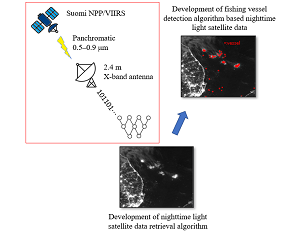
Illegal nighttime fishing remains difficult to monitor because vessels often deactivate the Automatic Identification System (AIS). This study presents a supervised deep neural network (DNN) approach for detecting nighttime fishing vessel lights using the Day/Night Band (DNB) data from the Visible Infrared Imaging Radiometer Suite (VIIRS) onboard the Suomi NPP and NOAA-20 satellites. The model integrates DNB radiance features with lunar illumination information to reduce false detections caused by moonlight. The dataset comprises summer-season observations (2020–2021) in waters near Jeju Island, South Korea, with labels derived from temporally matched AIS records. The proposed DNN is evaluated using a stratified train–test split and compared with conventional machine-learning baselines. Experimental results demonstrate improved performance, achieving an F1 score above 0.90, indicating the robust detection capability under low-light maritime conditions. These findings highlight the potential of VIIRS DNB data combined with deep learning for large-scale nighttime maritime monitoring beyond AIS-dependent systems.
References
T. A. Croft, “Nighttime Images of the Earth from Space,” Scientific American, vol. 239, no. 1, pp. 86-101, 1978.
M. H. Kim, “The Spatio-Temporal Dynamics Estimation of Economic Growth in Border Regions, China, Using DMSP-OLS,” Journal of the Korean Cartographic Association, vol. 19, no. 2, pp. 65-77, 2019.
C. D. Elvidge, K. Baugh, M. Zhizhin, F. C. Hsu, and T. Ghosh, “VIIRS Night-Time Lights,” International Journal of Remote Sensing, vol. 38, no. 21, pp. 5860-5879, 2017
Z. Wang and X. Xiong, “VIIRS On-Orbit Spatial Characterization Using the Moon,” IEEE Geoscience and Remote Sensing Letters, vol. 11, no. 6, pp. 1116-1120, 2014.
S. D. Miller, W. Straka III, S. P. Mills, C. D. Elvidge, T. F. Lee, J. Solbrig, et al., “Illuminating the Capabilities of the Suomi National Polar-Orbiting Partnership (NPP) Visible Infrared Imaging Radiometer Suite (VIIRS) Day/Night Band,” Remote Sensing, vol. 5, no. 12, pp. 6717-6766, 2013.
S. Yoon, H. T. Lee, M. K. Kim, H. M. Choi, J. S. Lee, H. J. Han, et al., “Night Fishing Boat Light Detection Using DNB Data and Deep Neural Network,” Journal of Coastal Research, vol. 116, no., pp. 220-224, 2024.
Z. Gao, J. Zhou, Y. Meng, T. Zhang, and Z. Long, “Night-Time Vessel Detection Based on Enhanced Dense Nested Attention Network,” Remote Sensing, vol. 16, no. 6, article no. 1038, 2024.
S. Yoon, H. T. Lee, H. M. Choi, and H Yang, “Verification of Night Light Satellite Data Using AIS Data,” Proceedings of the Korean Institute of Navigation and Port Research, pp. 211-212, 2022. (In Korean)
I. Asanuma, T. Yamaguchi, J. G. Park, K. J. Mackin, and J. Mittleman, “Detection Limit of Fishing Boats by the Day Night Band (DNB) on VIIRS,” Imaging Spectrometry XXI, vol. 9976, pp. 181-188, 2016.
W. Takeuchi and Y. Huang, “Mapping and Tracking Nighttime Fishing Activities within Japan EEZ Using VIIRS Boat Detection,” Asian J Geoinfo, vol. 22, article no. 2209006,-1.
W. Zhou, H. Hu, and T. Cheng, “Multi-Nighttime-Light Data Comparison Analysis Based on Image Quality Values and Lit Fishing Vessel Identification Effect,” Frontiers in Environmental Science, vol. 11, article no. 1174894, 2023.
G. Chen, Y. Liu, Y. Tian, and H. Tian, “Use of VIIRS DNB Satellite Images to Detect Nighttime Fishing Vessel Lights in Yellow Sea,” Proceedings of the 3rd International Conference on Computer Science and Application Engineering, pp. 1-5, 2019.
GSFC JPSS CMO, Joint Polar Satellite System (JPSS) Algorithm Specification Volume II: Data Dictionary for the Cloud Physical Properties Block 2.0.0, JPSS Ground Project Code 474-00448-02-16-B0200, 2015.
Global Fishing Watch, https://globalfishingwatch.org/data/ais-viirs-reveals-dark-fleet/, 2022
S. Yoon, H.-T. Lee, H.-M. Choi, and J.-S. Lee, “Automatic Extraction and Validation of Nighttime Lights from VIIRS Data Using AIS,” KIOST Research Report, pp. 1–12, 2023.
U. Syarifudin, D. Salman, S. A. Ali, and Budimawan, “Application of VIIRS-DNB Satellite Data to Detect Ship Distribution Patterns, Fishing Activity Index and Planning Instrument of Pelagic Capture Fisheries in Bone Bay Waters,” International Journal of Science and Research, vol. 6, no. 6, pp. 693-702, 2017.
.Kim, G. H., et al., “Physical Characteristics and Classification of the Ulleung Warm Eddy in the East Sea (Japan Sea),” The Sea, vol. 24, no. 3, pp. 121–135, 2019.
M. E. Tsuda, N. A. Miller, R. Saito, J. Park, and Y. Oozeki, “Automated VIIRS Boat Detection Based on Machine Learning and Its Application to Monitoring Fisheries in the East China Sea,” Remote Sensing, vol. 15, no. 11, article no. 2911, 2023.
V. S. Devarajulu, “AI-Driven Mission-Critical Software Optimization for Small Satellites: Integrating an Automated Testing Framework,” Proceedings of the Small Satellite Conference, article no. 124, 2025.
S. R. Addula and G. S. Sajja, “Automated Machine Learning to Streamline Data-Driven Industrial Application Development,” Second International Conference Computational and Characterization Techniques in Engineering & Sciences, pp. 1-4, 2024.
Published
Issue
Section
License
Copyright (c) 2026 Suk Yoon, Kwang-Seok Kim, Hee-Jeong Han, Hyeong-Tak Lee, Hyun Yang

This work is licensed under a Creative Commons Attribution-NonCommercial 4.0 International License.
Submission of a manuscript implies: that the work described has not been published before that it is not under consideration for publication elsewhere; that if and when the manuscript is accepted for publication. Authors can retain copyright in their articles with no restrictions. is accepted for publication. Authors can retain copyright of their article with no restrictions.

Since Jan. 01, 2019, AITI will publish new articles with Creative Commons Attribution Non-Commercial License, under The Creative Commons Attribution Non-Commercial 4.0 International (CC BY-NC 4.0) License.
The Creative Commons Attribution Non-Commercial (CC-BY-NC) License permits use, distribution and reproduction in any medium, provided the original work is properly cited and is not used for commercial purposes.
How to Cite