Development Method of High CRI LED Lighting Reflecting the Spectral Ratio Characteristics of Natural Light by Wavelength Band
DOI:
https://doi.org/10.46604/aiti.2026.15444Keywords:
natural light LED realizing high CRI, color rendering index (CRI), spectral ratio of natural light, analysis of characteristics of natural light, spectral power distribution (SPD)Abstract
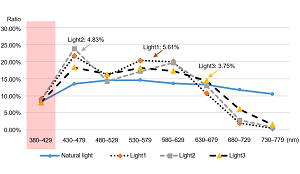
Although natural light is the standard reference for color rendering evaluation, limited efforts have been made to develop a lighting system that achieves high color rendering while replicating the spectral characteristics of natural light. This paper proposes a method for developing LED lighting that mimics the spectral ratio characteristics of natural light and achieves high color rendering. Based on the analysis of measured natural light spectra, spectral ratio characteristics are derived according to changes in color temperature. Simulations are conducted by adding light sources with specific peak wavelengths (405 nm, 630 nm) to commercial LED lighting. Based on the simulation results, a development approach for natural light LED lighting with high color rendering is proposed. Experimental results demonstrate that a color rendering index (CRI) of 90 or higher (including R9 and R12 ≥ 80) can be achieved for lighting systems with baseline CRI values of 80, 85, and 90.
References
M. Knoop, O. Stefani, B. Bueno, B. Matusiak, R. Hobday, A. Wirz-Justice, et al., “Daylight: What Makes the Difference?” Lighting Research & Technology, vol. 52, no. 3, pp. 423-442, 2020.
M. Mácha and S. Dušan, “Daylight Simulation Based on Real Daylight LED Module,” Proceedings of the 21st International Conference LIGHT SVĚTLO, pp. 213-216, 2015.
S. H. Lee, S. T. Oh, and J. H. Lim, “Fade Lighting Control Method for Visual Comfort and Energy Saving,” Proceedings of Engineering and Technology Innovation, vol. 25, pp. 54-62, 2023.
X. Huang, “Cyan Phosphors for Full-Visible-Spectrum Lighting: Shining New Light on High-CRI White PC-LEDs,” Science Bulletin, vol. 64, no. 22, pp. 1649-1651, 2019.
Method of Measuring and Specifying Colour Rendering Properties of Light Sources, CIE Standard 13.3, 1995.
Y. Ohno, “Spectral Design Considerations for White LED Color Rendering,” Optical Engineering, vol. 44, no. 11, article no. 111302. 2005.
H. S. Jo and U. C. Ryu, “Study on CRI and CCT Variations of LED Lightings according to RGB Color Changes of Multi-Chip LEDs,” Journal of the Korean Institute of Illuminating and Electrical Installation Engineers, vol. 30, no. 12, pp. 12-19, 2016. (In Korean)
S. T. Oh and J. H. Lim, “CRI-Based Smart Lighting System That Provides Characteristics of Natural Light,” Information, vol. 14, no. 12, article no. 628, 2023.
L. Balazs and J. Nadas, “Color Quality of Hybrid LED Systems,” VII. Lighting Conference of the Visegrad Countries (Lumen V4), pp. 1-4, 2018.
M. R. Luo, “The Quality of Light Sources,” Coloration Technology, vol. 127, no. 2, pp. 75-87, 2011.
S. Ezpeleta, E. Orduna-Hospital, J. Aporta, M. J. Luesma, I. Pinilla, and A. Sanchez-Cano, “Evaluation of Visual and Nonvisual Levels of Daylight from Spectral Power Distributions considering Orientation and Seasonality,” Applied Sciences, vol. 11, no. 13, article no. 5996, 2021.
A. De Almeida, B. Santos, B. Paolo, and M. Quicheron, “Solid State Lighting Review – Potential and Challenges in Europe,” Renewable and Sustainable Energy Reviews, vol. 34, pp. 30-48, 2014.
R. Malik, S. Mondal, N. K. Saha, and S. Bhunia, “A CCT Tunable Daylight-Integrated LED Lighting System for the Improvement of Health and Well-Being of Human Beings,” IEEE Sustainable Smart Lighting World Conference & Expo (LS18), pp. 1-5, 2023.
Y. Zhao, D. Xue, J. Wang, M. Lu, X. Shen, X. Gao, et al., “Smart Quantum Dot LEDs with Simulated Solar Spectrum for Intelligent Lighting,” Nanotechnology, vol. 31, no. 50, article no. 505207, 2020.
Seoul Semiconductor, https://www.seoulsemicon.com/en/technology/sunlike, 2023.
H. O. Ji, J. Y. Su, and R. D. Young, “Healthy, Natural, Efficient and Tunable Lighting: Four-Package White LEDs for Optimizing the Circadian Effect, Color Quality and Vision Performance,” Light: Science & Applications, vol. 3, article no. e141, 2014.
Q. Dai, W. Cai, W. Shi, L. Hao, and M. Wei, “A Proposed Lighting-Design Space: Circadian Effect versus Visual Illuminance,” Building and Environment, vol. 122, pp. 287-293, 2017.
J. Y. Lee, S. T. Oh, and J. H. Lim, “Exhibition Hall Lighting Design that Fulfill High CRI Based on Natural Light Characteristics - Focusing on CRI Ra, R9, R12,” Journal of Internet Computing and Services, vol. 25, no. 4, pp. 65-72, 2024. (In Korean)
J. Nie, T. Zhou, Z. Chen, W. Dang, F. Jiao, J. Zhan, et al., “Investigation on Entraining and Enhancing Human Circadian Rhythm in Closed Environments Using Daylight-Like LED Mixed Lighting,” Science of The Total Environment, vol. 732, article no. 139334, 2020.
V. Štampfl and J. Ahtik, “Quality of Colour Rendering in Photographic Scenes Illuminated by Light Sources with Light-Shaping Attachments,” Applied Sciences, vol. 14, no. 5, article no. 1814, 2024.
I. Petrinska, “Investigation of the Color Rendering of LED Luminaires for Human Centric Lighting,” Sixth Junior Conference on Lighting (Lighting), pp. 1-5, 2021.
P. Sims, Y. Y. Lai, and T. Jory, “A Review of Various Models for Classifying Light Source Color Rendition and Guide to Using LEDs to Achieve Fidelity Color Rendering for Retail and Other Indoor Environments,” Luminus Devices, Inc., White Paper, 2021.
H. S. Jeong and J. Ryeom, “Color Quality Evaluation of High Color Rendering White LEDs according to Phosphor Types and Composition Ratio,” Journal of the Korean Institute of Electrical and Electronic Material Engineers, vol. 30, no. 7, pp. 463-468, 2017. (In Korean)
Y. Ohno, “Color Rendering and Luminous Efficacy of White LED Spectra,” Fourth International Conference on Solid State Lighting, vol. 5530, pp. 88-98, 2004.
J. O. Kim, H. S. Jo, and U. C. Ryu, “Improving CRI and Scotopic-to-Photopic Ratio Simultaneously by Spectral Combinations of CCT-Tunable LED Lighting Composed of Multi-Chip LEDs,” Current Optics and Photonics, vol. 4, no. 3, pp. 247-252, 2020.
Z. Wang, Y. Nagai, J. Liu, N. Zou, and J. Liang, “Artificial Lighting Environment Evaluation of the Japan Museum of Art Based on the Emotional Response of Observers,” Applied Sciences, vol. 10, no. 3, article no. 1121, 2020.
L. Cao, W. Li, B. Devakumar, N. Ma, X. Huang, and A. F. Lee, “Full-Spectrum White Light-Emitting Diodes Enabled by an Efficient Broadband Green-Emitting CaY2ZrScAl3O12:Ce3+ Garnet Phosphor,” ACS Applied Materials & Interfaces, vol. 14, no. 4, pp. 5643-5652, 2022.
Y. S. Kim, S. T. Oh, and J. H. Lim, “The Control Method for Wavelength-Based CCT of Natural Light Using Warm/Cool White LED,” Proceedings of Engineering and Technology Innovation, vol. 25, pp. 35-43, 2023.
Published
Issue
Section
License
Copyright (c) 2026 Seung-Taek Oh, Ji-Young Lee, Se-Hyun Lee, Jae-Hyun Lim

This work is licensed under a Creative Commons Attribution-NonCommercial 4.0 International License.
Submission of a manuscript implies: that the work described has not been published before that it is not under consideration for publication elsewhere; that if and when the manuscript is accepted for publication. Authors can retain copyright in their articles with no restrictions. is accepted for publication. Authors can retain copyright of their article with no restrictions.

Since Jan. 01, 2019, AITI will publish new articles with Creative Commons Attribution Non-Commercial License, under The Creative Commons Attribution Non-Commercial 4.0 International (CC BY-NC 4.0) License.
The Creative Commons Attribution Non-Commercial (CC-BY-NC) License permits use, distribution and reproduction in any medium, provided the original work is properly cited and is not used for commercial purposes.
How to Cite