A Sales Prediction Model for Live Commerce on Douyin (TikTok): Using Streaming Strategy Data and Viewer Comment Data
DOI:
https://doi.org/10.46604/aiti.2026.16033Keywords:
TikTok, live commerce, sales prediction, natural language processing, influencer marketingAbstract
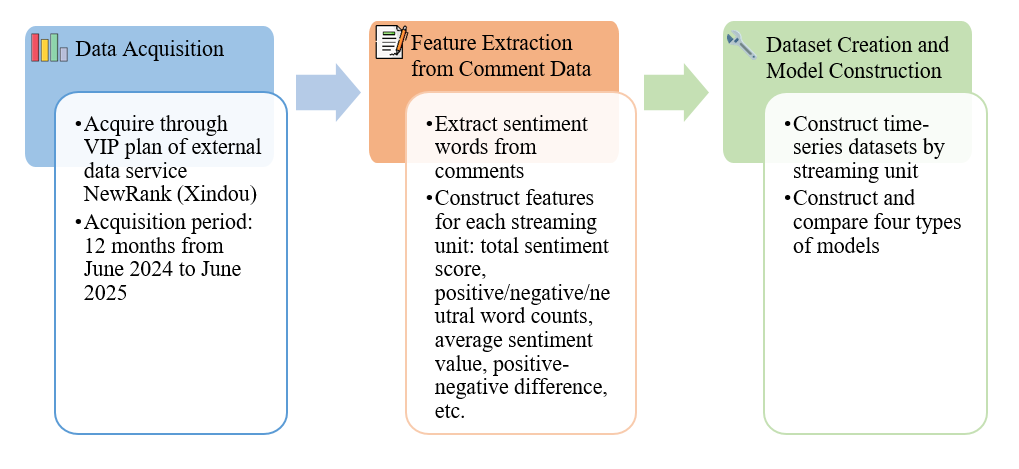
This study develops a sales prediction model for Douyin live commerce, focusing on five cosmetics influencers. Using sales revenue as the outcome, it examines whether quantitative operational variables and viewer comment features can explain sales performance. The dataset includes cumulative viewers, streaming duration, start time, preview video characteristics, and comment-derived features based on sentiment-related measures and keywords. Multiple regression and random forest regression are used to compare predictive performance, and the results are interpreted through the stimulus-organism-response (S-O-R) framework. The random forest model using only quantitative variables generally achieves the highest R², indicating that operational variables are the main drivers of sales prediction. The effects of individual variables differ across influencers, suggesting that effective sales strategies are influencer-specific. In contrast, linguistic features extracted from comments add limited predictive value, likely because the comments are brief, repetitive, and dominated by emojis or stamps.
References
DataReportal, “Digital 2025: Global Overview Report,” https://www.datareportal.com, accessed in 2025.
S. Wang and H. Zhang, “Industrial information integration through autonomous AI agents: Paradoxical effects on transparency, dehumanization, and responsible retail operations,” Journal of Industrial Information Integration, ,vol. 51 article no. 101089, 2026.
Grand View Research, “Live Commerce Market Size, Share & Trends Analysis Report,” https://www.grandviewresearch.com, accessed in 2024.
China Association of Performing Arts, “Annual Report on China’s Live Streaming and Short Video Industry,” https://www.capa.com.cn/, accessed in 2025.
E-Commerce Research Center of China, “China Live Commerce Development Report,” http://www.100ec.cn, accessed in 2024.
P&S Intelligence, “China E-Commerce Market Size, Share, Growth and Analysis Report,” https://www.psmarketresearch.com/market-analysis/china-e-commerce-market-report, accessed in 2024.
L. Wang and X. Zhang, “Livestream Sales Prediction Based on an Interpretable Deep-Learning Model,” Scientific Reports, vol. 14, article no. 20594, 2024.
Y. Jiang, “The Impact of Interaction on Customer Engagement in Live Commerce,” Shogaku Kenkyu Ronshu, no. 55, pp. 39-55, 2021. http://hdl.handle.net/10291/22001. (in Japanese)
K. Kishiya and J. Wang, “A Study on Impulse Buying Under Time Constraints in Live Commerce: Effects of Word-of-Mouth and Consumer Knowledge,” The Business Review of Kansai University, vol. 68, no. 4, pp. 37-53, 2024. (in Japanese).
C. Lou and S. Yuan, “Influencer Marketing: How Message Value and Credibility Affect Consumer Trust of Branded Content on Social Media,” Journal of Interactive Advertising, vol. 19, no. 1, pp. 58-73, 2019.
Y. Lin and K. Minamikawa, “The Influence of Influencers on Consumer Behavior in Live Commerce,” Nanzan Management Review, vol. 37, no. 2, pp. 167-185, 2022. https://nanzan-u.repo.nii.ac.jp/records/4226. (in Japanese)
G. Ilieva, T. Yankova, M. Ruseva, Y. Dzhabarova, S. Klisarova-Belcheva, and M. Bratkov, “Social Media Influencers: Customer Attitudes and Impact on Purchase Behaviour,” Information, vol. 15, no. 6, article no. 359, 2024.
S. Wang and H. Zhang, “Generative AI in International Hotel Marketing: Impacts on Employee Creativity and Performance,” International Journal of Contemporary Hospitality Management, vol. 37, no. 8, pp. 2601-2626, 2025.
F. Xu, Z. Pan, and R. Xia, “E-Commerce Product Review Sentiment Classification Based on a Naïve Bayes Continuous Learning Framework,” Information Processing & Management, vol. 57, no. 5, article no. 102221, 2020.
S. Chen, S. Ke, S. Han, S. Gupta, and U. Sivarajah, “Which Product Description Phrases Affect Sales Forecasting? An Explainable AI Framework by Integrating WaveNet Neural Network Models with Multiple Regression,” Decision Support Systems, vol. 176, article no. 114065, 2024.
S. Wang and Z. Sun, “Roles of artificial intelligence experience, information redundancy, and familiarity in shaping active learning: Insights from intelligent personal assistants,” Education and Information Technologies, vol. 30, no. 2, pp. 2525-2546, 2025.
S. M. Lundberg and S.-I. Lee, “A Unified Approach to Interpreting Model Predictions,” Advances in Neural Information Processing Systems, vol. 30, pp. 4768-4777, 2017.
L. Xu, H. Lin, Y. Pan, H. Ren, and J. Chen, “Construction of an Emotion Lexicon Ontology,” Journal of the China Society for Scientific and Technical Information, vol. 27, no. 2, pp. 180–185, 2008. https://ir.dlut.edu.cn/info/1013/1142.htm. (in Chinese)
Published
Issue
Section
License
Copyright (c) 2026 Yi Mei, Kohei Otake

This work is licensed under a Creative Commons Attribution-NonCommercial 4.0 International License.
Submission of a manuscript implies: that the work described has not been published before that it is not under consideration for publication elsewhere; that if and when the manuscript is accepted for publication. Authors can retain copyright in their articles with no restrictions. is accepted for publication. Authors can retain copyright of their article with no restrictions.

Since Jan. 01, 2019, AITI will publish new articles with Creative Commons Attribution Non-Commercial License, under The Creative Commons Attribution Non-Commercial 4.0 International (CC BY-NC 4.0) License.
The Creative Commons Attribution Non-Commercial (CC-BY-NC) License permits use, distribution and reproduction in any medium, provided the original work is properly cited and is not used for commercial purposes.
How to Cite