
Seismic Response Comparison of Fixed-Base and Base-Isolated 8-Story Buildings with Frame and Shear Wall Systems
DOI:
https://doi.org/10.46604/aiti.2026.16055Keywords:
base isolation, frame, mid-rise buildings, shear wall, time historyAbstract
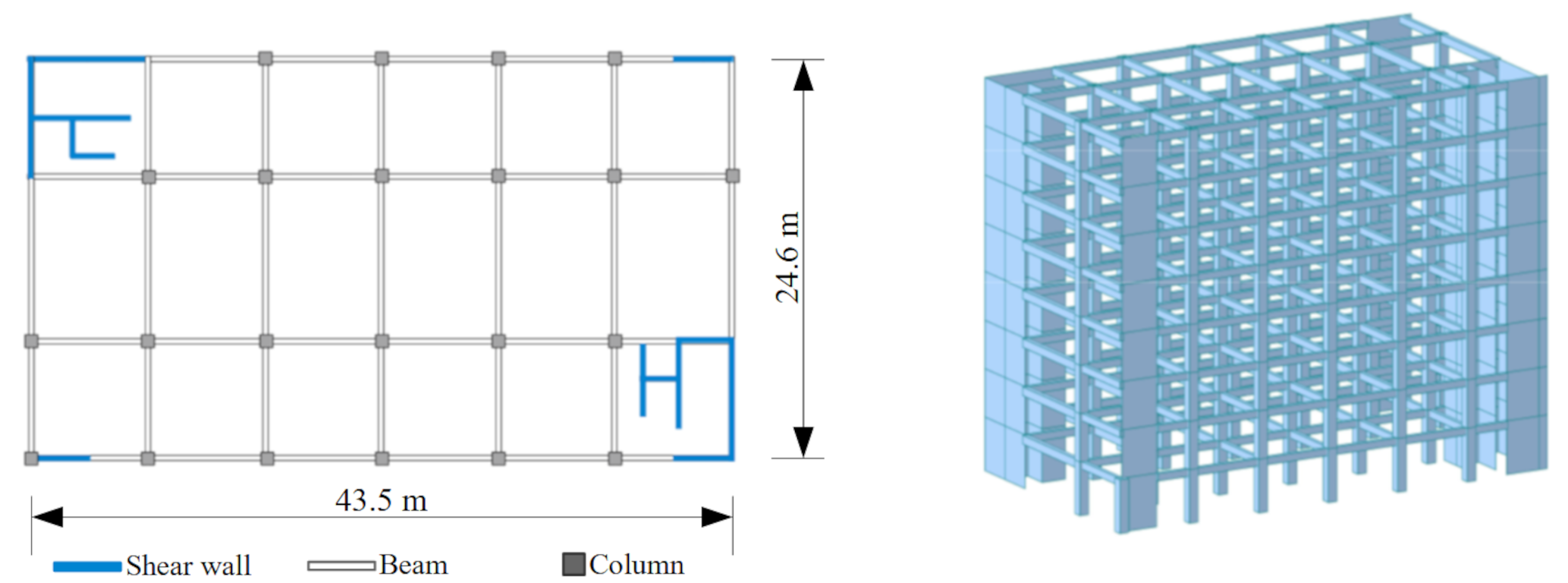
This study investigates the effects of different lateral load-resisting systems on engineering demand parameters (EDPs) and evaluates the suitability of spectral acceleration (Sa) as an intensity measure for predicting their seismic response. Eight-story reinforced concrete buildings with four configurations—fixed-base moment-resisting frame, fixed-base dual system with shear walls, base-isolated moment-resisting frame, and base-isolated dual system with shear walls—were analyzed. The seismic responses are obtained through nonlinear time-history analyses using 11 ground motion records scaled to match the site conditions. Four key response parameters are examined: maximum lateral displacement, interstory drift, floor acceleration, and base shear. Overall, the base-isolated dual system exhibited the best performance across all response parameters. In addition, Sa can be reasonably used to estimate floor acceleration in frame structures. However, the use of Sa to estimate floor acceleration in dual systems with shear walls tends to underestimate the actual response.
References
A. Du, X. Wang, Y. Xie, and Y. Dong, “Regional Seismic Risk and Resilience Assessment: Methodological Development, Applicability, and Future Research Needs – An Earthquake Engineering Perspective,” Reliability Engineering & System Safety, vol. 233, article no. 109104, 2023.
J. Liao, D. Forcellini, J. Fang, and L. Sun, “An Entropy-Based Multi-Criteria Approach for Intensity Measure Selection in Seismic Resilience of Structures,” Resilient Cities and Structures, vol. 5, no. 1, pp. 1-13, 2026.
O. C. Celik, M. B. C. Ulker, C. Gocer, S. Guntepe, O. Koz, M. M. Eyupgiller, et al., “Multidisciplinary Reconnaissance Investigation Covering Structural, Geotechnical, and Architectural Based Damage to Mid-rise Residential Buildings Following the February 6th, 2023 Kahramanmaraş, Türkiye Earthquake Doublets (Mw 7.8, Mw 7.6),” Soil Dynamics and Earthquake Engineering, vol. 182, article no. 108738, 2024.
I. O. Demirel, A. Yakut, and B. Binici, “Seismic Performance of Mid-Rise Reinforced Concrete Buildings in Izmir Bayrakli after the 2020 Samos Earthquake,” Engineering Failure Analysis, vol. 137, article no. 106277, 2022.
M. Megawati, K. F. Ma, P. F. Chen, D. Sianipar, and M. C. Hsieh, “Source Characterization of Intermediate-Depth Earthquakes in Southern Java, Indonesia,” Journal of Asian Earth Sciences, vol. 264, article no. 106040, 2024.
V. Librian, M. Ramdhan, A. D. Nugraha, M. M. Mukti, S. Syuhada, B.-G. Lühr, et al., “Detailed Seismic Structure Beneath the Earthquake Zone of Yogyakarta 2006 (Mw ∼6.4), Indonesia, from Local Earthquake Tomography,” Physics of the Earth and Planetary Interiors, vol. 351, article no. 107170, 2024.
B. Voight, E. K. Constantine, S. Siswowidjoyo, and R. Torley, “Historical Eruptions of Merapi Volcano, Central Java, Indonesia, 1768-1998,” Journal of Volcanology and Geothermal Research, vol. 100, no. 1-4, pp. 69-138, 2000.
B. Sunardi, Sismanto, E. Hartantyo, and M. Nukman, “Seismic Vulnerability in Yogyakarta Basin Based on HVSR Frequency Domain Window Rejection Algorithm,” International Journal of Design & Nature and Ecodynamics, vol. 20, no. 4, pp. 813-823, 2025.
M. Marius, “Seismic Behaviour of Reinforced Concrete Shear Walls with Regular and Staggered Openings after the Strong Earthquakes between 2009 and 2011,” Engineering Failure Analysis, vol. 34, pp. 537-565, 2013.
F. Naeim and J. M. Kelly, Design of Seismic Isolated Structures: From Theory to Practice, 1st ed., New York, USA: Wiley, 1999.
J. Zhang, Y. Li, H. Yang, X. Ji, L. Gu, W. Li, et al., “Enhancing the Overturning Resistance Capacity of High Aspect Ratio Structure through Hybrid Base Isolation and Inter-storey Isolation,” Soil Dynamics and Earthquake Engineering, vol. 187, article no. 108993, 2024.
A. Demir, A. H. Kayhan, and M. Palanci, “Response-and Probability-Based Evaluation of Spectrally Matched Ground Motion Selection Strategies for Bi-directional Dynamic Analysis of Low-to Mid-rise RC Buildings,” Structures, vol. 58, article no. 105533, 2023.
Building Code Requirements for Structural Concrete and Commentary, SNI Standard 2847, 2019 (in Indonesian).
Seismic Design Code for Building and Nonbuilding Structures, SNI Standard 1726, 2019 (in Indonesian).
MIDAS IT, “Midas Gen: General Structural Analysis System for Buildings and General Structures,” https://www.midasuser.com/en/product/gen, accessed in 2025.
Prestandard and Commentary for the Seismic Rehabilitation of Buildings, FEMA Standard 356, 2000.
Y. Domadzra, M. Bhandari, and M. Hasan, “Influence of Characteristics of Lead Rubber Bearing Isolator on the Seismic Response of a Base-Isolated Building,” Journal of Structural Design and Construction Practice, vol. 30, no. 3, article no. 04025044, 2025.
Minimum Design Loads and Associated Criteria for Buildings and Other Structures, SNI Standard 1727, 2020 (in Indonesian).
A. Cipta, A. Solikhin, I. C. Priambodo, R. Robiana, H. Afif, et al., Local Site Atlas (Vs30) of Indonesia Based on Engineering Geomorphological Classification, 1st ed., Jakarta, Indonesia: Center for Volcanology and Geological Hazard Mitigation, Geological Agency, Ministry of Energy and Mineral Resources, 2022.
PuSGeN, Indonesian Earthquake Hazard Deaggregation Map for the Design and Evaluation of Earthquake-Resistant Infrastructure, 1st ed., Jakarta, Indonesia: Directorate of Housing and Settlement Engineering, Directorate General of Human Settlements, Ministry of Public Works and Housing, 2022.
T. D. Ancheta, R. B. Darragh, J. P. Stewart, E. Seyhan, W. J. Silva, B. S.-J. Chiou, et al., “NGA-West2 Database,” Earthquake Spectra, vol. 30, no. 3, pp. 989-1005, 2014.
Y. Bozorgnia, N. A. Abrahamson, S. K. Ahdi, T. D. Ancheta, L. A. Atik, R. J. Archuleta, et al., “NGA-Subduction Research Program,” Earthquake Spectra, vol. 38, no. 2, pp. 783-798, 2022.
I. Nurhuda, P. Sabdono, M. R. Afrizal, L. A. P. Pratama, and S. A. Faishal, “Empirical Formula for the Fundamental Period of Reinforced Concrete Moment Resisting Frames in Indonesia,” Jurnal Teknik Sipil, vol. 32, no. 1, pp. 1-8, 2025.
B. A. Bradley, “Design Seismic Demands from Seismic Response Analyses: A Probability-Based Approach,” Earthquake Spectra, vol. 27, no. 1, pp. 213-224, 2011.
O. H. Mohamed, B. Abderrachid, and O. Abdelhafid, “LRB System Performance Validation and Its New Design Approach for Conventional Buildings in Algeria,” Practice Periodical on Structural Design and Construction, vol. 29, no. 3, article no. 04024029, 2024.
N.G. Wariyatno, H. A. Lie, F.-P. Hsiao, and B. S. Gan, “Design Philosophy for Buildings’ Comfort-Level Performance,” Advances in Technology Innovation, vol. 6, no. 3, pp. 157-168, 2021.
S. O. Khamesi and S. M. Mir Mohammad Hosseini, “A Numerical Study of Influential Parameters on Rocking Response of Shallow Foundations of Single Degree of Freedom (SDOF) Structures,” Journal of Engineering Research, vol. 11, no. 2, article no. 100055, 2023.
W.-I. Liao, C.-H. Loh, and K.-C. Tsai, “Study on the Fragility of Building Structures in Taiwan,” Natural Hazards, vol. 37, no. 1-2, pp. 55-69, 2006.
Published
Issue
Section
License
Copyright (c) 2026 Ilham Nurhuda, Windu Partono, Rico Fernando Onggowarsito, Revanza Aby Pradana, Faishal Najwan Ahmad, Junia Anisa Marizki

This work is licensed under a Creative Commons Attribution-NonCommercial 4.0 International License.
Submission of a manuscript implies: that the work described has not been published before that it is not under consideration for publication elsewhere; that if and when the manuscript is accepted for publication. Authors can retain copyright in their articles with no restrictions. is accepted for publication. Authors can retain copyright of their article with no restrictions.

Since Jan. 01, 2019, AITI will publish new articles with Creative Commons Attribution Non-Commercial License, under The Creative Commons Attribution Non-Commercial 4.0 International (CC BY-NC 4.0) License.
The Creative Commons Attribution Non-Commercial (CC-BY-NC) License permits use, distribution and reproduction in any medium, provided the original work is properly cited and is not used for commercial purposes.
How to Cite