
Parametric Optimization of Gas Metal Arc Welding Process Parameters
DOI:
https://doi.org/10.46604/aiti.2026.16345Keywords:
gas metal arc welding, low-carbon steel, finite element model, response surface methodology, welding parameters optimizationAbstract
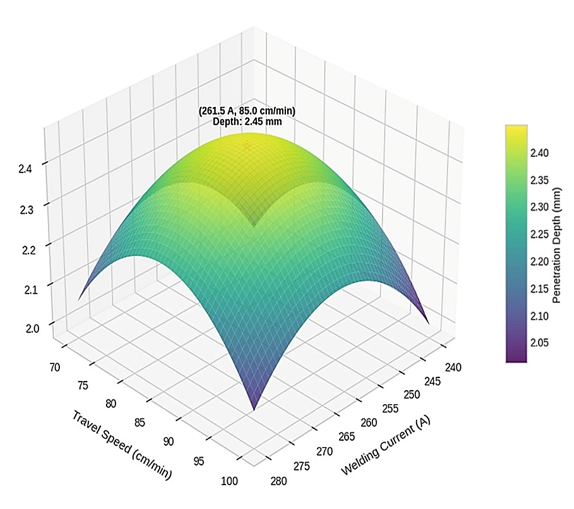
The gas metal arc welding (GMAW) parameters for a homogeneous low-carbon steel butt-welded plate are optimized using a systematic integrated model. This study aims to create a thermo-mechanical finite element model to predict the weld bead geometry during GMAW. The numerical model incorporates the Goldak double-ellipsoid model, temperature-dependent material properties, and coupled thermo-mechanical finite element analysis. The model is validated against published experimental data and used for a parametric study. Response surface methodology is then applied to develop a statistical model for optimizing GMAW parameters while maintaining geometric constraints on fusion width and cumulative heat. The validated computational model exhibits exceptional precision in reconstructing the weld bead geometry, with prediction errors below 5% in penetration depth and fusion width. The optimized parameters are: 261.5 A of current, 25.8 V of voltage, and 850 mm/min of travel velocity with 2.45 mm penetration depth and 9.98 mm fusion width.
References
Y. Cheng, R. Yu, Q. Zhou, H. Chen, W. Yuan, and Y. Zhang, “Real-Time Sensing of Gas Metal Arc Welding Process–A Literature Review and Analysis,” Journal of Manufacturing Processes, vol. 70, pp. 452-469, 2021.
B. A. Varadhan, G. Palani, R. Ramasamy, and V. Madeshwaren, “Optimising Geometry of Weld Beads for High-Performance Welding of Hot Rolled Carbon Steel by Taguchi Technique,” Matéria (Rio de Janeiro), vol. 30, article no. e20240771, 2025.
P. F. Mendez, “Calculation of Thermal Features in Welding and Additive Manufacturing,” IOP Conference Series: Materials Science and Engineering, vol. 1281, no. 1, article no. 012021, 2023.
O. B. Oruowho, J. I. Achebo, K. O. Obahiagbon, and U. O. Frank, “Prediction of Welding Parameters to Minimize Undercut Defects in Arc Welding Using Response Surface Methodology (RSM): A Robust Multi-Factorial Analysis,” UNIZIK Journal of Engineering and Applied Sciences, vol. 5, no. 3, pp. 2771-2781, 2025.
Y. Tu, Z. Liu, Y. Tu, and M. Sheng, “Computational Modeling of Residual Stress in Welded High-Strength Steel Box Sections,” PLOS One, vol. 20, no. 9, article no. e0332445, 2025.
K. Kalita, D. Burande, R. K. Ghadai, and S. Chakraborty, “Finite Element Modelling, Predictive Modelling and Optimization of Metal Inert Gas, Tungsten Inert Gas and Friction Stir Welding Processes: A Comprehensive Review,” Archives of Computational Methods in Engineering, vol. 30, pp. 271-299, 2023.
A. Shash, M. H. El-Moayed, M. Abdrabou, and M. Elsherbiny, “A Coupled Experimental and Numerical Analysis of AA6063 Friction Stir Welding,” Proceedings of the Institution of Mechanical Engineers, Part C: Journal of Mechanical Engineering Science, vol. 236, no. 15, pp. 8392-8400, 2022.
Y. Zhang, H. Li, and J. Liao, “Thermo-Mechanical Simulation and Experimental Validation of Gas Metal Arc Welding of Low-Carbon Steel Butt Joints,” Journal of Manufacturing Processes, vol. 68, pp. 115-127, 2021.
M. Maronek, B. Savytskyi, J. Barta, and J. Kotianova, “Analysis of the Influence of Arc Length and Dynamics Correction on the Dimensional Characteristics of Weld Overlays Using the DOE Method,” 1st International Conference on Cutting Tools, Trnava, Slovakia, 2024.
S. Omprakasam, R. Raghu, and C. B. Ayyanar, “Multi-Objective Welding Optimization for AA5052 Using Taguchi-Fuzzy Approach,” SAE International Journal of Materials and Manufacturing, vol. 18, no. 3, pp. 229-243, 2025.
Y. Pookamnerd, T. Phatungthane, and C. Summatta, “Optimized GMAW Parameters for Enhancing Mechanical Properties of Dissimilar AA6061 and AA7075 Alloy Welds Using Hybrid ANN-GA Approach,” EUREKA Physics and Engineering, no. 2, pp. 166-180, 2025.
A. Mayai, S. Prasomthong, and Y. Pookamnerd, “Development of Hybrid ANN-GA and RSM Models for Optimizing Mechanical Properties in SS400-SUS304 Welds,” EUREKA Physics and Engineering, no. 3, pp. 152-165, 2025.
K. V. Rao, S. Parimi, L. S. Raju, and G. Suresh, “Modelling and Optimization of Weld Bead Geometry in Robotic Gas Metal Arc-Based Additive Manufacturing Using Machine Learning, Finite-Element Modelling and Graph Theory and Matrix Approach,” Soft Computing, vol. 26, no. 2, pp. 3385–3399, 2022.
I. Tlili, D. Baleanu, S. M. Sajadi, F. Ghaemi, and M. A. Fagiry, “Numerical and Experimental Analysis of Temperature Distribution and Melt Flow in Fiber Laser Welding of Inconel 625,” The International Journal of Advanced Manufacturing Technology, vol. 121, no. 1-2, pp. 765–784, 2022.
M. S. Khan, S. I. Shahabad, M. Yavuz, W. W. Duley, E. Biro, and Y. Zhou, “Numerical Modelling and Experimental Validation of the Effect of Laser Beam Defocusing on Process Optimization During Fiber Laser Welding of Automotive Press-Hardened Steels,” Journal of Manufacturing Processes, vol. 67, pp. 535-544, 2021.
Y. Liu, M. Ge, G. Zeng, Z. Wang, K. Chen, X. Yin, and W. Wang, “Process Analysis and Multi-Parameter Optimization of 5052 Aluminum Alloy FSW Based on Thermo-Mechanical Coupling and Taguchi Method,” Scientific Reports, vol. 15, article no. 335, 2025.
B. Meyghani, “A Modified Friction Model and its Application in Finite-Element Analysis of Friction Stir Welding Process,” Journal of Manufacturing Processes, vol. 72, pp. 29-47, 2021.
A. Janeczek, J. Tomków, H. A. Derazkola, K. Łyczkowska, and D. Fydrych, “Effect of Underwater Friction Stir Welding Parameters on AA5754 Alloy Joints: Experimental Studies,” The International Journal of Advanced Manufacturing Technology, vol. 134, pp. 5643-5655, 2024.
B. Wang, L. Yu, M. Li, J. Guo, C. Ji, and J. Hu, “Welding Process Parameters and Mechanical Properties of Carbon Fiber-Reinforced Thermoplastic Composites: Experimental and Simulation Analysis,” Engineering Fracture Mechanics, vol. 315, article no. 110831, 2025.
W. Sun, H. Ma, and W. Qu, “A Hybrid Numerical Method for Non-Linear Transient Heat Conduction Problems with Temperature-Dependent Thermal Conductivity,” Applied Mathematics Letters, vol. 148, article no. 108868, 2024.
M. P. Iqbal, R. Jain, S. K. Pal, and P. Mandal, “Numerical Modelling of Friction Stir Welding of Pipes: Effect of Tool Shoulder on Mechanical Property and Metallurgical Characterization,” Journal of Manufacturing Processes, vol. 79, pp. 326-339, 2022.
P. Liu, Y. Cai, C. Du, Y Chen, Z. Zhao, and C. Zhang, “An Elastoplastic Mechanical-Thermal Model for Temperature Rise Simulation of Two-Dimensional Triaxially Braided Composites Under Quasi-Static Loads,” Composite Structures, vol. 306, article no. 116559, 2023.
R. Ghorbel, A. Ktari, and N. Haddar, ”Experimental Analysis of Temperature Field and Distortions in Multi-Pass Welding of Stainless Cladded Steel,” The International Journal of Advanced Manufacturing Technology, vol. 113, pp. 3525-3542, 2021.
I. Šantak, A. Barac, M. Holik, and M. Živić, “Python-Based Calculation and Display of Temperature Field Distribution in Arc Welding,” 12th International Scientific and Professional Conference SBZ, Engineering Technologies in Manufacturing of Welded Constructions and Products, Slavonski Brod, Požega, Croatia, 2023.
L. E. de S. Paes, J. R. Andrade, F. S. Lobato, E. de S. Magalhães, V. Ponomarov, F. J. de Souza, et al., “Sensitivity Analysis and Multi-Objective Optimization of Tungsten Inert Gas (TIG) Welding Based on Numerical Simulation,” The International Journal of Advanced Manufacturing Technology, vol. 122, pp. 783-797, 2022.
M. D. Iordache, C. Badulescu, M. Diakhate, M. A. Constantin, E. L. Nitu, Y. Demmouche, et al., “A Numerical Strategy to Identify the FSW Process Optimal Parameters of a Butt-Welded Joint of Quasi-Pure Copper Plates: Modeling and Experimental Validation,” The International Journal of Advanced Manufacturing Technology, vol. 115, pp. 2505-2520, 2021.
D. K. Gupta and R. S. Mulik, “Thermo-Mechanical Modeling and Experimental Validation of Residual Stresses in ER70S-6 Component Manufactured by WAAM Process,” Welding in the World, vol. 69, pp. 3351-3369, 2025.
M. A. Afabor, E. Emozino, I. D. Friday, O. O. David, and A. S. Adzor, “Predictive Modelling of TIG Welding Process Parameters: A Comparative Study of Taguchi, Fuzzy Logic, and Response Surface Methodology,” Nigerian Journal of Technology, vol. 44, no. 1, pp. 48-56, 2025.
Published
Issue
Section
License
Copyright (c) 2026 Wael Hekmat Ahmed Shaheen, Marwan Ali Salman, Yahya M. Hamad, Wisam Thamer Abbood

This work is licensed under a Creative Commons Attribution-NonCommercial 4.0 International License.
Submission of a manuscript implies: that the work described has not been published before that it is not under consideration for publication elsewhere; that if and when the manuscript is accepted for publication. Authors can retain copyright in their articles with no restrictions. is accepted for publication. Authors can retain copyright of their article with no restrictions.

Since Jan. 01, 2019, AITI will publish new articles with Creative Commons Attribution Non-Commercial License, under The Creative Commons Attribution Non-Commercial 4.0 International (CC BY-NC 4.0) License.
The Creative Commons Attribution Non-Commercial (CC-BY-NC) License permits use, distribution and reproduction in any medium, provided the original work is properly cited and is not used for commercial purposes.
How to Cite