
Systematic Design and Performance Evaluation of LCL-Filtered Grid-Forming Inverters under Different Operating Conditions
DOI:
https://doi.org/10.46604/aiti.2026.16442Keywords:
grid-forming inverters, LCL filter, cascaded controllers, resonance frequency, stabilityAbstract
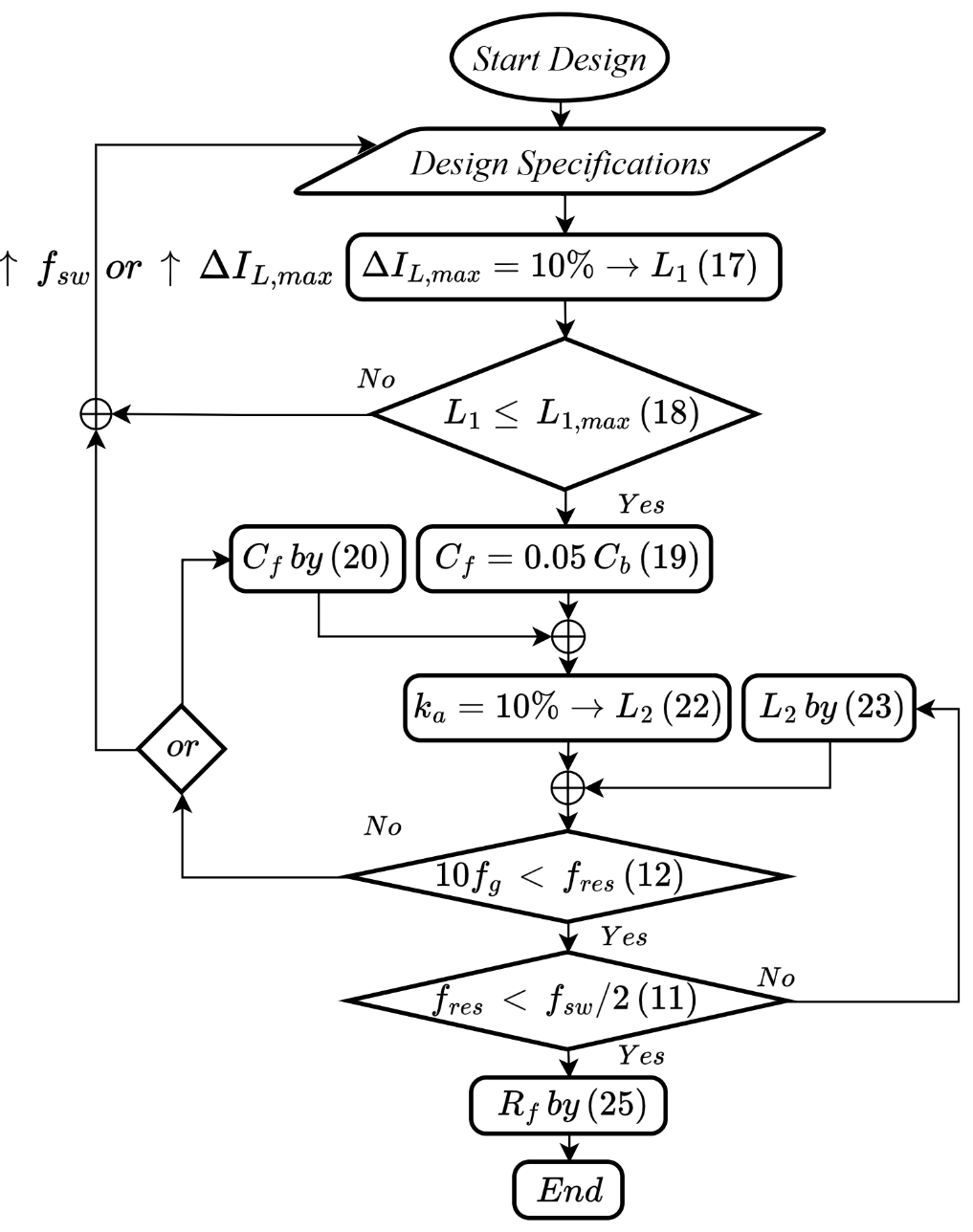
This study aims to develop a systematic design for inductor-capacitor-inductor (LCL)-filtered grid-forming inverters (GFMIs) and evaluates their performance under various operating scenarios. The proposed methodology presents the mathematical modeling of GFMI in the dq reference frame, designs the LCL filter parameters within a stable resonance-frequency region, and employs a bandwidth-coordination scheme to design cascaded current and voltage controllers. Small-signal stability analysis based on eigenvalues is used to assess stability under varying grid strength and parameter variations. Results from MATLAB/Simulink show that the proposed design provides stable operation and acceptable dynamic performance in both grid-connected and stand-alone modes. Furthermore, the inverter output voltage and current achieve low total harmonic distortion (THD) of 4.3% and 1.2%, respectively, at rated load. Although current THD increases under light-load grid-connected mode, the total demand distortion (TDD) remains below 5% for all tested conditions, thereby satisfying the requirements of IEEE Standard 519.
References
V. V. Babu, J. P. Roselyn, C. Nithya, and P. Sundaravadivel, “Development of Grid-Forming and Grid-Following Inverter Control in Microgrid Network Ensuring Grid Stability and Frequency Response,” Electronics, vol. 13, no. 10, article no. 1958, 2024.
Y. Zhang, C. Song, T. Wang, and K. Wang, “Optimization of Passive Damping for LCL-Filtered AC Grid-Connected PV-Storage Integrated Systems,” Electronics, vol. 14, no. 4, article no. 801, 2025.
X. Gao, D. Zhou, A. Anvari-Moghaddam, and F. Blaabjerg, “Seamless Switching Method between Grid-Following and Grid-Forming Control for Renewable Energy Conversion Systems,” IEEE Transactions on Industry Applications, vol. 61, no. 1, pp. 597-606, 2025.
I. Bennia, E. Elbouchikhi, A. Harrag, Y. Daili, A. Saim, A. E. M. Bouzid, et al., “Design, Modeling, and Validation of Grid-Forming Inverters for Frequency Synchronization and Restoration,” Energies, vol. 17, no. 1, article no. 59, 2024.
X. Jia, S. Yu, Y. Zhang, Y. Feng, and B. Zhou, “LCL Grid-Connected Inverter Resonance Feedforward-Active Damping Hybrid Control Strategy for Mitigating Weak Grid Resonance and Harmonic Currents,” Energies, vol. 18, no. 22, article no. 6010, 2025.
H. Alrajhi, S. A. Raza, H. Babsail, and A. Alattas, “Design, Analysis and Comprehensive Assessment of LCL Filters for VSC Applications,” Journal of Umm Al-Qura University for Engineering and Architecture, vol. 16, no. 3, pp. 559-573, 2025.
M. Saleem, K. Y. Choi, and R. Y. Kim, “Resonance Damping for an LCL Filter Type Grid-Connected Inverter with Active Disturbance Rejection Control under Grid Impedance Uncertainty,” International Journal of Electrical Power & Energy Systems, vol. 109, pp. 444-454, 2019.
N. Rasekh and M. Hosseinpour, “LCL Filter Design and Robust Converter Side Current Feedback Control for Grid-Connected Proton Exchange Membrane Fuel Cell System,” International Journal of Hydrogen Energy, vol. 45, no. 23, pp. 13055-13067, 2020.
D. Chen, S. Zhang, and H. Lin, “An Active Damping Control Strategy for Suppressing LCL Resonant Point Migration for Three-Phase Grid-Tied Inverter,” Scientific Reports, vol. 14, no. 1, article no. 22911, 2024.
M. Cengi̇z and T. Duman, “Sliding Mode Control for a Single-Phase Grid-Connected H-Bridge NPC Inverter with a Symmetrical LCL Filter,” Computers and Electrical Engineering, vol. 117, article no. 109298, 2024.
M. Ijaz, R. Nazir, M. Alhussein, J. Ahmad, K. Aurangzeb, and F. Saleem, “Digital Resonant Control of Power Converters under Variable Grid Frequency Conditions,” Frontiers in Energy Research, vol. 11, article no. 1272329, 2023.
M. Parvez, M. F. M. Elias, N. A. Rahim, F. Blaabjerg, D. Abbott, and S. F. Al-Sarawi, “Comparative Study of Discrete PI and PR Controls for Single-Phase UPS Inverter,” IEEE Access, vol. 8, pp. 45584-45595, 2020.
M. H. Ravanji, D. B. Rathnayake, M. Z. Mansour, and B. Bahrani, “Impact of Voltage-Loop Feedforward Terms on the Stability of Grid-Forming Inverters and Remedial Actions,” IEEE Transactions on Energy Conversion, vol. 38, no. 3, pp. 1554-1565, 2023.
O. Babayomi, Y. Li, Z. Zhang, and K. B. Park, “Advanced Control of Grid-Connected Microgrids: Challenges, Advances, and Trends,” IEEE Transactions on Power Electronics, vol. 40, no. 6, pp. 7681-7708, 2025.
M. Liserre, F. Blaabjerg, and S. Hansen, “Design and Control of an LCL-Filter-Based Three-Phase Active Rectifier,” IEEE Transactions on Industry Applications, vol. 41, no. 5, pp. 1281-1291, 2005.
A. Reznik, M. G. Simões, A. Al-Durra, and S. M. Muyeen, “LCL Filter Design and Performance Analysis for Grid-Interconnected Systems,” IEEE Transactions on Industry Applications, vol. 50, no. 2, pp. 1225-1232, 2014.
H. H. Abbas, Q. Shafiee, and H. Bevrani, “Optimal Passive LCL Filter Design for Grid-Connected Converters in Weak Grids,” Electric Power Systems Research, vol. 235, article no. 110896, 2024.
M. H. Rashid, Power Electronics Handbook, 4th ed., Oxford: Butterworth-Heinemann, 2017.
M. H. Mahlooji, H. R. Mohammadi, and M. Rahimi, “A Review on Modeling and Control of Grid-Connected Photovoltaic Inverters with LCL Filter,” Renewable and Sustainable Energy Reviews, vol. 81, part 1, pp. 563-578, 2018.
Y. Han, M. Yang, H. Li, P. Yang, L. Xu, E. A. A. Coelho, et al., “Modeling and Stability Analysis of LCL-Type Grid-Connected Inverters: A Comprehensive Overview,” IEEE Access, vol. 7, pp. 114975-115001, 2019.
S. Albatran, A. Koran, I. A. Smadi, and H. J. Ahmad, “Optimal Design of Passive RC-Damped LCL Filter for Grid-Connected Voltage Source Inverters,” Electrical Engineering, vol. 100, no. 4, pp. 2499-2508, 2018.
J. Jo and H. Cha, “Design of Effective Passive Damping Resistor of Grid-Connected Inverter with LCL Filter for Industrial Applications,” Journal of Electrical Engineering & Technology, vol. 14, no. 5, pp. 2039-2048, 2019.
A. Yazdani and R. Iravani, Voltage-Sourced Converters in Power Systems: Modeling, Control, and Applications, 1st ed., Hoboken, NJ: IEEE Press/John Wiley & Sons, 2010.
H. Alrajhi, Y. Al-Harbi, A. Al-Zahrani, S. A. Raza, A. Daraz, and M. Al-Kaabi, “Comprehensive Analysis of PI Tuning Techniques for VSC Applications,” Journal of Umm Al-Qura University for Engineering and Architecture, vol. 16, no. 3, pp. 599-616, 2025.
C. Bajracharya, “Control of VSC-HVDC for Wind Power,” Master’s thesis, Department of Electrical Power Engineering, Norwegian University of Science and Technology, Trondheim, Norway, 2008.
R. Ali, H. Heydari-doostabad, S. Sajedi, and T. O’Donnell, “Improved Design of Passive Damping for Single Phase Grid-Connected LCL Filtered Inverter Considering Impedance Stability,” IET Power Electronics, vol. 17, no. 4, pp. 511-523, 2024.
C. Yanarates and Z. Zhou, “Symmetrical Pole Placement Method-Based Unity Proportional Gain Resonant and Gain Scheduled Proportional (PR-P) Controller with Harmonic Compensator for Single Phase Grid-Connected PV Inverters,” IEEE Access, vol. 9, pp. 93165-93181, 2021.
L. M. Engan, S. Ekrheim, S. Bjarghov, J. R. A. Klemets, I. Schytte, and G. Kjølle, “Reference Dataset for Semi-Urban and Rural Norwegian Low Voltage Distribution Grids,” Data in Brief, vol. 59, article no. 111453, 2025.
IEEE Standard for Harmonic Control in Electric Power Systems, IEEE Standard 519, 2022.
Y. Du, D. D. C. Lu, G. James, and D. J. Cornforth, “Modeling and Analysis of Current Harmonic Distortion from Grid Connected PV Inverters under Different Operating Conditions,” Solar Energy, vol. 94, pp. 182-194, 2013.
Published
Issue
Section
License
Copyright (c) 2026 Melad Nasser Abdulahad, Yasir Mohammed Younis Ameen, Basil M. Saied

This work is licensed under a Creative Commons Attribution-NonCommercial 4.0 International License.
Submission of a manuscript implies: that the work described has not been published before that it is not under consideration for publication elsewhere; that if and when the manuscript is accepted for publication. Authors can retain copyright in their articles with no restrictions. is accepted for publication. Authors can retain copyright of their article with no restrictions.

Since Jan. 01, 2019, AITI will publish new articles with Creative Commons Attribution Non-Commercial License, under The Creative Commons Attribution Non-Commercial 4.0 International (CC BY-NC 4.0) License.
The Creative Commons Attribution Non-Commercial (CC-BY-NC) License permits use, distribution and reproduction in any medium, provided the original work is properly cited and is not used for commercial purposes.
How to Cite