
Automated Tooth Numbering and Periodontal Bone Loss Severity Detection Using Residual U-Net and Tooth Long Axis in Panoramic Radiography
DOI:
https://doi.org/10.46604/aiti.2026.16511Keywords:
residual U-net, tooth numbering, periodontal bone loss severity, panoramic radiographs, oriented bounding boxAbstract
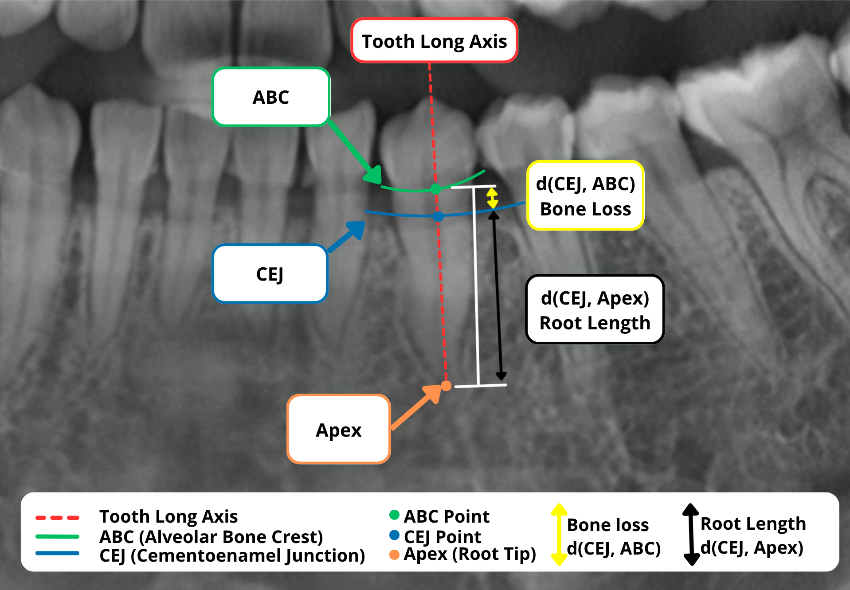
Periodontitis is a major cause of tooth loss, and its assessment from panoramic radiographs remains subjective. This study proposes an integrated framework for automatic tooth numbering and periodontal bone loss severity assessment using a residual U-Net architecture. The framework performs cemento-enamel junction (CEJ) segmentation, alveolar bone crest (ABC) segmentation, and tooth numbering based on the Fédération Dentaire Internationale (FDI) system. It estimates tooth long-axis using an oriented bounding box (OBB) for anatomically consistent bone loss measurement. Several residual backbones are evaluated, with ResNet34 achieving the best performance. Results obtain dice scores of 0.968 and 0.960 for CEJ and ABC segmentation, respectively, and 0.852 for tooth numbering. Bone loss severity evaluation on 265 teeth from 10 panoramic radiographs shows that the OBB-based approach outperforms axis-aligned bounding boxes (AABB) method, improving accuracy from 0.61 to 0.63 and macro-F1 score from 0.45 to 0.47. These results demonstrate the feasibility of automated and anatomically consistent periodontal assessment.
References
F. Chairunisa, A. Ramadhani, S. Takehara, K. M. Thwin, T. Z. Tun, H. Okubo, L. Hanindriyo, et al., “Oral Health Status and Oral Healthcare System in Indonesia: A Narrative Review,” Journal of International Society of Preventive and Community Dentistry, vol. 14, no. 5, pp. 352-361, 2024.
N. T. Hashim, R. Babiker, V. Padmanabhan, A. T. Ahmed, N. C. S. K. Chaitanya, R. Mohammed, et al., “The Global Burden of Periodontal Disease: A Narrative Review on Unveiling Socioeconomic and Health Challenges,” International Journal of Environmental Research and Public Health, vol. 22, no. 4, article no. 624, 2025.
M. Zhang, Y. Liu, H. Afzali, and D. T. Graves, “An Update on Periodontal Inflammation and Bone Loss,” Frontiers in Immunology, vol. 15, article no. 1385436, 2024.
E. Tian, J. Hong, Z. Tang, R. Ren, S. Li, A. A. Abdulqader, et al., “Development and Validation of a Polyfit Approach for Assessing Alveolar Bone Loss Using Panoramic Radiography,” BMC Oral Health, vol. 25, no. 1, article no. 417, 2025.
S. Kurt-Bayrakdar, I. S. Bayrakdar, M. B. Yavuz, N. Sali, Ö. Çelik, O. Köse, et al., “Detection of Periodontal Bone Loss Patterns and Furcation Defects from Panoramic Radiographs Using Deep Learning Algorithm: A Retrospective Study,” BMC Oral Health, vol. 24, no. 1, article no. 155, 2024.
B. G. Zancan, J. A. Carneiro, C. U. Martins, C. Tirapelli, C. P. Capel, E. D. Costa, et al., “AI-Powered Precision in Dental Radiographic Analysis Using Tailored CNNs for Tooth Numbering and Cavity Detection,” PLOS Digital Health, vol. 4, no. 11, article no. e0001074, 2025.
A. AlGhaihab, A. J. Moretti, J. Reside, L. Tuzova, Y.-S. Huang, and D. A. Tyndall, “Automatic Detection of Radiographic Alveolar Bone Loss in Bitewing and Periapical Intraoral Radiographs Using Deep Learning Technology: A Preliminary Evaluation,” Diagnostics, vol. 15, no. 5, article no. 576, 2025.
M. B. Yavuz, N. Sali, S. K. Bayrakdar, C. Ekşi, B. S. İmamoğlu, İ. Ş. Bayrakdar, et al., “Classification of Periapical and Bitewing Radiographs as Periodontally Healthy or Diseased by Deep Learning Algorithms,” Cureus, vol. 16, no. 5, article no. e60550, 2024.
R. H. Putra, E. R. Astuti, I. K. E. Wijaksana, A. Fariza, R. M. Sitalaksmi, and N. Yoda, “Automated Periodontal Bone Loss Detection on Panoramic Radiographs Using You Only Look Once v8 (YOLOv8): A Retrospective AI Approach,” Journal of International Oral Health, vol. 17, no. 3, pp. 203-211, 2025.
K. C. Li, Y. C. Mao, M. F. Lin, Y. Q. Li, C. A. Chen, T. Y. Chen, et al., “Detection of Tooth Position by YOLOv4 and Various Dental Problems Based on CNN with Bitewing Radiograph,” IEEE Access, vol. 12, pp. 11822-11835, 2024.
H. Tunç, N. Akkaya, B. Aykanat, and G. Ünsal, “U-Net-Based Deep Learning for Simultaneous Segmentation and Agenesis Detection of Primary and Permanent Teeth in Panoramic Radiographs,” Diagnostics, vol. 15, no. 20, article no. 2577, 2025.
J. Ryu, D.-M. Lee, Y.-H. Jung, O. Kwon, S. Park, J. Hwang, et al., “Automated Detection of Periodontal Bone Loss Using Deep Learning and Panoramic Radiographs: A Convolutional Neural Network Approach,” Applied Sciences, vol. 13, no. 9, article no. 5261, 2023.
T. Xue, L. Chen, and Q. Sun, “Deep Learning Method to Automatically Diagnose Periodontal Bone Loss and Periodontitis Stage in Dental Panoramic Radiograph,” Journal of Dentistry, vol. 150, article no. 105373, 2024.
S. S. Alharbi, A. A. AlRugaibah, H. F. Alhasson, and R. U. Khan, “Detection of Cavities from Dental Panoramic X-Ray Images Using Nested U-Net Models,” Applied Sciences, vol. 13, no. 23, article no. 12771, 2023.
M. A. Makrygiannakis, A. Ntokos, and E. G. Kaklamanos, “Development and Evaluation of an Attention-Gated U-Net Model for Binary Segmentation of Teeth versus Background in Panoramic Radiographs for Orthodontic Applications,” European Journal of Orthodontics, vol. 48, no. 1, article no. cjaf114, 2026.
J. Ma, Y. He, F. Li, L. Han, C. You, and B. Wang, “Segment Anything in Medical Images,” Nat Commun, vol. 15, no. 1, article no. 654, 2024.
X. Sun, J. Liu, H. Shen, X. Zhu, and P. Hu, “On Efficient Variants of Segment Anything Model: A Survey,” International Journal of Computer Vision, vol. 133, no. 10, pp. 7406-7436, 2025.
M. S. Tonetti, H. Greenwell, and K. S. Kornman, “Staging and Grading of Periodontitis: Framework and Proposal of a New Classification and Case Definition,” Journal of Periodontology, vol. 89, no. S1, pp. S159-S172, 2018.
W. Zhou, X. Lu, D. Zhao, M. Jiang, L. Fan, W. Zhang, et al., “A Dual-Labeled Dataset and Fusion Model for Automatic Teeth Segmentation, Numbering, and State Assessment on Panoramic Radiographs,” BMC Oral Health, vol. 24, no. 1, article no. 1201, 2024.
J. C. Turp and K. W. Alt, “Designating Teeth: The Advantages of the FDI’s Two-Digit System,” Quintessence International, vol. 26, no. 7, pp. 501-504, 1995.
Y. Pamungkas, E. Triandini, W. Yunanto, and Y. Thwe, “Impact of hyperparameter tuning on ResNet-UNet models for enhanced brain tumor segmentation in MRI scans,” International Journal of Robotics and Control Systems, vol. 5, no. 2, pp. 917-936, 2025.
Z. Huang, B. Li, Y. Cheng, and J. Kim, “Odontogenic Cystic Lesion Segmentation on Cone-Beam CT Using an Auto-Adapting Multi-Scaled UNet,” Frontiers in Oncology, vol. 14, article no. 1379624, 2024.
J. G. Caton, G. Armitage, T. Berglundh, I. L. C. Chapple, S. Jepsen, K. S. Kornman, et al., “A New Classification Scheme for Periodontal and Peri-Implant Diseases and Conditions – Introduction and Key Changes from the 1999 Classification,” Journal of Periodontology, vol. 89, no. S1, pp. S1-S8, 2018.
D. Müller, I. Soto-Rey, and F. Kramer, “Towards a Guideline for Evaluation Metrics in Medical Image Segmentation,” BMC Research Notes, vol. 15, no. 1, article no. 210, 2022.
K. H. Zou, S. K. Warfield, A. Bharatha, C. M. Tempany, M. R. Kaus, S. J. Haker, et al., “Statistical Validation of Image Segmentation Quality Based on a Spatial Overlap Index: Scientific Reports,” Academic Radiology, vol. 11, no. 2, pp. 178-189, 2004.
Published
Issue
Section
License
Copyright (c) 2026 Widi Arrohman, Arna Fariza, Muhammad Udin Harun Al Rasyid, Eha Renwi Astuti, Ramadhan Hardani Putra

This work is licensed under a Creative Commons Attribution-NonCommercial 4.0 International License.
Submission of a manuscript implies: that the work described has not been published before that it is not under consideration for publication elsewhere; that if and when the manuscript is accepted for publication. Authors can retain copyright in their articles with no restrictions. is accepted for publication. Authors can retain copyright of their article with no restrictions.

Since Jan. 01, 2019, AITI will publish new articles with Creative Commons Attribution Non-Commercial License, under The Creative Commons Attribution Non-Commercial 4.0 International (CC BY-NC 4.0) License.
The Creative Commons Attribution Non-Commercial (CC-BY-NC) License permits use, distribution and reproduction in any medium, provided the original work is properly cited and is not used for commercial purposes.
How to Cite