
A Lightweight Real-Time EEG-Based Brain–Computer Interface for Imagined Speech-Controlled Robotics via Machine Learning
DOI:
https://doi.org/10.46604/emsi.2026.15979Keywords:
brain–computer interface, electroencephalography (EEG), real-time imagined speech, XGBoost, assistive roboticsAbstract
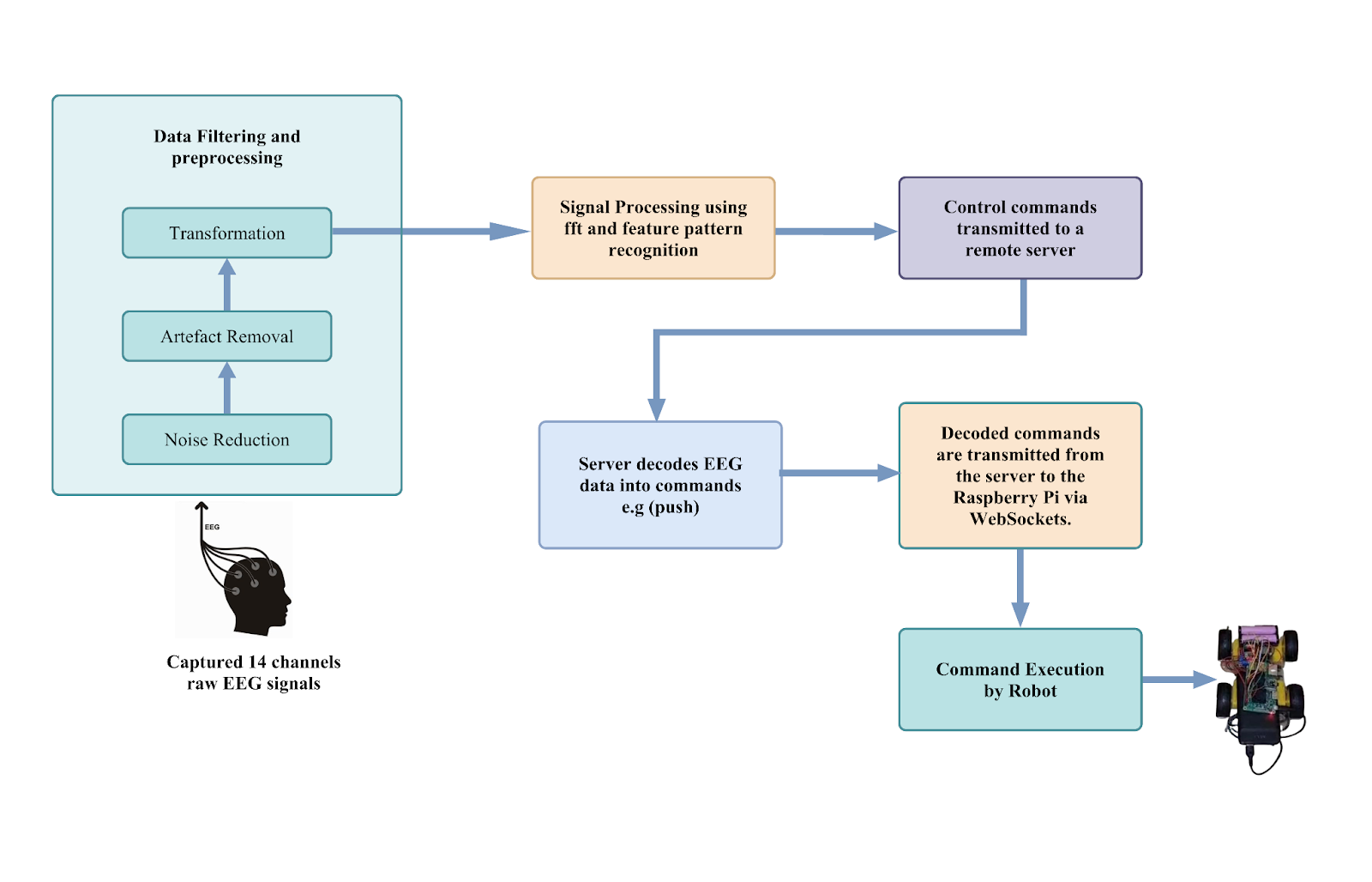
This study aims to develop a lightweight, real-time brain–computer interface system for classifying imagined speech commands using electroencephalography (EEG) signals acquired from a 14-channel Emotiv headset. Four motor-related imagined speech commands—push, pull, left, and right—are recorded from 15 participants, with a neutral state serving as a baseline. Continuous wavelet transform (CWT) is applied to extract time–frequency features from the EEG signals, which are converted into scalograms representations and used as inputs for machine learning models. Among the evaluated classifiers, XGBoost achieves the highest classification accuracy of 98.10%. The system is deployed on a Raspberry Pi-controlled robotic platform, enabling real-time inference within 900 ms. The results demonstrate efficiency, low computational overhead, and highlight the potential of consumer-grade EEG devices for real-time assistive robotics applications.
References
S. R and S. S Tippannavar, “EEG Based Smart Wheelchair Using Raspberry Pi for Elderly and Paralysed Patients,” Proceedings of the 2nd IEEE Mysore Sub Section International Conference (MysuruCon), IEEE press, pp. 1-5, 2022.
V. Chaurasia, V. Mishra, and L. Jain, “Brain-Bot: An Unmanned Ground Vehicle (UGV) Using Raspberry Pi and Brain Computer Interface (BCI) Technology,” Proceedings of Advances in Computing and Data Sciences: ICACDS 2016, Communications in Computer and Information Science, vol. 721, pp. 252-261, 2017
I. Rakhmatulin, and S. Volkl, “Brain-Computer-Interface Controlled Robot via RaspberryPi and PiEEG,” arXiv preprint arXiv:2202.01936, 2022.
V. Asanza, A.Constantine, S. Valarezo, and E. Peláez, “Implementation of a Classification System of EEG Signals Based on FPGA,” Proceedings of Seventh International Conference on eDemocracy & eGovernment (ICEDEG), pp. 87-92, 2020.
B. B. Das, P. Kumar, D. Kar, S. K. Ram, K. S. Babu, and R.K.Mohapatra, “A Spatio-Temporal Model for EEG-Based Person Identification,” Multimedia Tools and Applications, vol. 78, no. 19, pp. 28157-28177, 2019.
E. H. Houssein, A. Hammad, and A. A. Ali, “Human Emotion Recognition from EEG-Based Brain –Computer Interface Using Machine Learning: A Comprehensive Review,” Neural Computing and Applications, vol. 34, no. 15, pp. 12527-12557, 2022.
P. Saha, S. Fels, and M. Abdul-Mageed, “Deep Learning the EEG Manifold for Phonological Categorization from Active Thoughts,” Proceedings of IEEE International Conference on Acoustics, Speech and Signal Processing (ICASSP), pp. 2762-2766, 2019.
P. Kumar, and E. Scheme, “A Deep Spatio-Temporal Model for EEG-Based Imagined Speech Recognition,” Proceedings of IEEE International Conference on Acoustics, Speech and Signal Processing (ICASSP), pp. 995-999, 2021.
A. Chaudhry, U. Khan, M. R. Palla, S. B. Singh, and S. V. Deshmukh, “A Prosthetic Arm Based on Electroencephalography by Signal Acquisition and Processing on MATLAB,” International Journal of Research in Engineering, Science and Management, vol. 5, no. 1, pp. 119-124, 2022.
W. Zgallai, J. T. Brown, A. Ibrahim, F. Mahmood, K. Mohammad, and Maitha Khalfan, “Deep Learning AI Application to an EEG Driven BCI Smart Wheelchair.” Proceedings of Advances in Science and Engineering Technology International Conferences (ASET), pp. 1-5, 2019.
R. Bousseta, I. El Ouakouak, M. Gharbi, and F. Regragui, “EEG Based Brain Computer Interface for Controlling a Robot Arm Movement Through Thought,” IRBM, vol. 39, no. 2, pp. 129-135, 2018.
M. AlSaleh, R. Moore, H. Christensen, and M. Arvaneh, “Discriminating Between Imagined Speech and Non-Speech Tasks Using EEG,” Proceedings of 40th Annual International Conference of the IEEE Engineering in Medicine and Biology Society (EMBC), pp. 1952-1955, 2018.
U. Lal, A. V. Chikkankod, and L. Longo, “Fractal Dimensions and Machine Learning for Detection of Parkinson’s Disease in Resting-State Electroencephalography,” Neural Computing and Applications, vol. 36, no. 15, pp. 8257-8280, 2024.
Y. An, and H. K. Lam, and S. H. Ling, “Multi-Classification for EEG Motor Imagery Signals Using Data Evaluation-Based Auto-Selected Regularized FBCSP and Convolutional Neural Network,” Neural Computing and Applications, vol. 35, no. 16, pp. 12001-12027, 2023.
D. Raab, A.Theissler, and M. Spiliopoulou, “XAI4EEG: Spectral and Spatio-Temporal Explanation of Deep Learning-Based Seizure Detection in EEG Time Series,” Neural Computing and Applications, vol. 35, no. 14, pp. 10051-10068, 2023.
X. Xu, N. Drougard, and R. N. Roy, “Topological Data Analysis as a New Tool for EEG Processing,” Frontiers in Neuroscience, vol. 15, article no. 761703, 2021.
K. Hirano, S. Nishimura, and S. Mitra, “Design of Digital Notch Filters,” IEEE Transactions on Communications, vol. 22, no. 7, pp. 964-970, 1974.
I. W. Selesnick, and C. S. Burrus, “Generalized Digital Butterworth Filter Design,” IEEE Transactions on Signal Processing, vol. 46, no. 6, pp. 1688-1694, 1998.
I. Aliyu, and C. G. Lim, “Selection of Optimal Wavelet Features for Epileptic EEG Signal Classification with LSTM,” Neural Computing and Applications, vol. 35, no. 2, pp. 1077-1097, 2023.
R. M. Rady, D. Elsalamawy, M. R. M. Rizk, O. A. Alim, and N. D. Moussa, “Enhancing Affordable EEG to Act as a Quantitative EEG for Inattention Treatment Using MATLAB,” Neural Computing and Applications, vol. 37, pp. 5849-5871, 2025.
M. Karimian-Kelishadrokhi, and F. Safi-Esfahani, “TD-LSTM: A Time Distributed and Deep-Learning-Based Architecture for Classification of Motor Imagery and Execution in EEG Signals,” Neural Computing and Applications, vol. 36, no. 25, pp. 15843-15868, 2024.
G. Kumar, T. Das, and K. Singh, “Early Detection of Depression through Facial Expression Recognition and Electroencephalogram-Based Artificial Intelligence-Assisted Graphical User Interface,” Neural Computing and Applications, vol. 36, no. 12, pp. 6937-6954, 2024.
M. Nour, S. Ozturk, and K. Polat, “A Novel Classification Framework Using Multiple Bandwidth Method with Optimized CNN for Brain-Computer Interfaces with EEG-fNIRS Signals,” Neural Computing and Applications, vol. 33, no. 22, pp. 15815-15829, 2021.
R. Saia, S. Carta, G. Fenu, and L. Pompianu, “Influencing Brain Waves by Evoked Potentials as Biometric Approach: Taking Stock of the Last Six Years of Research,” Neural Computing and Applications, vol. 35, no. 16, pp. 11625-11651, 2023.
T. Khanam, S. Siuly, and H. Wang, “An Optimized Artificial Intelligence Based Technique for Identifying Motor Imagery from EEGs for Advanced Brain Computer Interface Technology,” Neural Computing and Applications, vol. 35, no. 9, pp. 6623-6634, 2023.
S. McWeeny, and E. Norton, “Understanding Event-Related Potentials (ERPs) in Clinical and Basic Language and Communication Disorders Research: A Tutorial,” International Journal of Language & Communication Disorders, vol. 55, no. 4, pp. 445-457, 2020.
H. Ahmadieh, F. Gassemi, and M. H. Moradi, “A Hybrid Deep Learning Framework for Automated Visual Image Classification Using EEG Signals,” Neural Computing and Applications, vol. 35, no. 28, pp. 20989-21005, 2023.
X. Y. Liu, W. L. Wang, M. Liu, and M. Y. Cheni, T. Pereira, D. Y. Doda, Y. F. Ke, et al., “Recent Applications of EEG-Based Brain-Computer-Interface in the Medical Field,” Military Medical Research, vol. 12, no. 14, pp. 1-42, 2025.
Published
Issue
Section
License
Copyright (c) 2026 Hanif Adedotun, Precious Akah, Nyangwarimam Obadiah Ali

This work is licensed under a Creative Commons Attribution-NonCommercial 4.0 International License.
Copyright Notice
Submission of a manuscript implies: that the work described has not been published before that it is not under consideration for publication elsewhere; that if and when the manuscript is accepted for publication. Authors can retain copyright in their articles with no restrictions. Also, author can post the final, peer-reviewed manuscript version (postprint) to any repository or website.
Since Sep. 01, 2023, EMSI will publish new articles with Creative Commons Attribution Non-Commercial License, under Creative Commons Attribution Non-Commercial 4.0 International (CC BY-NC 4.0) License.
The Creative Commons Attribution Non-Commercial (CC-BY-NC) License permits use, distribution and reproduction in any medium, provided the original work is properly cited and is not used for commercial purposes.
How to Cite