Consumer Behavior toward Near-Expired Convenience Store Meals: An Empirical Investigation Based on Value-Attitude-Behavior Model
DOI:
https://doi.org/10.46604/peti.2026.15959Keywords:
value-attitude-behavior model, surplus food, convenience store, mobile apps, food wasteAbstract
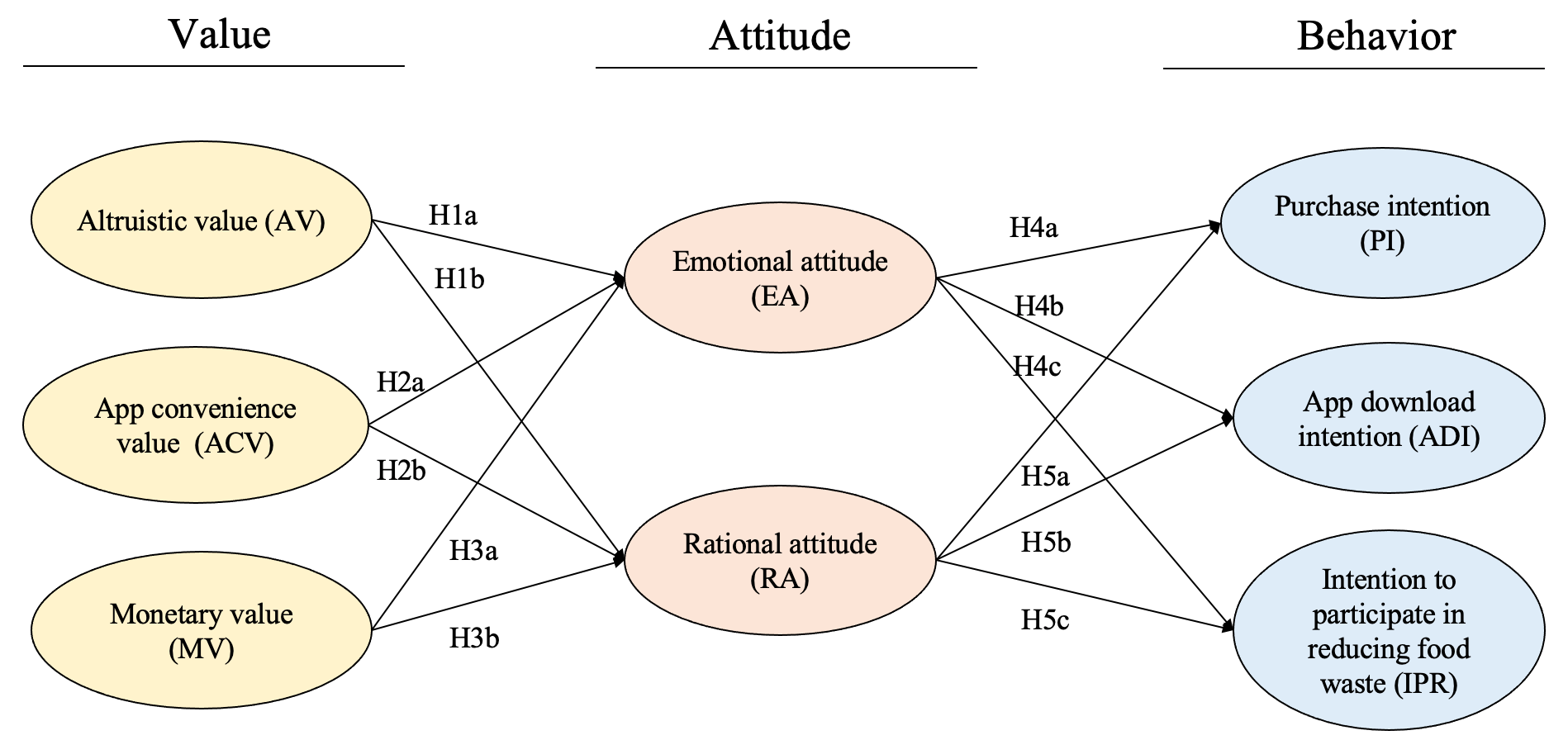
Convenience stores in Taiwan discard over 500 metric tons of food each month, with 80% of it being near-expired. Despite this significant waste, consumer-perspective research addressing the issue remains limited. This study aims to investigate consumer behavior toward near-expired convenience store meals using the value-attitude-behavior (VAB) model. It examines how consumer values (altruism, app convenience, and monetary savings) influence emotional and rational attitudes, which in turn affect intentions to purchase meals, download related applications, and reduce food waste. Based on 222 valid online survey responses, the results indicate that altruistic and monetary values enhance both emotional and rational attitudes, whereas app convenience value primarily strengthens rational attitudes. Emotional attitudes significantly influence intentions to purchase meals, download the app, and reduce food waste, while rational attitudes primarily encourage app downloads and willingness to reduce food waste. Implications for advancing sustainable food waste education are also provided.
References
Sarthi, M. Singh, A. Wagh, V. Johar, and V. Bisht, “Food Waste Management: A Way Forward for Ensuring Food Security and Sustainability,” Environment Conservation Journal, vol. 25, no. 4, pp. 1191-1203, 2024.
M. E. Buisman, R. Haijema, and J. M. Bloemhof-Ruwaard, “Discounting and Dynamic Shelf Life to Reduce Fresh Food Waste at Retailers,” International Journal of Production Economics, vol. 209, pp. 274-284, 2019.
L. Huang, O. Papaluca, M. Tani, and A. A. A. Bukhari, “Towards the Development of More Sustainable Services: Investigating Functional and Experiential Drivers of Consumer Behavior in Online Food Delivery Market,” Sustainable Development, vol. 34, no. 1, pp. 1399-1410, 2026.
Z. Nazirova and S. Borbala, “Values, Attitudes and the Behaviour Paradigm: A Systematic Literature Review,” Journal of Human Values, vol. 30, no. 2, pp. 214-239, 2024.
J. D. Pincus, “Values as Motives: Implications for Theory, Methods, and Practice,” Integrative Psychological and Behavioral Science, vol. 58, no. 4, pp. 1704-1750, 2024.
V. A. Zeithaml, “Consumer Perceptions of Price, Quality, and Value: A Means-End Model and Synthesis of Evidence,” Journal of Marketing, vol. 52, no. 3, pp. 2-22, 1988.
M. D. Habib, P. Kaur, V. Sharma, and S. Talwar, “Analyzing the Food Waste Reduction Intentions of UK Households. A Value-Attitude-Behavior (VAB) Theory Perspective,” Journal of Retailing and Consumer Services, vol. 75, article no. 103486, 2023.
A. A. Sheikh, M. F. Yousaf, M. S. Alshuaibi, B. Tariq, S. Durrani, I. Hameed, et al., “Modeling a Value-Attitude-Behavior Framework and Personality Traits: Examining Consumers’ Green Purchase Behavior for Environmentally Friendly Technology Products,” Discover Sustainability, vol. 6, article no. 779, 2025.
E. Hong, J. Park, and B. Lim, “Exploring Perceived Value’s Impact on Attitudes in Autonomous Public Transportation Services: A Multi-Dimensional Approach,” Total Quality Management & Business Excellence, vol. 36, no. 1-2, pp. 100-124, 2025.
M. J. Kim, C. M. Hall, O. Kwon, and K. Sohn, “Space Tourism: Value-Attitude-Behavior Theory, Artificial Intelligence, and Sustainability,” Journal of Retailing and Consumer Services, vol. 77, article no. 103654, 2024.
I. Tuncer, C. Unusan, and C. Cobanoglu, “Service Quality, Perceived Value and Customer Satisfaction on Behavioral Intention in Restaurants: An Integrated Structural Model,” Journal of Quality Assurance in Hospitality & Tourism, vol. 22, no. 4, pp. 447-475, 2021.
S. Li, X. Huang, Y. Sheng, and K. Chen, “The Interactive Effect of Recommendation Subjects and Message Types on Consumers’ Suboptimal Food Purchase Intentions,” Journal of Retailing and Consumer Services, vol. 84, article no. 104200, 2025.
Q. Tian, W. Gao, Y. Lin, Y. Yu, and C. Li, “Online Purchasing and Household Food Waste: Unpacking the Role of Value Assessment Discrepancies from Purchase to Usage,” Journal of Retailing and Consumer Services, vol. 89, part A, article no. 104594, 2026.
S. J. Breckler, “Empirical Validation of Affect, Behavior, and Cognition as Distinct Components of Attitude,” Journal of Personality and Social Psychology, vol. 47, no. 6, pp. 1191-1205, 1984.
B. Luceri, T. H. A. Bijmolt, S. Bellini, and S. Aiolfi, “What Drives Consumers to Shop on Mobile Devices? Insights from a Meta-Analysis,” Journal of Retailing, vol. 98, no. 1, pp. 178-196, 2022.
G. McLean, K. Osei-Frimpong, K. Al-Nabhani, and H. Marriott, “Examining Consumer Attitudes towards Retailers’ M-Commerce Mobile Applications – An Initial Adoption vs. Continuous Use Perspective,” Journal of Business Research, vol. 106, pp. 139-157, 2020.
Y. Zhong, “The Influence of Reference Group on Consumers’ Purchase Intention of Near-Expired Food,” Asia Pacific Journal of Marketing and Logistics, vol. 37, no. 11, pp. 3291-3310, 2025.
S. H. Schwartz, “Basic Values: How They Motivate and Inhibit Prosocial Behavior,” in Prosocial Motives, Emotions, and Behavior: The Better Angels of Our Nature, M. Mikulincer and P. R. Shaver, Eds., Washington, DC: American Psychological Association, 2010, pp. 221-241.
K. C. Gehrt and L. J. Yale, “The Dimensionality of the Convenience Phenomenon: A Qualitative Reexamination,” Journal of Business and Psychology, vol. 8, no. 2, pp. 163-180, 1993.
R. Yadav, M. S. Balaji, and C. Jebarajakirthy, “How Psychological and Contextual Factors Contribute to Travelers’ Propensity to Choose Green Hotels?” International Journal of Hospitality Management, vol. 77, no. 1, pp. 385-395, 2019.
L. Ding, “The Effects of Self-Efficacy and Collective Efficacy on Customer Food Waste Reduction Intention: The Mediating Role of Ethical Judgment,” Journal of Hospitality and Tourism Insights, vol. 5, no. 4, pp. 752-770, 2022.
C. H. Hsiao, C. P. Chen, H. C. Yang, J. L. Liang, and K. Y. Tang, “Examining the Impact of Sustainable Value and Economic Value on TPASS Usage Intention,” Advances in Technology Innovation, vol. 11, no. 1, pp. 79-89, 2026.
C. Park, S. Lee, C. K. Lee, and Y. Reisinger, “Volunteer Tourists’ Environmentally Friendly Behavior and Support for Sustainable Tourism Development Using Value-Belief-Norm theory: Moderating Role of Altruism,” Journal of Destination Marketing & Management, vol. 25, article no. 100712, 2022.
T. L. Childers, C. L. Carr, J. Peck, and S. Carson, “Hedonic and Utilitarian Motivations for Online Retail Shopping Behavior,” Journal of Retailing, vol. 77, no. 4, pp. 511-535, 2001.
R. T. Wang and K. Kaplanidou, “I Want to Buy More Because I Feel Good: The Effect of Sport-Induced Emotion on Sponsorship,” International Journal of Sports Marketing and Sponsorship, vol. 15, no. 1, pp. 52-66, 2013.
S. Manca and F. Fornara, “Attitude Toward Sustainable Transport as a Function of Source and Argument Reliability and Anticipated Emotions,” Sustainability, vol. 11, no. 12, article no. 3288, 2019.
J. I. M. de Groot, K. Bondy, and G. Schuitema, “Listen to Others or Yourself? The Role of Personal Norms on the Effectiveness of Social Norm Interventions to Change Pro-Environmental Behavior,” Journal of Environmental Psychology, vol. 78, article no. 101688, 2021.
W. B. Dodds, K. B. Monroe, and D. Grewal, “Effects of Price, Brand, and Store Information on Buyers’ Product Evaluations,” Journal of Marketing Research, vol. 28, no. 3, pp. 307-319, 1991.
Y. Baek, “Analysis of User’s Attitude Toward Apps, Intention to Use and Continual Consuming Intention–Focused on Mobile Commerce,” International Journal of Contents, vol. 9, no. 4, pp. 35-44, 2013.
E. Park, “Social Acceptance of Green Electricity: Evidence from the Structural Equation Modeling Method,” Journal of Cleaner Production, vol. 215, pp. 796-805, 2019.
Published
Issue
Section
License
Copyright (c) 2026 Chun-Hua Hsiao, Chien-Hung Lin, Yu-En Lai, Cheng-Ping Chen, Kai-Yu Tang

This work is licensed under a Creative Commons Attribution-NonCommercial 4.0 International License.
Submission of a manuscript implies: that the work described has not been published before that it is not under consideration for publication elsewhere; that if and when the manuscript is accepted for publication. Authors can retain copyright of their article with no restrictions. Also, author can post the final, peer-reviewed manuscript version (postprint) to any repository or website.

Since Oct. 01, 2015, PETI will publish new articles with Creative Commons Attribution Non-Commercial License, under The Creative Commons Attribution Non-Commercial 4.0 International (CC BY-NC 4.0) License.
The Creative Commons Attribution Non-Commercial (CC-BY-NC) License permits use, distribution and reproduction in any medium, provided the original work is properly cited and is not used for commercial purposes
How to Cite