
A Hybrid Autoencoder-XGBoost Framework for High-Performance UPI Fraud Detection
DOI:
https://doi.org/10.46604/peti.2026.16002Keywords:
decision-support systems, digital payments security, financial technology (FinTech), machine learning scalability, real-time transaction monitoringAbstract
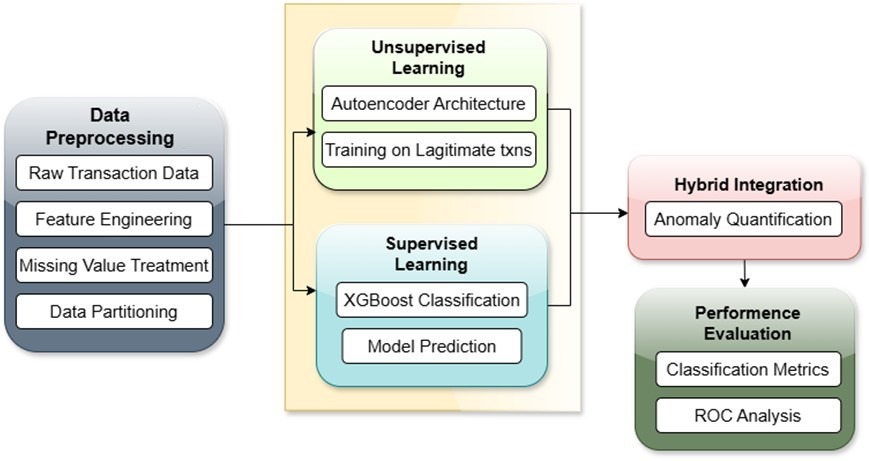
This paper proposes a scalable hybrid autoencoder–XGBoost system for detecting unified payment interface fraud. The approach begins by training an autoencoder on legitimate transactions to learn normal behavior patterns, where reconstruction errors are derived and utilized as anomaly scores. These scores serve as engineered features in an XGBoost classifier for final fraud classification. The system is tested on a synthetic dataset of 2.68 million transactions. The findings show near-perfect performance, with accuracy, precision, recall, and F1-scores close to 1.0 and a receiver operating characteristic curve-area under curve (ROC–AUC) of 0.99999995. However, these results are influenced by deterministic fraud patterns in the simulated dataset, leading to near-separable classes with domain-driven balance features. Therefore, the performance should be interpreted as proof-of-concept under controlled synthetic conditions rather than absolute evidence of real-world effectiveness. The model demonstrates the potential of anomaly-aware feature enrichment for handling severely imbalanced data. Future work will focus on validation with real-world UPI data and adaptive learning upgrades.
References
J. Putrevu and C. Mertzanis, “The Adoption of Digital Payments in Emerging Economies: Challenges and Policy Responses,” Digital Policy, Regulation and Governance, vol. 26, no. 5, pp. 476-500, 2024.
S. M. Mathew, S. Shanimon, S. Joseph, and M. Abraham, “Exploring the Exponential Growth of UPI in India: A Study on Digital Payment Transformation (2016–2024),” Library Progress International, vol. 44, no. 3, pp. 10796-10805, 2024.
M. Razi-ur-Rahim, M. R. Rabbani, F. Uddin, and Z. H. Shaikh, “Adoption of UPI Among Indian Users: Using Extended Meta-UTAUT Model,” Digital Business, vol. 4, no. 2, article no.100093, 2024.
D. Devassy, D. K. S, G. P. Mannickathan, A. Biju, A. T, and D. R, “FedUPI: Federated Learning Empowered Detection of Fraudulent UPI Transactions,” Proceedings of the 5th International Conference on Soft Computing for Security Applications (ICSCSA), IEEE, pp. 1007-1015, 2025.
A. Aljaradat, G. Sarkar, and S. K. Shukla, “Modelling Cybersecurity Impacts on Digital Payment Adoption: A Game Theoretic Approach,” Journal of Economic Criminology, vol. 5, article no. 100089, 2024.
N. B. Chakka and S. S. Saheb, “Mobile Payment Fraud Detection in UPIs through Machine Learning Techniques: A Systematic Review,” Multidisciplinary Reviews, vol. 9, no. 6, article no. 2026280, 2025.
R. U., M. P. Raj, J. N. Mithra, S. S. Balaji, L. A. Narayanan, and J. M. D. Y., “A Robust UPI Fraud Identification Scheme over Digital Money Transactions Using Learning Powered Classification Principles,” Proceedings of International Conference on Electronics and Renewable Systems (ICEARS), IEEE, pp. 1551-1558, 2025.
R. Rani, A. Alam, and A. Javed, “Secure UPI: Machine Learning-Driven Fraud Detection System for UPI Transactions,” Proceedings of 2nd International Conference on Disruptive Technologies (ICDT-2024), IEEE, pp.924-928, 2024.
R. Rethisha, S. Cyindia H., and R. Geetha, “Leveraging Machine Learning Techniques of Real Time Detection of UPI Fraud,” Proceedings of International Conference on Intelligent Sustainable Systems (ICISS), IEEE, pp. 1506-1510, 2025.
M. N. Raju, Y. C. Reddy, P. N. Babu, V. S. P. Ravipati, and V. Chaitanya, “Detection of Fraudulent Activities in Unified Payments Interface using Machine Learning - LSTM Networks,” Proceedings of 7th International Conference on Circuit Power and Computing Technologies (ICCPCT), IEEE, pp.769-774, 2024.
S. K. L. Naikl, A. Kiran, V. P. Kumar, S. Mannam, Y. Kalyani, and M. Silparaj, “Fraud Fighters - How AI and ML are Revolutionizing UPI Security,” Proceedings of International Conference on Science Technology Ingineering and Management (ICSTEM), IEEE, pp. 1-7, 2024.
S. Bharath, G. L. Vara Prasad, V. Sujatha, S. Hemajothi, D. Sharada Mani, and N. G. Merlin, “HMLM: An Intelligent Artificial Intelligence Assisted Strategy to Identify UPI Frauds Based on Hybrid Markov Learning Methodology,” Proceedings of International Conference on Innovative Computing, Intelligent Communication and Smart Electrical Systems (ICSES), IEEE, pp. 1-6, 2024.
S. Janbhasha, C. H. N. S. Kumar, V. Sitharamulu, B. N. V. Madhu Babu, H. R. Battu, and K. Venkataramana, “A Hybrid Approach for Fraud Detection in Digital Wallet Transactions Using Adversarial Autoencoders and Gated Recurrent Units,” Engineering, Technology and Applied Science Research, vol. 15, no. 4, pp. 25532-25537, 2025.
K. Prakash, M. Franklin, M. Shunmugasundaram, K. Sankar Ganesh, and S. Gangadharan, “Fraud Detection in the Banking Sector Using Gated Green Anaconda Progressive Generative Axial Adversarial Attention Network,” Intelligent Decision Technologies, vol. 19, no. 5, pp. 3281-3303, 2025.
N. Singh and S. Tripathy, “FedShield: Federated Learning Based Robust Online Payment Fraud Detection,” Journal of Supercomputing, vol. 81, no. 13, article no. 1289, 2025.
O. Manta, V. Vasile, and E. Rusu, “Banking Transformation Through FinTech and the Integration of Artificial Intelligence in Payments,” FinTech, vol. 4, no. 2, article no.13, 2025.
A. Hamed, Y. Bansal, M. Mohamad, A. Jimenez-Aranda, and T. Gaber, “AI Security in Contactless Payments and Education: A Review,” Journal of Engineering Education Transformations, vol. 39, no. s1, pp. 20-25, 2025.
F. M. Talaat, T. Medhat, and W. M. Shaban, “Precise Fraud Detection and Risk Management with Explainable Artificial Intelligence,” Neural Computing and Applications, vol. 37, no. 23, pp. 19199-19229, 2025.
C. G. Arnaldo, R. D. A. Jurado, F. P. Moreno, and M. Z. Suárez, “Enhancing Security in Airline Ticket Transactions: A Comparative Study of SVM and LightGBM,” Applied Sciences, vol. 15, no. 17, article no. 9581, 2025.
G. Prabu, A. J. F. Prakash, E. R. Joseph, S. M. Poonkuzhali, R. Ramya, and S. Subha, “Unlocking the Power of UPI: A Machine Learning Journey Through Digital Payment and Data Visualization Models,” Proceedings of the International Conference on Data Science, Agents & Artificial Intelligence (ICDSAAI), pp. 1-7, 2025.
R. El Youbi, F. Messaoudi, M. Loukili, and R. Loukili, “From Click to Checkout: Deep Learning for Real-Time Fraud Detection in E-Payment Systems,” Statistics, Optimization & Information Computing, vol. 14, no. 6, pp. 3398-3408, 2025.
H. M. R. Al Lawati, A. Zainal, B. A. S. Al-Rimy, M. A. N. Al-Azawi, M. N. Kassim, S. A. Almalki, et al., “An Integrated Preprocessing and Drift Detection Approach With Adaptive Windowing for Fraud Detection in Payment Systems,” IEEE Access, vol. 13, pp. 92036-92056, 2025.
M. S. A. Mozumder, M. B. H. Sakil, M. R. Hasan, M. A. Hasan, K. M. N. R. Fuad, M. F. Mridha, et al., “Hybrid Contrastive Learning With Attention-Based Neural Networks for Robust Fraud Detection in Digital Payment Systems,” IEEE Open Journal of the Computer Society, vol. 6, pp. 1053-1064, 2025.
H. N. Himabindu Gurajada and R. Autade, “Quantum Computing for Fraud Detection in Real-Time Payment Systems,” Proceedings of International Conference on Computing Technologies & Data Communication (ICCTDC), IEEE, pp. 1-8, 2025.
M. Tamilselvi, R. Begum, K. K, J. Giri, D. Sheela, and M. O. Sabri, “Experimental Evaluation Unified Payment Interface (UPI) Fraud Detection System Using Elevated Deep Learning Methodology” Proceedings of the International Conference on Emerging Trends in Engineering and Medical Sciences (ICETEMS), IEEE, pp. 40-45, 2024.
A. A. Abdirahman, A. O. Hashi, U. M. Dahir, M. A. Abdi, and O. E. R. Rodriguez, “Enhancing Security in Mobile Wallet Payments: Machine Learning-Based Fraud Detection Across Prominent Wallet Platforms,” International Journal of Electronics and Communication Engineering, vol. 11, no. 3, pp. 96-105, 2024.
T. Madhavappa and B. Sathyanarayana, “An Efficient Framework Based on Optimized CNN-RNN for Online Transaction Fraud Detection in Financial Transactions,” International Journal of System Assurance Engineering and Management, vol. 10, no. 53s, pp. 689-713, 2025.
S. Renukadevi, B. C. Manujakshi, T. M. Shashidhar, and N. Sivakumar, “Fraud Detection in Financial Transactions Using Gradient Boost with Hybrid Optimization,” Journal of Machine and Computing, vol. 5, no. 4, pp. 2328-2344, 2025.
C. Dong and S. Xiao, “Enhancing Financial Fraud Detection in Digital Finance Applications Through Machine Learning Algorithms and Real-Time Data Analytics,” Journal of Computational Methods in Sciences and Engineering, article no.14727978251352131, 2025.
M. Bakirci, “Performance Evaluation of Low-Power and Lightweight Object Detectors for Real-Time Monitoring in Resource-Constrained Drone Systems,” Engineering Applications of Artificial Intelligence, vol. 159, part B, article no. 111775, 2025.
Published
Issue
Section
License
Copyright (c) 2026 Naga Bhavani Chakka, Shaiku Shahida Saheb

This work is licensed under a Creative Commons Attribution-NonCommercial 4.0 International License.
Submission of a manuscript implies: that the work described has not been published before that it is not under consideration for publication elsewhere; that if and when the manuscript is accepted for publication. Authors can retain copyright of their article with no restrictions. Also, author can post the final, peer-reviewed manuscript version (postprint) to any repository or website.

Since Oct. 01, 2015, PETI will publish new articles with Creative Commons Attribution Non-Commercial License, under The Creative Commons Attribution Non-Commercial 4.0 International (CC BY-NC 4.0) License.
The Creative Commons Attribution Non-Commercial (CC-BY-NC) License permits use, distribution and reproduction in any medium, provided the original work is properly cited and is not used for commercial purposes
How to Cite