Comparative Evaluation of Deep Learning Models for Small-Scale Autonomous Driving Under Embedded System Constraints
DOI:
https://doi.org/10.46604/peti.2026.16240Keywords:
autonomous driving, deep learning, model evaluation, embedded systemsAbstract
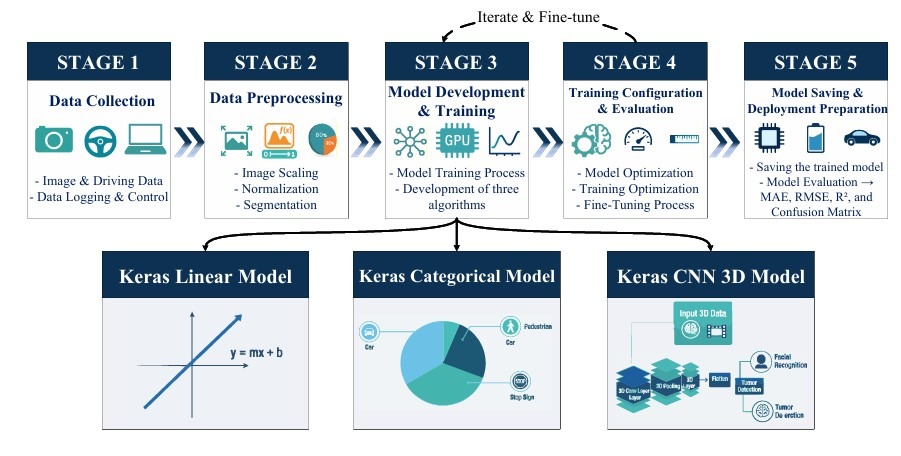
This study compares vision-based autonomous driving models for small-scale vehicles under embedded resource constraints. Three architectures—a linear model, a categorical model, and a convolutional neural network (CNN) 3D Model—are evaluated on the DonkeyCar platform. Training data comprise over 23,000 front-facing images with control commands, which are collected through joystick-based teleoperation. Model performance is benchmarked using quantitative metrics (mean absolute error (MAE), root mean squared error (RMSE), coefficient of determination (R²)) and driving tests using Raspberry Pi 4. The CNN 3D model achieves the highest prediction accuracy, whereas the linear model provides more stable driving with lower computational cost. The findings indicate that model performance and hardware limits must be considered when selecting models for embedded applications: the linear model is suitable for resource-constrained platforms requiring real-time stability, the categorical model suits discrete decision-making, and the CNN 3D model supports accuracy-prioritized tasks with greater computing capacity.
References
B. R. Kiran, I. Sobh, V. Talpaert, P. Mannion, A. A. Al Sallab, S. Yogamani, et al., “Deep Reinforcement Learning for Autonomous Driving: A Survey,” IEEE Transactions on Intelligent Transportation Systems, vol. 22, no. 6, pp. 3182-3200, 2021.
Z. Zhu, X. and H. Zhao, “A Survey of Deep RL and IL for Autonomous Driving Policy Learning,” IEEE Transactions on Intelligent Transportation Systems, vol. 23, no. 11, pp. 14043-14065, 2022.
L. Le Mero, D. Yi, M. Dianati, and A. Mouzakitis, “A Survey on Imitation Learning Techniques for End-to-End Autonomous Vehicles,” IEEE Transactions on Intelligent Transportation Systems, vol. 23, no. 9, pp. 14128-14147, 2022.
D. Coelho and M. Oliveira, “A Review of End-to-End Autonomous Driving in Urban Environments,” IEEE Access, vol. 10, pp. 75296-75311, 2022.
P. S. Chib and P. Singh, “Recent Advancements in End-to-End Autonomous Driving Using Deep Learning: A Survey,” IEEE Transactions on Intelligent Vehicles, vol. 9, no. 1, pp. 103-118, 2024.
L. Chen, P. Wu, K. Chitta, B. Jaeger, A. Geiger, and H. Li, “End-to-End Autonomous Driving: Challenges and Frontiers,” IEEE Transactions on Pattern Analysis and Machine Intelligence, vol. 46, no. 12, pp. 10164-10183, 2024.
J. Zhao, Y. Wu, R. Deng, S. Xu, J. Gao, and A. F. Burke, “A Survey of Autonomous Driving from a Deep Learning Perspective,” ACM Computing Surveys, vol. 57, no. 10, article no. 263, pp. 1-60, 2025.
P. Moraes, M. Rodriguez, K. S. Kappel, H. Sodre, S. Fernandez, I. Nunes, et al., “Mini Autonomous Car Driving Based on 3D Convolutional Neural Networks,” Proceedings of the IEEE Brazilian Symposium on Robotics, pp. 206-212, 2025.
S. Hu, L. Chen, P. Wu, H. Li, J. Yan, D. Tao, “ST-P3: End-to-End Vision-Based Autonomous Driving via Spatial-Temporal Feature Learning,” Proceedings of the European Conference on Computer Vision, pp. 533-549, 2022.
K. Chitta, A. Prakash, B. Jaeger, Z. Yu, K. Renz, A. Geiger, “TransFuser: Imitation with Transformer-Based Sensor Fusion for Autonomous Driving,” IEEE Transactions on Pattern Analysis and Machine Intelligence, vol. 45, no. 11, pp. 12878-12895, 2023.
X. Jia, P. Wu, L. Chen, J. Xie, C. He, J. Yan, et al., “Think Twice Before Driving: Towards Scalable Decoders for End-to-End Autonomous Driving,” Proceedings of the IEEE Conference on Computer Vision and Pattern Recognition, pp. 21983-21994, 2023.
A. M. Karadeniz and N. F. Koçak, “Steering Angle Prediction in Autonomous Vehicles: A Deep Learning Approach Combining VGG16 and LSTM,” Journal of Computer & Electrical and Electronics Engineering Sciences, vol. 2, no. 2, pp. 46-51, 2024.
B. Khawaldeh, A. M. Mora, and H. Faris, “Optimizing Steering Angle Prediction in Self-Driving Vehicles Using Evolutionary Convolutional Neural Networks,” AI, vol. 5, no. 4, pp. 2147-2169, 2024.
S. Paniego, E. Shinohara, and J. M. Cañas, “Autonomous Driving in Traffic with End-to-End Vision-Based Deep Learning,” Neurocomputing, vol. 594, article no. 127874, 2024.
H.-I. Liu, M. Galindo, H. Xie, L. K. Wong, H. H. Shuai, Y. H. Li, et al., “Lightweight Deep Learning for Resource-Constrained Environments: A Survey,” ACM Computing Surveys, vol. 56, no. 10, article no. 267, pp. 1-42, 2024.
G. Akkad, A. Mansour, and E. Inaty, “Embedded Deep Learning Accelerators: A Survey on Recent Advances,” IEEE Transactions on Artificial Intelligence, vol. 5, no. 5, pp. 1954-1972, 2023.
C. Silvano, D. Ielmini, F. Ferrandi, L. Fiorin, S. Curzel, L. Benini, et al., “A Survey on Deep Learning Hardware Accelerators for Heterogeneous HPC Platforms,” ACM Computing Surveys, vol. 57, no. 11, article no. 286, 2025.
X. Wang, Z. Tang, J. Guo, T. Meng, C. Wang, T. Wang et al., “Empowering Edge Intelligence: A Comprehensive Survey on On-Device AI Models,” ACM Computing Surveys, vol. 57, no. 9, article no. 228, pp. 1-39, 2025.
R. Cordova-Cardenas, D. Amor, and Á. Gutiérrez, “Edge AI in Practice: A Survey and Deployment Framework for Neural Networks on Embedded Systems,” Electronics, vol. 14, no. 24, article no. 4877, 2025.
T. Huang, H. Pan, W. Sun, and H. Gao, “Sine Resistance Network-Based Motion Planning Approach for Autonomous Electric Vehicles in Dynamic Environments,” IEEE Transactions on Transportation Electrification, vol. 8, no. 2, pp. 2862-2873, 2022.
Downloads
Published
Issue
Section
License
Copyright (c) 2026 Korawit Krajangpan, Kittinan Petsri

This work is licensed under a Creative Commons Attribution-NonCommercial 4.0 International License.
Submission of a manuscript implies: that the work described has not been published before that it is not under consideration for publication elsewhere; that if and when the manuscript is accepted for publication. Authors can retain copyright of their article with no restrictions. Also, author can post the final, peer-reviewed manuscript version (postprint) to any repository or website.

Since Oct. 01, 2015, PETI will publish new articles with Creative Commons Attribution Non-Commercial License, under The Creative Commons Attribution Non-Commercial 4.0 International (CC BY-NC 4.0) License.
The Creative Commons Attribution Non-Commercial (CC-BY-NC) License permits use, distribution and reproduction in any medium, provided the original work is properly cited and is not used for commercial purposes
How to Cite