Comparative Analysis of Multi-Horizon Deep Learning for Water Quality Forecasting in Shrimp Ponds
DOI:
https://doi.org/10.46604/peti.2026.16540Keywords:
water quality, forecasting, deep learning, multi-horizonAbstract
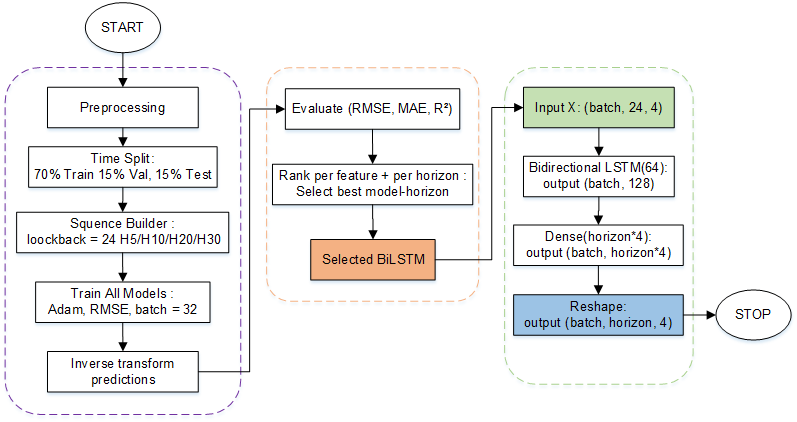
Accurate multi-step water-quality prediction is essential for proactive and sustainable aquaculture management. Existing studies often evaluate only limited deep learning (DL) architectures or forecasting horizons, making fair comparisons difficult. This study systematically compares seven DL architectures for forecasting pH, temperature, salinity, and dissolved oxygen (DO) using 6,741 records collected from shrimp ponds at seven Indonesian locations (2017–2025). All models are evaluated using the same preprocessing, optimization, and evaluation settings for forecasting horizons of 5, 10, 20 and 30 steps ahead. Prediction performance consistently decreases as the forecasting horizon increases. Bidirectional long short-term memory (BiLSTM) achieves the lowest root mean square error (RMSE) (2.18) and mean absolute error (MAE) (0.82) at horizon 5 (H5), although repeated experiments indicate that the observed differences are not statistically significant. Performance varies across longer forecasting horizons, with gated recurrent unit (GRU) achieving the lowest RMSE at H20 (2.69).
References
K. Zhang, Z. Ye, M. Qi, W. Cai, J. L. Saraiva, Y. Wen, et al., “Water Quality Impact on Fish Behavior: A Review from an Aquaculture Perspective,” Reviews in Aquaculture, vol. 17, no. 1, article no. e12985, 2025.
M. G. C. Emerenciano, A. N. Rombenso, F. D. N. Vieira, M. A. Martins, G. J. Coman, H. H. Truong, et al., “Intensification of Penaeid Shrimp Culture: An Applied Review of Advances in Production Systems, Nutrition and Breeding,” Animals, vol. 12, no. 3, article no. 236, 2022.
L. Liu, W. Cheng, and H. W. Kuo, “A Narrative Review on Smart Sensors and IoT Solutions for Sustainable Agriculture and Aquaculture Practices,” Sustainability, vol. 17, no. 12, article no. 5256, 2025.
F. Karakulov, B. Menglikulov, A. Mamasadikov, S. Kholbutaeva, A. Mukhtorov, G. Abdulkhaeva, et al., “The Impact of Climate-Smart Technology Adoption on Agricultural Productivity and Environmental Sustainability,” Emerging Science Journal, vol. 9, no. 6, pp. 3087-3115, 2025.
L. Salazar-Gámez, G. Cárdenas-Calvachi, M. Bolaños-Bolaños, M. Paz-Solarte, A. Bernal-Meneses, J. Camues-Sanchez, et al., “Impact of Water Quality and Sediments on the Riparian Vegetation of Andean Lake,” Civil Engineering Journal, vol. 11, no. 9, 2025.
T. Li, J. Lu, J. Wu, Z. Zhang, and L. Chen, “Predicting Aquaculture Water Quality Using Machine Learning Approaches,” Water, vol. 14, no. 18, article no. 2836, 2022.
M. H. Nishat, M. H. R. B. Khan, T. Ahmed, S. N. Hossain, A. Ahsan, M. M. El-Sergany, et al., “Comparative Analysis of Machine Learning Models for Predicting Water Quality Index in Dhaka’s Rivers of Bangladesh,” Environmental Sciences Europe, vol. 37, no. 1, article no. 31, 2025.
Y. Lin, “Progressive Neural Network for Multi-Horizon Time Series Forecasting,” Information Sciences, vol. 661, article no. 120112, 2024.
S. Kim, “Sluice Gate Operation and Managed Water Levels Improve Predicted Estuarine Lake Water Quality,” Civil Engineering Journal, vol. 11, no. 1, pp. 178-189, 2025.
X. Ji, L. Liu, B. Duan, Y. Li, H. Xing, B. Wang, et al., “Long-Term Multivariate Water Quality Forecasting for Sustainable Aquaculture Management,” Water Research X, vol. 29, article no. 100402, 2025.
P. Wongburi and J. K. Park, “Prediction of Wastewater Treatment Plant Effluent Water Quality Using Recurrent Neural Network (RNN) Models,” Water, vol. 15, no. 19, article no. 3325, 2023.
J. Xu, K. Wang, C. Lin, L. Xiao, X. Huang, and Y. Zhang, “FM-GRU: A Time Series Prediction Method for Water Quality Based on Seq2seq Framework,” Water, vol. 13, no. 8, article no. 1031, 2021.
Z. Gao, J. Chen, G. Wang, S. Ren, L. Fang, A. Yinglan, et al., “A Novel Multivariate Time Series Prediction of Crucial Water Quality Parameters with Long Short-Term Memory (LSTM) Networks,” Journal of Contaminant Hydrology, vol. 259, article no. 104262, 2023.
Z. Jamshidzadeh, M. Ehteram, and H. Shabanian, “Bidirectional Long Short-Term Memory (BILSTM) - Support Vector Machine: A New Machine Learning Model for Predicting Water Quality Parameters,” Ain Shams Engineering Journal, vol. 15, no. 3, article no. 102510, 2024.
S. S. Baek, J. Pyo, and J. A. Chun, “Prediction of Water Level and Water Quality Using a CNN-LSTM Combined Deep Learning Approach,” Water, vol. 12, no. 12, article no. 3399, 2020.
A. M. Elshewey, H. M. El-Bakry, and A. M. Osman, “Enhancing Water Potability Classification Using a Hybrid GRU with LSTM Deep Learning Models Based on Relief Algorithm and Bayesian Optimization,” Evolving Systems, vol. 17, no. 1, article no. 10, 2026.
J. Huan, C. Zhang, X. Xu, Y. Qian, H. Zhang, Y. Fan, et al., “River Water Quality Forecasting: A Novel LSTM-Transformer Approach Enhanced by Multi-Source Data,” Environmental Monitoring and Assessment, vol. 197, no. 9, article no. 1040, 2025.
R. P. Shete, A. M. Bongale, and D. Dharrao, “Lightweight Cryptographic and Scalable IoT Systems for Encryption across GSM-MQTT Architectures in Resource-Constrained Aquaculture Environment,” Engineering, Technology & Applied Science Research, vol. 15, no. 4, pp. 25133-25139, 2025.
S. M. Robeson and C. J. Willmott, “Decomposition of the Mean Absolute Error (MAE) Into Systematic and Unsystematic Components,” PLOS ONE, vol. 18, no. 2, article no. e0279774, 2023.
D. S. K. Karunasingha, “Root Mean Square Error or Mean Absolute Error? Use Their Ratio as Well,” Information Sciences, vol. 585, pp. 609-629, 2022.
D. Zhang, “Coefficients of Determination for Mixed-Effects Models,” Journal of Agricultural, Biological, and Environmental Statistics, vol. 27, no. 4, pp. 674-689, 2022.
Downloads
Published
Issue
Section
License
Copyright (c) 2026 Santi, Arna Fariza, Agus Indra Gunawan

This work is licensed under a Creative Commons Attribution-NonCommercial 4.0 International License.
Submission of a manuscript implies: that the work described has not been published before that it is not under consideration for publication elsewhere; that if and when the manuscript is accepted for publication. Authors can retain copyright of their article with no restrictions. Also, author can post the final, peer-reviewed manuscript version (postprint) to any repository or website.

Since Oct. 01, 2015, PETI will publish new articles with Creative Commons Attribution Non-Commercial License, under The Creative Commons Attribution Non-Commercial 4.0 International (CC BY-NC 4.0) License.
The Creative Commons Attribution Non-Commercial (CC-BY-NC) License permits use, distribution and reproduction in any medium, provided the original work is properly cited and is not used for commercial purposes
How to Cite