
An Optimized Hybrid Bio-Inspired Framework for Machine Learning-Based 5G Resource Allocation
DOI:
https://doi.org/10.46604/peti.2026.16627Keywords:
5G networks, resource allocation, machine learning, grey wolf optimizerAbstract
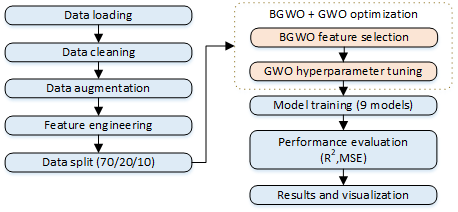
This study presents a lightweight hybrid framework for optimizing radio resource allocation in 5G networks, enabling high prediction accuracy with low computational complexity for edge deployment. A binary grey wolf optimization (BGWO) algorithm is used for feature selection, while a continuous GWO algorithm is used for hyperparameter adjustment of nine regression models trained using machine learning on a pre-processed public dataset for 5G networks. To ensure evaluation integrity, the dataset is segmented for training, validation, and testing before feature selection and expansion, preventing data leakage. Model performance is assessed using mean squared error (MSE) and the coefficient of determination (R²). The optimized decision tree achieves the best overall performance, improving R² from 46.32% to 99.44% and reducing MSE from 0.00470 to 0.00005, while random forest and support vector machine (SVM) exceed 99% R². These results demonstrate that the proposed framework achieves accurate and computationally efficient resource allocation for 5G networks.
References
Jyoti, Amandeep, and D. Kumar, "Investigating Resource Allocation Techniques and Key Performance Indicators (Kpis) For 5g New Radio Networks: A Review," International Journal of Computer Networks and Applications, vol. 10, no. 3, 2023.
N. R. Pindi and F. J. Velez, "Traffic Scheduling and Resource Allocation for Heterogeneous Services in 5g New Radio Networks: A Scoping Review," Smart Cities, vol. 8, no. 5, article no. 168, 2025.
W. K. Abdulwahab and S. M. Hadi, "Low Complexity High Throughput Low Density Parity Check Code Based on Compromised Iteration Over 5g Out Door Channel," Proceedings of Engineering and Technology Innovation, vol. 30, pp. 53-65, 2025.
A. Yousuf and N. Kumar, "5G Resource Allocation for Efficient Usage of Bandwidth Using Machine Learning," International Journal for Research in Applied Science & Engineering Technology, vol. 12, no. 6, pp. 2408-2421, 2024.
P. Ramesh and P. T. V. Bhuvaneswari, "Machine Learning Driven Clustering for Silhouetting 5G Network Throughput," Scientific Reports, vol. 16, article no. 10583, 2026.
M. Kamruzzaman, N. I. Sarkar, and J. Gutierrez, "Machine Learning-Based Resource Allocation Algorithm to Mitigate Interference in D2D-Enabled Cellular Networks," Future Internet, vol. 16, no. 11, article no. 408, 2024.
K. J. Rustamov, "5G-Enabled Internet of Things: Latency Optimization through AI-Assisted Network Slicing," Qubahan Techno Journal, vol. 2, no. 1, pp. 1-10, 2023.
A.-I. Manolopoulos, V.-M. Alevizaki, M. Anastassopoulos, and A. Tzanakaki, "An AI-Assisted Framework for Lifecycle Management of Beyond 5G Services," IEEE Access, vol. 12, pp. 179463-179477, 2024.
I. Konstantoulas, I. Loi, D. Tsimas, K. Sgarbas, A. Gkamas, and C. Bouras, "A Framework for User Traffic Prediction and Resource Allocation in 5G Networks," Applied Sciences, vol. 15, no 13, article no. 7603, 2025.
Z. Z. Saleh, M. F. Abbod, and R. Nilavalan, "Intelligent Resource Allocation via Hybrid Reinforcement Learning in 5G Network Slicing," IEEE Access, vol. 13, pp. 47440-47458, 2025.
H. E. Benmadani, M. Azni, T. E. Alharbi, M. S. Alzaidi, and M. Tounsi, "Deep Reinforcement Learning-Based Dynamic Scheduling for Real-Time Applications in LTE and RAN Slicing for eMBB in 5G," IEEE Access, vol. 13, pp. 33555-33570, 2025.
P. Ramesh, P. T. V. Bhuvaneswari, V. S. Dhanushree, G. Gokul, and S. Sahana, "User Association-Based Load Balancing Using Reinforcement Learning in 5G Heterogeneous Networks," The Journal of Supercomputing, vol. 81, article no. 328, 2025.
A. H. Abbas, "A Reinforcement Learning-Driven Scheduler for Minimizing Uplink Delay in 5G Networks," Journal of Al-Qadisiyah for Computer Science and Mathematics, vol. 17, no. 4, pp. 274-284, 2025.
G. Kougioumtzidis, V. K. Poulkov, P. I. Lazaridis, and Z. D. Zaharis, "Deep Reinforcement Learning-Based Resource Allocation for QoE Enhancement in Wireless VR Communications," IEEE Access, vol. 13, pp. 25045-25058, 2025.
Z. Yu, F. Gu, H. Liu, and Y. Lai, "5G Multi-Slices Bi-Level Resource Allocation by Reinforcement Learning," Mathematics, vol. 11, no. 3, article no. 760, 2023.
M. A. Hady, S. Hu, M. Pratama, Z. Cao, and R. Kowalczyk, "Multi-Agent Reinforcement Learning for Resources Allocation Optimization: A Survey," Artificial Intelligence Review, vol. 58, article no. 354, 2025.
B. G. Padmageetha, P. K. Naik, and M. Patil, "Resource Allocation in 5G Networks—Machine Learning Approach," Journal of Electrical Systems, vol. 20, no. 3, pp. 4165-4179, 2024.
A. A. Alhussan and S. K. Towfek, "5G Resource Allocation Using Feature Selection and Greylag Goose Optimization Algorithm," Computers, Materials & Continua, vol. 80, no. 1, pp. 1179–1201, 2024.
X. Yao and A. P. Yuste, "An ML-Based Resource Allocation Scheme for Energy Optimization in 5G NR," Sensors, vol. 25, no. 16, article. no. 4978, 2025.
C. Wongoutong, "The Impact of Neglecting Feature Scaling in k-Means Clustering," PLoS ONE, vol. 19, no. 12, article no. e0310839, 2024.
Downloads
Published
Issue
Section
License
Copyright (c) 2026 Esraa Taha Heussien, Walled Khalid Abdulwahab

This work is licensed under a Creative Commons Attribution-NonCommercial 4.0 International License.
Submission of a manuscript implies: that the work described has not been published before that it is not under consideration for publication elsewhere; that if and when the manuscript is accepted for publication. Authors can retain copyright of their article with no restrictions. Also, author can post the final, peer-reviewed manuscript version (postprint) to any repository or website.

Since Oct. 01, 2015, PETI will publish new articles with Creative Commons Attribution Non-Commercial License, under The Creative Commons Attribution Non-Commercial 4.0 International (CC BY-NC 4.0) License.
The Creative Commons Attribution Non-Commercial (CC-BY-NC) License permits use, distribution and reproduction in any medium, provided the original work is properly cited and is not used for commercial purposes
How to Cite