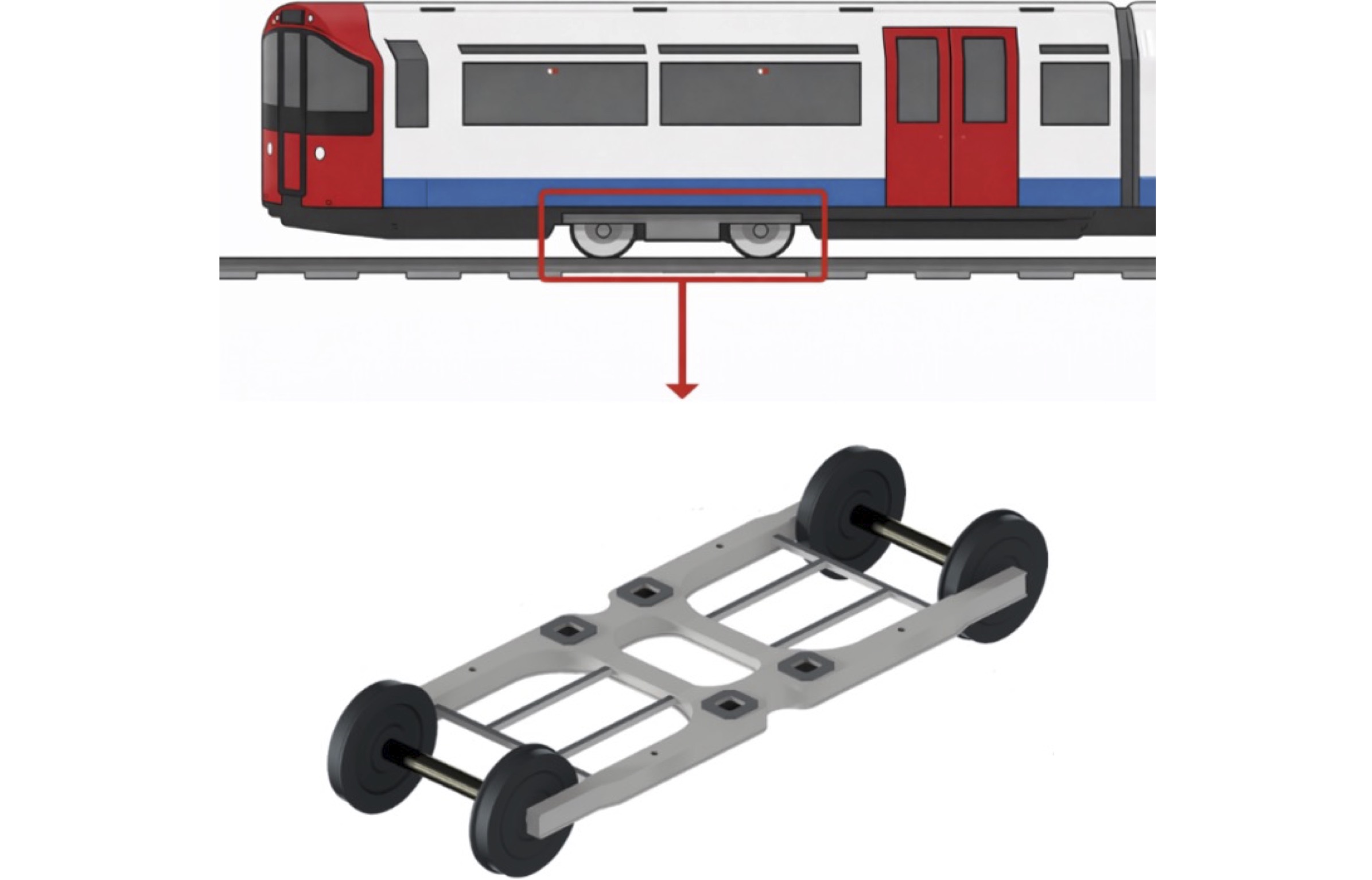
Mechanistic Influence of Wheelset Bracket Orientation on Load Transfer and Structural Efficiency of Railway Bogie Frames Using FEM
DOI:
https://doi.org/10.46604/aiti.2026.16257Keywords:
finite element analysis, railway bogie frame, wheelset bracket orientation, structural responseAbstract
This study investigates the influence of wheelset bracket orientation on the load transfer mechanism and structural performance of railway bogie frames using finite element analysis. Three configurations, namely vertical, horizontal, and cross orientations, were modeled and evaluated in ANSYS Workbench under identical material properties, boundary conditions, and loading scenarios. Static, dynamic, and impact loading conditions were considered to assess stress, deformation, and structural safety. The results show that bracket orientation significantly affects load distribution and structural response. Among the investigated configurations, the horizontal orientation exhibits the most favorable performance, characterized by lower stress concentration, reduced deformation, higher stiffness, and improved safety margins. In contrast, the vertical orientation demonstrates the most critical response and operates closer to the material yield limit. These findings confirm that wheelset bracket orientation is an important design parameter influencing the reliability, durability, and structural efficiency of railway bogie frames.
References
Z. KNikšić D. Pavković, M. Cipek, M. Trstenjak, T. J. Mlinarić, and M. Nikšić, “An Overview of Current Challenges and Emerging Technologies to Facilitate Increased Energy Efficiency, Safety, and Sustainability of Railway Transport,” Future Internet, vol. 15, no. 11, article no. 347, 2023.
C. Bragança, E. F. Souza, D. Ribeiro, A. Meixedo, T. N. Bittencourt, and H. Carvalho “Drive-by Methodologies Applied to Railway Infrastructure Subsystems: A Literature Review-Part II: Track and Vehicle,” Applied Sciences, vol. 13, no. 12, article no. 6982, 2023.
M. M. Islam, M. S. Hossain, M. R. Islam, and M. A. Hossain, “Improving Reliability and Stability of Power Systems: A Comprehensive Review on the Role of Energy Storage Systems to Enhance Flexibility,” IEEE Access, vol. 12, pp. 152738-152765, 2024.
Y. Wu and Z. Ren, “Fatigue Damage Assessment of a Metro Vehicle Bogie Frame Based on Measured Field Load,” Machines, vol. 13, no. 4, article no. 306, 2025.
G. Papaioannou, C. Shen, M. Rothhämel, and R. Happee, “Occupants Comfort: What About Human Body Dynamics in Road and Rail Vehicles?,” Vehicle Mechanics and Mobility, vol. 63, no. 7, pp. 1242-1245, 2025.
K. Holenko, O. Dykha, E. Koda, I. Kernytskyy, O. Horbay, Y. Royko, et al., “Structure and Strength Optimization of the Bogdan ERCV27 Electric Garbage Truck Spatial Frame Under Static Loading,” Applied Sciences, vol. 14, no. 23, article no. 11012, 2024.
M. Xie, Y. Wei, Q. Xin, L. Li, and Y. He, “Fatigue Resistance of Fillet Welds of Traction Rod Brackets on a Locomotive Bogie Based on International Union of Railways Standards and Improvement Measures Adopted,” Applied Sciences, vol. 13, no. 9, article no. 5494, 2023.
T. J. Dang, Z. Liu, P. Masarati, M. Morandini, L. J. Ma, and X. W. Zhou, “Multibody Dynamics Modeling and Simulation of Supersonic Flexible Rocket Sled-Track Systems,” American Institute of Aeronautics and Astronautics Journal, vol. 63, no. 7, pp. 2847-2869, 2025.
A. Cascino, E. Meli, and A. Rindi, “Development of a Design Procedure Combining Topological Optimization and a Multibody Environment: Application to a Tram Motor Bogie Frame,” Vehicles, vol. 6, no. 4, pp. 1843-1856, 2024.
A. Ortiz-Marqués, P. Caldevilla, E. Goldmann, M. Safuta, M. Fernández-Raga, and M. Górski, “Porosity and Permeability in Construction Materials as Key Parameters for Their Durability and Performance: A Review,” Buildings, vol. 15, no. 18, article no. 3422, 2025.
I. A. Najar, R. Ahmadi, A. G. Amuda, R. Mourad, N. El Bendary, I. Ismail, et al., “Advancing Soil-Structure Interaction (SSI): A Comprehensive Review of Current Practices, Challenges, and Future Directions,” Journal of Infrastructure Preservation and Resilience, vol. 6, article no. 5, 2025.
S. K. Shil, “Petroleum Storage Tank Design and Inspection Using Finite Element Analysis Model for Ensuring,” Review of Applied Science and Technology, vol. 3, no. 4, pp. 94-127, 2024.
F. Guo, S. Wu, J. Liu, X. Wu, and W. Zhang, “An Innovative Stepwise Time-Domain Fatigue Methodology to Integrate Damage Tolerance into System Dynamics,” Vehicle Mechanics and Mobility, vol. 61, no. 2, pp. 550-572, 2023.
A. Yusufov, O. Khamidov, and N. Zayniddinov, “Prediction of the Stress - Strain State of the Bogie Frames of Shunting Locomotives using the Finite Element Method,” E3S Web of Conferences, vol. 401, article no. 03041, 2023.
C. Pany, “Vibration Analysis of Curved Panels and Shell Using Approximate Methods and Determination of Optimum Periodic Angle,” Advances in Mechanical and Power Engineering, pp. 354-365, 2023.
K. Shabla and C. Pany, “Finite Element Structural Analysis of Simply Supported Solid and Stiffened Plates: A Comparative Study,” Mechanical Engineering Advances, vol. 3, no. 1, article no. 1405, 2024.
C. Pany, “Cylindrical Shell Pressure Vessel Profile Variation Footprint in Strain Comparison of Test Data with Numerical Analysis,” Liquid and Gaseous Energy Resources, vol. 1, no. 2, pp. 91-101, 2021.
M. A. Sayeed and M. A. Shahin, “Dynamic Response Analysis of Ballasted Railway Track–Ground System under Train Moving Loads using 3D Finite Element Numerical Modelling,” Transportation Infrastructure Geotechnology, vol. 10, pp. 639-659, 2023.
M. Eghlimi, P. Memarzadeh, E. I. Z. Abadi, and P. Javadi, “An Innovative Two-Level Yielding Knee-Braced Frame with Deformation-Controlled Ring Damper,” Case Studies in Construction Materials, vol. 21, article no. e03856, 2024.
L. Gao, Y. Zhang, Y. Liu, Z. Wang, and X. Ji, “Study on the Cracking Behavior of Asphalt Mixture by Discrete Element Modeling with Real Aggregate Morphology,” Construction and Building Materials, vol. 368, article no. 130406, 2023.
M. J. Hörmann, "Topology Optimization of an Electric Powertrain Suspension Bracket," Master degree, Department of Engineering Mechanics, KTH Royal Institute of Technology, Stockholm, Sweeden, 2023.
K. Yelemessov, D. Baskanbayeva, N. V Martyushev, V. Y. Skeeba, V. E. Gozbenko, and A. I. Karlina, “Change in the Properties of Rail Steels during Operation and Reutilization of Rails,” Metals, vol. 13, no. 6, article no. 1043, 2023.
Y. Huang and J. Jiang, “A Critical Review of von Mises Criterion for Compatible Deformation of Polycrystalline Materials,” Crystals, vol. 13, no. 2, article no. 244, 2023.
R. G. Shang, S. Y. Xie, L. Q. Liao, G. Z. Qin, X. Y. Zhu, Z. H. Wang, et al., “Development, Validation, and Biomechanical Evaluation of a High-Fidelity Finite Element Model of the Forearm Musculoskeletal System,” BMC Musculoskeletal Disorders, vol. 27, article no. 223, 2026.
T. A. Burkhart, D. M. Andrews, and C. E. Dunning, “Finite Element Modeling Mesh Quality, Energy Balance and Validation Methods: A Review with Recommendations Associated with the Modeling of Bone Tissue,” Journal of Biomechanics, vol. 46, no. 9, pp. 1477-1488, 2013.
D. Oldoini, S. G. Barbieri, G. Devito, M. Giacopini, and M. Galea, “Effects of an Optimized Adhesive Distribution on Stresses and Strains in the Rotor and Magnets of a Surface Permanent-Magnet Synchronous Electric Motor,” Applied Sciences, vol. 15, no. 24, article no. 13179, 2025.
X. Liu, Q. Wang, Y. Wang, and Q. Dong, “Review of Calibration Strategies for Discrete Element Model in Quasi‑Static Elastic Deformation,” Scientific Reports, vol. 13, no. 1, article no. 13264, 2023.
S. Raghavendra, M. Dallago, F. Zanini, S. Carmignato, F. Berto, and M. Benedetti, “A Probabilistic Average Strain Energy Density Approach to Assess the Fatigue Strength of Additively Manufactured Cellular Lattice Materials,” International Journal of Fatigue, vol. 172, article no. 107601, 2023.
C. K. Park, C. T. Wu, and C. D. Kan, “On the Analysis of Dispersion Property and stable time step in Meshfree Method using the Generalized Meshfree Approximation,” Finite Elements in Analysis and Design, vol. 47, no. 7, pp. 683-697, 2011.
Ö. Kırmalı, N. Türker, T. Akar, and B. Yılmaz, “Finite Element Analysis of Stress Distribution in Autotransplanted Molars,” Journal of Dentistry, vol. 119, article no. 104082, 2022.
Published
Issue
Section
License
Copyright (c) 2026 Ryan, Fauzan, Irkham, Tim; Mufid

This work is licensed under a Creative Commons Attribution-NonCommercial 4.0 International License.
Submission of a manuscript implies: that the work described has not been published before that it is not under consideration for publication elsewhere; that if and when the manuscript is accepted for publication. Authors can retain copyright in their articles with no restrictions. is accepted for publication. Authors can retain copyright of their article with no restrictions.

Since Jan. 01, 2019, AITI will publish new articles with Creative Commons Attribution Non-Commercial License, under The Creative Commons Attribution Non-Commercial 4.0 International (CC BY-NC 4.0) License.
The Creative Commons Attribution Non-Commercial (CC-BY-NC) License permits use, distribution and reproduction in any medium, provided the original work is properly cited and is not used for commercial purposes.
How to Cite