
Studying the Effect of Stiffener Configurations on the Structural Response of Hopper Wagon Using Finite Element Analysis
DOI:
https://doi.org/10.46604/aiti.2026.16309Keywords:
hopper wagon, stiffener configuration, finite element analysis, multi-compartment loading, structural responseAbstract
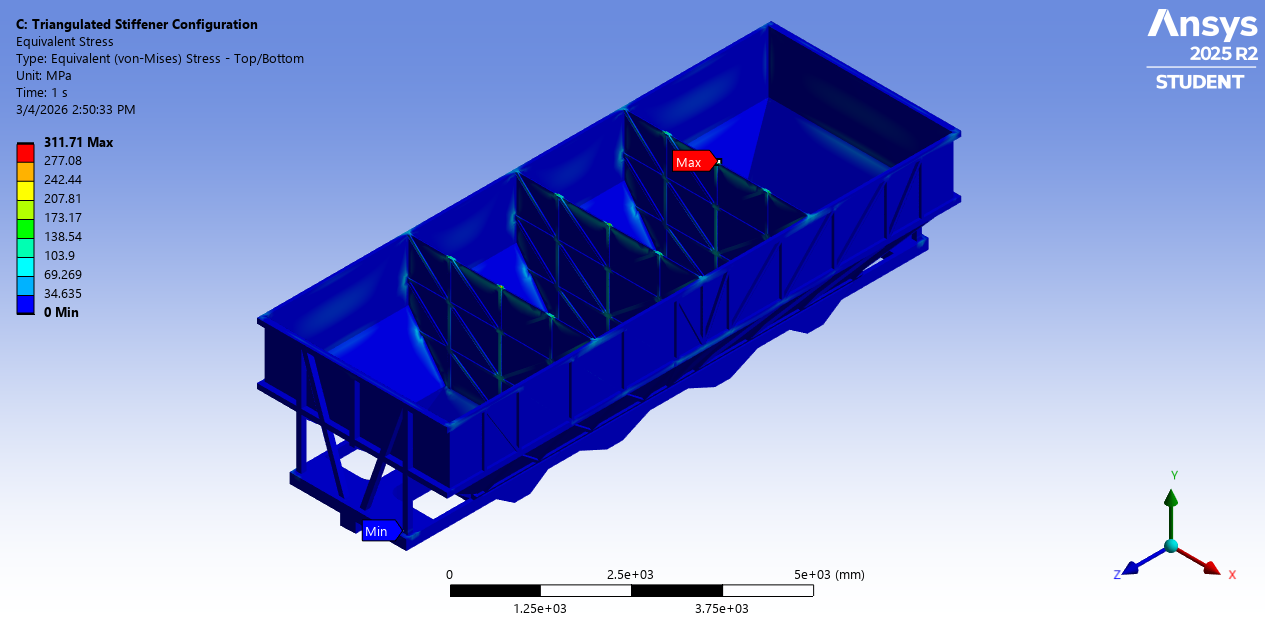
Hopper wagons are subjected to complex loading conditions during granular material transportation. This study aims to evaluate the effect of stiffener configurations on the structural response of a hopper wagon using finite-element analysis under multi-compartment loading conditions. Three configurations are analyzed: vertical, rectangular, and triangulated stiffeners, with a non-uniform distribution of granular material to reflect real-world operating conditions. The results show that the triangulated configuration exhibits the lowest average deformation (15.466 mm) and a more uniform stress distribution. The vertical configuration yields the lowest maximum stress and the highest safety factor, but is less effective at controlling global deformation. Conversely, the rectangular configuration increases structural stiffness but produces stresses close to the material’s yield limit. The analysis also indicates that the most critical loading conditions do not always occur under full loading. Overall, the triangulated configuration provides the best balance among stiffness, stability, and structural safety across various loading conditions.
References
H. Huang, Y. Zhang, D. Wang, Z. Fu, H. Tian, J. Shang, et al., “Study the Flow Capacity of Cylindrical Pellets in Hopper with Unloading Paddle Using DEM,” Agriculture, vol. 14, no. 4, article no. 523, 2024.
P. Chen, T. Huang, B. Wu, H. Qian, F. Xie, B. Liu, et al., “Modeling the Discharge Rate of a Screw Conveyor Considering Hopper–Conveyor Coupling Parameters,” Agriculture, vol. 14, no. 7, article no. 1203, 2024.
X. Bi, N. Zhao, M. Guo, W. Zhang, F. Zhou, W. Xie, et al., “Synergistic Redox and Adsorption for Enhanced Roxarsone Removal: Heterogeneous Fenton-Like Reaction with a Novel Composite of Nanoscale Zero-Valent Iron Supported on γ-Aluminum Oxide,” Chemical Engineering Science, vol. 287, no. 5, article no. 119713, 2024.
N. Nikolopoulos, E. Kordouli, L. Sygellou, K. Bourikas, C. Kordulis, and A. Lycourghiotis, “Mo Promoted Ni-ZrO₂ CO-Precipitated Catalysts for Green Diesel Production,” Chemical Engineering Science, vol. 270, no. 3, article no. 118540, 2023.
Y. Zhou, T. Wang, and J. Zhu, “Development of Gas-Solid Fluidization: Particulate and Aggregative,” Powder Technology, vol. 421, article no. 118420, 2023.
Y. Deng, H. Jiang, and Y. Ren, “Low-Velocity Impact Resistance Behaviors of Bionic Double-Helicoidal Composite Laminates,” International Journal of Mechanical Sciences, vol. 248, article no. 108248, 2023.
Y. Ichiyanagi, Y. Michitsuji, A. Matsumoto, Y. Sato, H. Ohno, S. Ogata, et al., “Simulation-Based Estimation of Wheel/Rail Friction Coefficient and Wear Number Considering Results of Full-Scale Roller-Rig Test,” Mechanical Engineering Journal, vol. 10, no. 3, pp. 1-11, 2023.
Q. Ye, Q. Luo, G. Feng, T. Wang, and H. Xie, “Stress Distribution in Roadbeds of Slab Tracks with Longitudinal Discontinuities,” Railway Engineering Science, vol. 31, no. 1, pp. 61-74, 2023.
J. D. Pozo, M. A. Hube, and Y. C. Kurama, “Quantification of Variability in Simulated Seismic Performance of RC Wall Buildings,” Engineering Structures, vol. 295, article no. 116872, 2023.
Z. Li, J. Fan, J. Xu, G. Feng, W. Guo, J. Cui, et al., “Experimental and Simulation Research on Rupture Behavior of Coal-Based Solid Waste Material Backfilling Column under Non-uniformly Distributed Load with Different Loading Ratios,” Case Studies in Construction Materials, vol. 20, no. 7, article no. e03125, 2024.
I. V. Kotov, R. Yu. Litvinov, A. V. Nefedov, and O. N. Chicheneva, “Vibrating Device for the Collapse of Bulk Materials in the Hoppers of the Sintering Shop,” CIS Iron and Steel Review, vol. 29, pp. 33-36, 2025.
D. E, B. Zhao, J. Cui, Z. Zhou, W. Sun, Y. Qiu, et al., “DEM Study on the Optimization of Asymmetric Hopper Configurations,” Powder Technology, vol. 473, article no. 122224, 2026.
Y. Song, Q. Lin, and J. Chen, “Research Progress on Curved Plates in China: Mechanical Analysis Methods and Load-Bearing Behaviours,” Structures, vol. 39, pp. 793-807, 2022.
E. Sabbioni, M. Carboni, D. Tarsitano, and S. Bruni, “Crack Detection in Railway Axles Using Continuous Monitoring and Periodic Non-destructive Inspection: Experimental Investigation on a Freight Wagon Using a Full-Scale Roller Rig,” Structural Health Monitoring, vol. 24, no. 6, pp. 3487-3502, 2025.
J. Lv, “Analysis of Dynamic Response Characteristics of Vehicle-Mounted Tank based on the Finite Element Method,” Journal of Vibroengineering, vol. 28, no. 1, pp. 143-159, 2026.
Q. Xiao, M. Zhang, D. Chen, X. Wang, and C. Lei, “The Operational Performance and Fatigue Life Analysis of Internal Suspension Bogie,” Journal of the Brazilian Society of Mechanical Sciences and Engineering, vol. 47, no. 12, article no. 634, 2025.
P. W. Cleary and M. L. Sawley, “DEM Modelling of Industrial Granular Flows: 3D Case Studies and the Effect of Particle Shape on Hopper Discharge,” Applied Mathematical Modelling, vol. 26, no. 2, pp. 89-111, 2002.
G. Dyck, A. Rogers, and J. Paliwal, “A Review of Analytical Methods for Calculating Static Pressures in Bulk Solids Storage Structures,” KONA Powder and Particle Journal, vol. 41, pp. 108-122, 2024.
E. Eidin, T. Bielik, I. Touitou, J. Bowers, C. McIntyre, D. Damelin, et al., “Thinking in Terms of Change Over Time: Opportunities and Challenges of Using System Dynamics Models,” Journal of Science Education and Technology, vol. 33, no. 1, pp. 1-28, 2024.
G. Vatulia, J. Gerlici, O. Fomin, A. Lovska, Y. Fomina, and K. Kravchenko, “Analysis of the Strength of the Supporting Structure of a TwoSection Hopper Wagon under Operating Loading Conditions,” Applied Sciences, vol. 13, no. 2, article no. 859, 2023.
S. Panchenko, J. Gerlici, A. Lovska, V. Ravlyuk, J. Dižo, and J. Harušinec, “Study on the Strength of the Brake Pad of a Freight Wagon under Uneven Loading in Operation,” Sensors, vol. 24, no. 2, article no. 463, 2024.
K. Sookchanchai, S. Joonjitdumrong, and V. Uthaisangsuk, “Structural Assessment of Flat Waggon Underframe for Freight Rail by Experiments and FE Analyses,” Australian Journal of Mechanical Engineering, vol. 24, no. 1, pp. 127-156, 2026.
A. Scherbakov, M. Aleksandrovskiy, D. Shavelkin, and N. Verbova, “Method for Obtaining Structures with a Given Degree of Dispersion in Low-Carbon and Low-Alloy Steels of Transport and Handling Equipment,” in Networked Control Systems for Connected and Automated Vehicles, Cham: Springer, pp. 1253-1264, 2023.
A. Teter and Z. Kolakowski, “Interactive Buckling of Wide Plates Made of Functionally Graded Materials with Rectangular Stiffeners,” Thin-Walled Structures, vol. 171, article no. 108750, 2022.
C. Chen, S. Li, J. Li, L. Zhang, and J. Yang, “Influence of Ballast Gradation on Repose Angle Using Large-Scale Hopper Flow Tests and DEM Simulation,” Powder Technology, vol. 456, article no. 120852, 2025.
S. Zhang, G. Yang, and X. Zhang, “Effect of Boundaries on Flow Behavior of Granular Material in a Hopper,” Powder Technology, vol. 466, article no. 121505, 2025.
U. Ulusoy, “A Review of Particle Shape Effects on Material Properties for Various Engineering Applications: From Macro to Nanoscale,” Minerals, vol. 13, no. 1, article no. 91, 2023.
Published
Issue
Section
License
Copyright (c) 2026 Rafif Ibnu Ardiansyah, Achmad Fauzan Hery Soegiharto, Mohamad Irkham Mamungkas; Abi Mufid Octavio

This work is licensed under a Creative Commons Attribution-NonCommercial 4.0 International License.
Submission of a manuscript implies: that the work described has not been published before that it is not under consideration for publication elsewhere; that if and when the manuscript is accepted for publication. Authors can retain copyright in their articles with no restrictions. is accepted for publication. Authors can retain copyright of their article with no restrictions.

Since Jan. 01, 2019, AITI will publish new articles with Creative Commons Attribution Non-Commercial License, under The Creative Commons Attribution Non-Commercial 4.0 International (CC BY-NC 4.0) License.
The Creative Commons Attribution Non-Commercial (CC-BY-NC) License permits use, distribution and reproduction in any medium, provided the original work is properly cited and is not used for commercial purposes.
How to Cite