
Local-Attention-Based Multilayer Long Short-Term Memory Model for Seismic Response Prediction: A Gantry Crane Case Study
DOI:
https://doi.org/10.46604/ijeti.2026.16408Keywords:
local attention, LSTM, seismic response prediction, gantry crane, incremental dynamic analysisAbstract
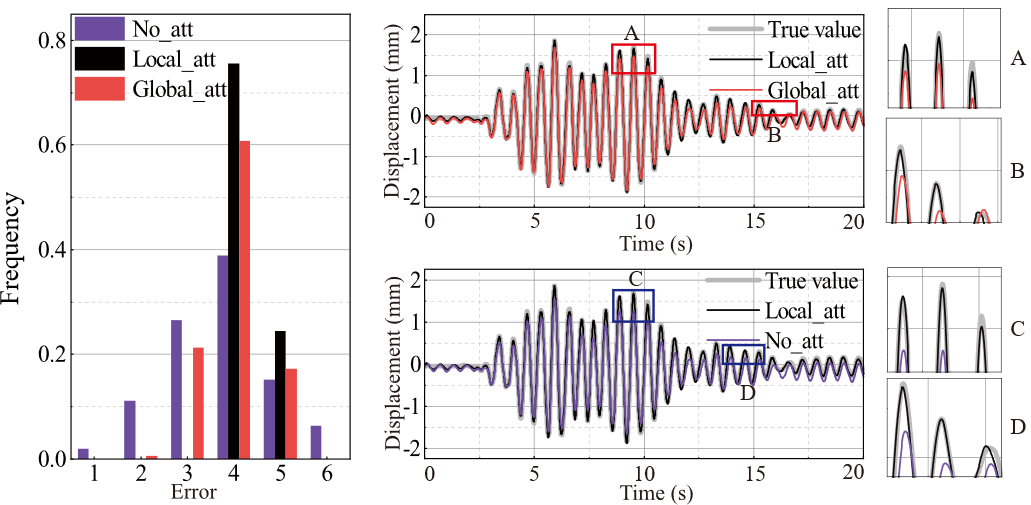
This study aims to develop a local-attention-based multilayer long short-term memory (LSTM) surrogate model for predicting the simulated horizontal displacement response of a gantry crane. The database is generated through incremental dynamic analysis using 100 ground-motion records scaled to 14 peak ground acceleration levels. To isolate the effect of attention scope, no-attention, global-attention, and local-attention configurations use the same LSTM backbone, data partitions, and training protocol. The local-attention mechanism reweights current and recent temporal representations while the recurrent states retain accumulated dynamic information. Across the investigated sample sizes, the local-attention model achieves the lowest minimum RMSE, more concentrated signed-error distributions, and a maximum test-set R² of 0.983, approximately 0.04 higher than the baselines in selected smaller-sample settings. Response histories show closer agreement around several peaks and rapidly varying segments. The two attention layers exhibit distinct but complementary allocation patterns, improving feature-processing transparency within the investigated gantry-crane and multi-intensity IDA framework.
References
X. Lu, L. Xie, H. Guan, Y. Huang, and X. Lu, “A Shear Wall Element for Nonlinear Seismic Analysis of Super-Tall Buildings Using OpenSees,” Finite Elements in Analysis and Design, vol. 98, pp. 14-25, 2015.
S.-Y. Zhai, Y.-F. Lyu, K. Cao, G.-Q. Li, W.-Y. Wang, and C. Chen, “Seismic Behavior of an Innovative Bolted Connection with Dual-Slot Hole for Modular Steel Buildings,” Engineering Structures, vol. 279, article no. 115619, 2023.
S. Mangalathu, H. Jang, S.-H. Hwang, and J.-S. Jeon, “Data-Driven Machine-Learning-Based Seismic Failure Mode Identification of Reinforced Concrete Shear Walls,” Engineering Structures, vol. 208, article no. 110331, 2020.
H. Jia, L. Ma, B. Jiang, Y. Zhai, Y. Li, and S. Zheng, “Life-Cycle Fragility Analysis of Near-Fault Simply Supported and T-Shaped Girder Bridges Considering Corrosion of Piers,” Structures, vol. 86, article no. 111477, 2026.
H. Jia, J. Hou, H. Bai, Z. Xu, K. Jia, and S. Zheng, “Coupled Effects of Corrosion and Fault-Crossing Ground Motions on Continuous Rigid Frame Bridges: Nonlinear Dynamic Response and Failure Mechanisms,” Steel and Composite Structures, vol. 59, no. 5, pp. 609-629, 2026.
Q. Peng, W. Cheng, H. Jia, and P. Guo, “Fragility Analysis of Gantry Crane Subjected to Near-Field Ground Motions,” Applied Sciences, vol. 10, no. 12, article no. 4219, 2020.
Q. Peng, W. Cheng, H. Jia, D. Guo, G. You, and C. Zhang, “Seismic Analysis of Uplift-Available Gantry Crane Subjected to Extreme Earthquake Loads,” Revista Internacional de Métodos Numéricos para Cálculo y Diseño en Ingeniería, vol. 37, no. 3, article no. 33, 2021.
Q. Peng, W. Cheng, P. Guo, and H. Jia, “Assessing Seismic Performance of Gantry Crane Subjected to Near-Field Ground Motions Using Incremental Dynamic and Endurance Time Analysis Methods,” Shock and Vibration, vol. 2022, no. 1, article no. 6624530, 2022.
H. Jia, Z. Liu, L. Xu, H. Bai, K. Bi, C. Zhang, et al., “Dynamic Response Analyses of Long-Span Cable-Stayed Bridges Subjected to Pulse-Type Ground Motions,” Soil Dynamics and Earthquake Engineering, vol. 164, article no. 107591, 2023.
H. Jia, W. Wu, L. Xu, Y. Zhou, S. Zheng, and C. Zhao, “Numerical Simulation and Damaged Analysis of a Simply-Supported Beam Bridge Crossing Potential Active Fault,” Engineering Structures, vol. 301, article no. 117283, 2024.
H. Jia, S. Chen, D. Guo, S. Zheng, and C. Zhao, “Track-Bridge Deformation Relation and Interaction of Long-Span Railway Suspension Bridges Subject to Strike-Slip Faulting,” Engineering Structures, vol. 300, article no. 117216, 2024.
N. G. Wariyatno, A. L. Han, Y. Haryanto, G. H. Sudibyo, Sumiyanto, Nastain, et al., “Formulating Seismic Intensity Scale (JMA-SIS) Using Response Spectrum: A New Approach for Structural Engineering Design,” Advances in Technology Innovation, vol. 10, no. 2, pp. 157-173, 2025.
Y. Hu, H. H. Tsang, N. Lam, and E. Lumantarna, “Physics-Informed Neural Networks for Enhancing Structural Seismic Response Prediction with Pseudo-Labelling,” Archives of Civil and Mechanical Engineering, vol. 24, no. 1, article no. 7, 2024.
Q. Peng, W. Cheng, H. Jia, P. Guo, and K. Jia, “Rapid Seismic Damage Assessment Using Machine Learning Methods: Application to a Gantry Crane,” Structure and Infrastructure Engineering, vol. 19, no. 6, pp. 779-792, 2023.
E. A. Moscoso Alcantara, M. D. Bong, and T. Saito, “Structural Response Prediction for Damage Identification Using Wavelet Spectra in Convolutional Neural Network,” Sensors, vol. 21, no. 20, article no. 6795, 2021.
Q. Peng, X. Wen, H. Jia, Y. Pan, X. Gu, C. Yin, et al., “A Novel Sensor-Independent Convolutional Neural Network for Structural Damage Detection: Illustrated by a Case Study on Gantry Crane,” Structures, vol. 71, article no. 107971, 2025.
H. S. Park, S. H. Yoo, D. Y. Yun, and B. K. Oh, “Investigation on Employment of Time and Frequency Domain Data for Predicting Nonlinear Seismic Responses of Structures,” Structures, vol. 61, article no. 105996, 2024.
F. Guo, Y. Dong, H. Tian, X. Zhang, and Q. Su, “Structural Seismic Response Prediction Based on Convolutional Neural Networks,” Vibroengineering Procedia, vol. 51, pp. 56-62, 2023.
H. Zhao, B. Wei, P. Zhang, P. Guo, Z. Shao, S. Xu, et al., “Safety Analysis of High-Speed Trains on Bridges under Earthquakes Using a LSTM-RNN-Based Surrogate Model,” Computers & Structures, vol. 294, article no. 107274, 2024.
Y. Shen, G. Ma, H. J. Hwang, D. J. Kim, and Z. Zhang, “Prediction of Seismic Response of Building Structures Using a CNN-LSTM-ATT Network with Transfer Learning,” Advances in Structural Engineering, vol. 28, no. 14, pp. 2710-2725, 2025.
X. Zhang, X. Xie, S. Tang, H. Zhao, X. Shi, L. Wang, et al., “High-Speed Railway Seismic Response Prediction Using CNN-LSTM Hybrid Neural Network,” Journal of Civil Structural Health Monitoring, vol. 14, no. 5, pp. 1125-1139, 2024.
Y. Liao, R. Lin, R. Zhang, and G. Wu, “Attention-Based LSTM (AttLSTM) Neural Network for Seismic Response Modeling of Bridges,” Computers & Structures, vol. 275, article no. 106915, 2023.
T. Saida and M. Nishio, “ExSRNet: Explainable Deep Learning Model for Seismic Response Prediction with Frequency Attention Mechanism,” Engineering Structures, vol. 343, part A, article no. 120953, 2025.
W. J. Tang, D. S. Wang, H. B. Huang, J. C. Dai, and F. Shi, “A Pre-Trained Deep Learning Model for Fast Online Prediction of Structural Seismic Responses,” International Journal of Structural Stability and Dynamics, vol. 24, no. 14, article no. 2450160, 2024.
Downloads
Published
Issue
Section
License
Copyright (c) 2026 Qihui Peng, Shihao Hu, Hongyu Jia, Hui Wang

This work is licensed under a Creative Commons Attribution-NonCommercial 4.0 International License.
Copyright Notice
Submission of a manuscript implies: that the work described has not been published before that it is not under consideration for publication elsewhere; that if and when the manuscript is accepted for publication. Authors can retain copyright in their articles with no restrictions. Also, author can post the final, peer-reviewed manuscript version (postprint) to any repository or website.

Since Jan. 01, 2019, IJETI will publish new articles with Creative Commons Attribution Non-Commercial License, under Creative Commons Attribution Non-Commercial 4.0 International (CC BY-NC 4.0) License.
The Creative Commons Attribution Non-Commercial (CC-BY-NC) License permits use, distribution and reproduction in any medium, provided the original work is properly cited and is not used for commercial purposes.
How to Cite





.jpg)