Leak Localization and Orifice Diameter Estimation in Coal Mine Gas Drainage Pipelines Using a Physics-Informed Dual-Stream Decoupling Network
DOI:
https://doi.org/10.46604/ijeti.2026.16761Keywords:
Coal mine gas drainage pipeline, leak localization, orifice diameter estimation, physics-informed learning, temporal attentionAbstract
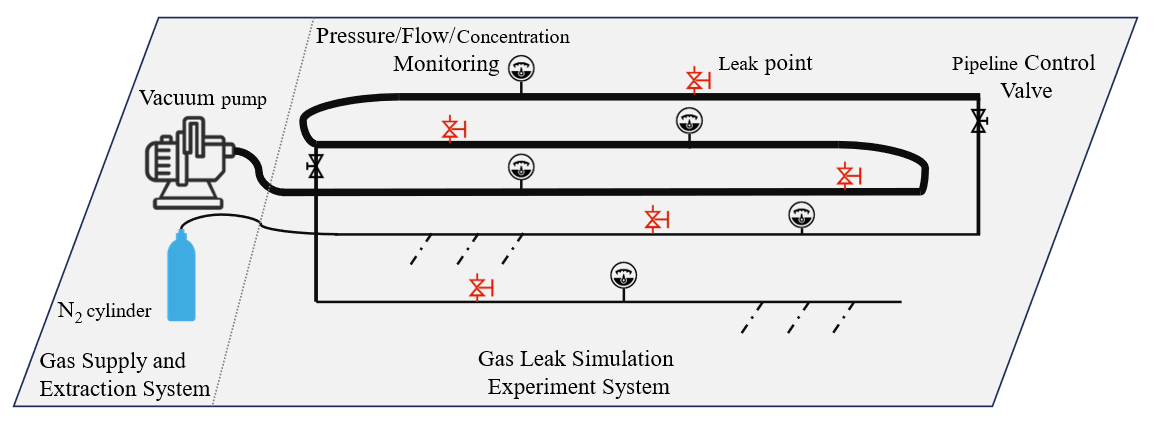
Leak localization and orifice diameter estimation involve different spatiotemporal scales, complicating joint prediction. This study aims to improve both tasks by constructing a multi-condition dataset from pressure, flow rate, and oxygen concentration signals and proposing a physics-informed dual-stream decoupling network (PI-DSDN). Its transient localization branch extracts multiscale pressure disturbances and uses a pressure-gradient energy mask to focus temporal attention on leakage transients. Its steady-state sizing branch decouples fast and slow variables and uses a macroscopic flow-rate difference to characterize post-leakage redistribution. On the test set, PI-DSDN achieves R² values of 0.9754 for localization and 0.9566 for sizing, with MAEs of 0.283 m and 0.0736 mm and RMSEs of 0.445 m and 0.1129 mm, respectively. Compared with CNN-LSTM, PI-DSDN reduces the localization and sizing MAEs by 45.2% and 45.1%, respectively. Ablation and attention analyses confirm that the physical priors selectively enhance transient localization and steady-state sizing, supporting more interpretable leak assessment.
References
L. Wang, Y. Sun, S. Zheng, L. Shu, and X. Zhang, “How Efficient Coal Mine Methane Control Can Benefit Carbon-Neutral Target: Evidence from China,” Journal of Cleaner Production, vol. 424, article no. 138895, 2023.
J. Sekhavati, S. H. Hashemabadi, and M. Soroush, “Computational Methods for Pipeline Leakage Detection and Localization: A Review and Comparative Study,” Journal of Loss Prevention in the Process Industries, vol. 77, article no. 104771, 2022.
H. Zhang, M. Shen, Z. Huo, Y. Zhang, L. Shu, and Y. Li, “Research on Gas Drainage Pipeline Leakage Detection and Localization Based on the Pressure Gradient Method,” Processes, vol. 12, no. 8, article no. 1590, 2024.
R. Xiao and J. Li, “Evaluation of Acoustic Techniques for Leak Detection in a Complex Low-Pressure Gas Pipeline Network,” Engineering Failure Analysis, vol. 143, part A, article no. 106897, 2023.
W. Gan, Y. Zhang, S. Jia, R. Luo, J. Tang, and C. Zhang, “UWFBG Array Vibration Sensing Technology for Gas Pipeline Leakage Detection and Location,” Optics Communications, vol. 560, article no. 130414, 2024.
R. Ma, J. Liu, W. Wu, Y. Yang, X. Liu, S. Zhang, et al., “Minor Pipeline Leak Detection and Localization Using Explainable Deep Learning with Fusion of Distributed Fiber-Optic Vibration and Temperature Signals,” Journal of Loss Prevention in the Process Industries, vol. 100, article no. 105844, 2026.
Z. Zuo, L. Ma, S. Liang, J. Liang, H. Zhang, and T. Liu, “A Semi-Supervised Leakage Detection Method Driven by Multivariate Time Series for Natural Gas Gathering Pipeline,” Process Safety and Environmental Protection, vol. 164, pp. 468–478, 2022.
J. Zhou, H. Lin, S. Li, H. Jin, B. Zhao, and S. Liu, “Leakage Diagnosis and Localization of the Gas Extraction Pipeline Based on SA-PSO BP Neural Network,” Reliability Engineering & System Safety, vol. 232, article no. 109051, 2023.
J. Zhou, W. Zhang, J. Zhao, J. Ge, W. Li, and J. Liu, “Research on Multi-Source Collaborative Leakage Location Method for Coal Mine Gas Extraction Pipeline Based on Stacking Integration Learning,” Processes, vol. 14, no. 12, article no. 1908, 2026.
X. Zhang, J. Shi, M. Yang, X. Huang, A. S. Usmani, G. Chen, et al., “Real-Time Pipeline Leak Detection and Localization Using an Attention-Based LSTM Approach,” Process Safety and Environmental Protection, vol. 174, pp. 460–472, 2023.
J. Liang, S. Liang, L. Ma, H. Zhang, J. Dai, and H. Zhou, “Leak Detection for Natural Gas Gathering Pipeline Using Spatio-Temporal Fusion of Practical Operation Data,” Engineering Applications of Artificial Intelligence, vol. 133, part D, article no. 108360, 2024.
P. Li, X. Wang, C. Jiang, H. Bi, Y. Liu, W. Yan, et al., “Advanced Transformer Model for Simultaneous Leakage Aperture Recognition and Localization in Gas Pipelines,” Reliability Engineering & System Safety, vol. 241, article no. 109685, 2024.
C. Wu, H. Lu, D. Liu, C. Wang, J. Gan, and Z. Li, “Research on Gas Pipeline Leakage Prediction Model Based on Physics-Aware GL-TransLSTM,” Biomimetics, vol. 10, no. 11, article no. 743, 2025.
N. J. H. Keumoe, A. Singh, I. Srivastava, B. Shinganand, and D. M. Mahapatra, “Methane Leak Detection in Natural Gas Pipelines and City Gate Stations Using an AI/ML-Integrated Simulation Framework,” Hydrogen Economy & Engineering, article no. 100010, 2026.
Q. Jing, X. Song, B. Sun, Y. Li, and L. Zhang, “Efficient Estimation of Natural Gas Leakage Source Terms Using Physical Information and Improved Particle Filtering,” Reliability Engineering & System Safety, vol. 260, article no. 110989, 2025.
K. R. Rahman, A. Khandakar, A. Barooah, M. A. Ayari, and M. A. Rahman, “Multiphase System Leak Detection, Localization, and Dimension Estimation Using Multi-Head Physics-Informed Neural Network,” Process Safety and Environmental Protection, vol. 211, article no. 108532, 2026.
O. M. Ibrahim, J. Shin, R. Sikka, P. M. Hansen, and K. Vaagsaether, “Experimental Study on Hydrogen Pipeline Leakage: Negative Pressure Wave Characteristics and Inline Detection Method,” Journal of Loss Prevention in the Process Industries, vol. 92, article no. 105452, 2024.
Y. Wang, W. Liu, Q. Zhang, L. Feng, and W. Liu, “Gas Pipeline Leakage Detection and Localization Method Based on VMD-DTW,” Flow Measurement and Instrumentation, vol. 102, article no. 102820, 2025.
J. Kim, S. Han, D. Kim, and Y. Lee, “Gas Pipeline Leak Detection by Integrating Dynamic Modeling and Machine Learning under the Transient State,” Energies, vol. 17, no. 21, article no. 5517, 2024.
B. Ayyildiz, M. Z. Sheriff, M. A. Rahman, A. Delgado, I. Hassan, H. Nounou, et al., “Research on Pinhole Accidental Gas Release in Pipelines: Statistical Modeling, Real Gas CFD Simulation, and Validation,” Process Safety and Environmental Protection, vol. 176, pp. 786–796, 2023.
A. Karpatne, G. Atluri, J. H. Faghmous, M. Steinbach, A. Banerjee, A. Ganguly, et al., “Theory-Guided Data Science: A New Paradigm for Scientific Discovery from Data,” IEEE Transactions on Knowledge and Data Engineering, vol. 29, no. 10, pp. 2318–2331, 2017.
A. Graves and J. Schmidhuber, “Framewise Phoneme Classification with Bidirectional LSTM and Other Neural Network Architectures,” Neural Networks, vol. 18, nos. 5-6, pp. 602–610, 2005.
D. Yan, G. Wang, J. Wang, L. Ren, and Z. Jia, “Pipeline Multi-Point Leakage Identification Based on Temporal Convolutional Network,” Flow Measurement and Instrumentation, vol. 106, article no. 102992, 2025.
G. E. Karniadakis, I. G. Kevrekidis, L. Lu, P. Perdikaris, S. Wang, and L. Yang, “Physics-Informed Machine Learning,” Nature Reviews Physics, vol. 3, no. 6, pp. 422–440, 2021.
R. Caruana, “Multitask Learning,” Machine Learning, vol. 28, no. 1, pp. 41–75, 1997.
W. Pei, T. Baltrušaitis, D. M. J. Tax, and L.-P. Morency, “Temporal Attention-Gated Model for Robust Sequence Classification,” Proceedings of the 2017 IEEE Conference on Computer Vision and Pattern Recognition (CVPR), pp. 820–829, 2017.
Downloads
Published
Issue
Section
License
Copyright (c) 2026 Weifeng Wang, Yu Zhang, Li Tang, Bin Liu, Yu Shao, Jie Dong, Zhangkun Chen

This work is licensed under a Creative Commons Attribution-NonCommercial 4.0 International License.
Copyright Notice
Submission of a manuscript implies: that the work described has not been published before that it is not under consideration for publication elsewhere; that if and when the manuscript is accepted for publication. Authors can retain copyright in their articles with no restrictions. Also, author can post the final, peer-reviewed manuscript version (postprint) to any repository or website.

Since Jan. 01, 2019, IJETI will publish new articles with Creative Commons Attribution Non-Commercial License, under Creative Commons Attribution Non-Commercial 4.0 International (CC BY-NC 4.0) License.
The Creative Commons Attribution Non-Commercial (CC-BY-NC) License permits use, distribution and reproduction in any medium, provided the original work is properly cited and is not used for commercial purposes.
How to Cite