
Detection and Classification of Floating Waste on Water Surfaces Using YOLO-Based Algorithms
DOI:
https://doi.org/10.46604/peti.2026.16023Keywords:
floating waste detection, image processing, object detection, YOLO, environmental monitoringAbstract
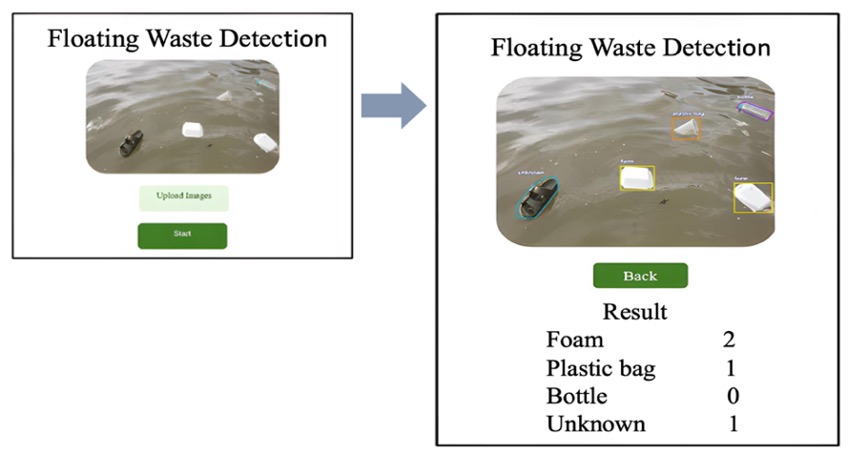
Floating waste on water surfaces is one of the causes in environmental pollution. Foam, plastics, and glass bottles are not readily biodegradable and adversely affect aquatic life. This research focuses on detecting, classifying, and counting non-biodegradable and hard-to-decompose waste floating on water surfaces using object detection techniques. Five classes of waste, cans, foam, plastic bags, plastic bottles, and miscellaneous items, are evaluated in this study. Detection and classification are performed by using six models-YOLOv5, YOLOv7, YOLOv8, YOLOv9, YOLOv10, and YOLOv11-which can identify overlapping objects. This study utilizes two datasets with varying resolutions, as well as two model sizes and two batch sizes. In the experimental evaluation, the YOLOv11 model outperforms the other models with a precision of 83% and mAP50 of 78%. Plastic bags and plastic bottles are classified more accurately by YOLOv11 than by YOLOv5, with improvements of 22% and 15%, respectively.
References
Y. Zheng, X. Nong, L. Chen, and D. Long, “A Novel Deep Learning-Based Floating Garbage Detection Approach and Its Effectiveness Evaluation in Environmentally Sustainable Development,” Journal of Environmental Management, vol. 38, pp. 125154, 2025.
A. Nahman, L. Haywood, and S. Oelofse, “The Economic Impact of Marine Plastic Debris in South Africa,” Marine Pollution Bulletin, vol. 212, pp. 117461, 2025.
S. Ashok, V. A. J. Venita, E. G. Shankari, M. Ranjana, and V. Prabhu, “Autonomous Watercraft for Cleanup of Floating Waste in Water Bodies Using YOLO,” Premier Journal of Science, vol 15, pp. 100144, 2025.
M. Liedermann, D. González-Fernández, F. Mendrik, L. Biermann, and T. H. van Emmerik, “Contributions to River Plastic Monitoring Across Scales, Volume II,” Frontiers in Earth Science, vol. 13, pp. 1636075, 2025.
J. P. Q. Tomas, J. E. E. Tupas, M. T. Soniel, C. H. M. E. Caruz, and D. B. Babar, “Real-Time Detection of Floating Debris in Waterways Using YOLOv8,” Proceedings of the 2024 14th International Workshop on Computer Science and Engineering (WCSE), Phuket Island, Thailand, pp. 19–21, 2024.
Y. Zhong, J. Wan, M. Cao, Z. Tan, Y. Qiu, L. Zhang, et al. “Lightweight Robust Detection of Anthropogenic Floating Debris in Turbid and Dynamic Aquatic Environments Via Enhanced Feature Fusion,” Scientific Reports, vol. 16, article no. 1373, 2025.
A. Konya and P. Nematzadeh, “Recent Applications of AI to Environmental Disciplines: A Review,” Science of The Total Environment, vol. 906, pp. 167705, 2024.
L.Jiao, F.Liu, S.Yang, Z. Feng, and R.Qu , “A Survey of Deep Learning-Based Object Detection,” Advances in Engineering Technology Research, vol. 7, pp. 128837-128868, 2019.
J. Meng, S. Shen, J. Wang, and C. Zhou “Object Detection Algorithms Based on Deep Learning: A Review,” Asian Journal of Research in Computer Science, vol. 17, no. 8, pp. 1-12, 2024.
B. Ganga, Lata B.T., and Venugopal K.R., “Object Detection and Crowd Analysis Using Deep Learning Techniques: Comprehensive Review and Future Directions,” Neurocomputing, vol. 597, article no. 127932, 2024.
Z. Q. Zhao, S.T.Xu, X.Wu, “Deep Learning Object Detection,” IEEE Transactions on Neural Networks and Learning Systems, vol. 30, pp. 3212–3231, 2019.
G. Pavithra, J. J. Jose, and T. A. Chandrappa, “Real-Time Color Classification of Objects from Video Streams,” Proceedings of The 2nd IEEE International Conference on Recent Trends in Electronics, Information & Communication Technology (RTEICT), IEEE Press, pp. 1683-1686, 2017.
B. Fan and X. Song, “A Review of Deep Learning Based Object Detection Algorithms,” Journal of Engineering Research and Reports, vol. 26, no. 11, pp. 88-99, 2024.
Y.H. Lee and W.B. Lee, Object Detection and Tracking Based on Deep Learning., Switzerland: Springer Nature, 2020.
P. K. Hebbar and P. K. Pullela, “Deep Learning in Object Detection: Advancements in Machine Learning and AI,” Proceedings of International Conference on the Confluence of Advancements in Robotics, Vision and Interdisciplinary Technology Management (IC-RVITM), IEEE Press, pp. 1-7, 2023
S. Doshi, K. Desai, and K. Mehta, “Various Approaches to Object Detection Using Deep Learning,” International Journal for Research in Applied Science and Engineering Technology, vol. 11, no. 7, pp. 1799-1806, 2023.
M. R. Arjasubrata, A. M. Bakir, G. N. Irene S, S. A. Sari, and M. D. Sulistiyo, “Trash Detection in Surface Waters Using YOLOv8,” Proceedings of the 11th International Conference on Information Technology and Electrical Engineering (ICITACEE), IEEE Press, pp. 332-337, 2024.
Y. Li, R. Wang, D. Gao, and Z. Liu, “A Floating-Waste-Detection Method for Unmanned Surface Vehicle Based on Feature Fusion and Enhancement,” Journal of Marine Science and Engineering, vol. 11, no. 12, article no. 2234, 2023.
C. Peng, B. He, W. Xi, and G. LIN, “Improved YOLOv7 Algorithm for Floating Waste Detection Based on GFPN and Long-Range Attention Mechanism,” Wuhan University Journal of Natural Sciences, vol. 29, no. 4, pp. 338-348, 2024.
B. S. Devi, D. Gupta, and R. P. Singh, “Yolo-Based Deep Learning Techniques for Identifying Floating Bottles in Inland Water: A Comprehensive Analysis,” Proceedings of International Conference on Computing, Communication, and Networking Technologies (ICCCNT), IEEE Press, pp. 1-6, 2024.
G. A. Sio, D. Guantero, and J. Villaverde, “Plastic Waste Detection on Rivers Using YOLOv5 Algorithm,” Proceedings of International Conference on Computing Communication and Networking Technologies (ICCCNT), IEEE Press, pp. 1-6, 2022.
L. Liu, B. Zhou, G. Liu, D. Lian, and R. Zhang, “Yolo-Based Multi-Model Ensemble for Plastic Waste Detection Along Railway Lines,” Proceedings of IEEE International Geoscience and Remote Sensing Symposium, IEEE Press, pp. 7658-7661, 2022.
S. C. Shrawne, J. Sawant, O. Chaubal, K. Suryawanshi, D. Sirwani, and V. K. Sambhe, “Multiclass Fruit Detection Using Improved YOLOv3 Algorithm,” International Journal of Advanced Computer Science and Applications, vol. 15, no. 9, pp. 978-988, 2024.
P. I. Montenegro-Montori, J. Camasca-Huamán, and J. Fabian, “Multi-Class Vehicle Detection and Automatic License Plate Recognition Based on YOLO in Latin American Context,” Advances in Intelligent Systems and Computing, vol. 1150, Springer, Cham, pp. 264-278, 2020.
S. Dong, J. Zhang, F. Wang, and X. Wang, “YOLO-Pest: a Real-Time Multi-Class Crop Pest Detection Model,” Proceedings of 11th International Conference on Graphics and Image Processing (ICGIP 2022), SPIE, pp. 1-7, 2022.
Y. Cheng, J. Zhu, M. Jiang, J. Fu, C. Pang, P. Wang, and Y. Bengio, “Flow: A Dataset and Benchmark for Floating Waste Detection in Inland Waters,” Proceedings of the IEEE/CVF International Conference on Computer Vision (ICCV), IEEE Press, pp. 10953-10962, 2021
T. Kataoka, T. Yoshida, and N. Yamamoto, “RiSID: River Surface Image Dataset for Instance Segmentation of Floating Macroplastic Debris,” Data in Brief, vol. 63, article no. 112189, 2025.
B. Badams, U. U. Sheikh, N. A. Wahab, S. A. A. Bakar, M. I. Masud, M. Khouj, et al., “A2ANet: Real-Time Detection of Floating Marine Debris Using Atrous Convolution and Channel Attention,” Ecological Informatics, vol. 94, article no. 103620, 2026.
C. Shorten and T. M. Khoshgoftaar, “A Survey on Image Data Augmentation for Deep Learning," Journal of Big Data, vol. 6, pp. 1-48, 2019.
L. N. Smith, “Cyclical Learning Rates for Training Neural Networks,” Proceedings of the 2017 IEEE Winter Conference on Applications of Computer Vision (WACV), IEEE Press, pp. 464-472, 2017.
Published
Issue
Section
License
Copyright (c) 2026 Boonchoo Jitnupong, Jirawan Charoensuk, Supaporn Bundasak, Supakrit Somritjinda, Nonpawit Silabumrungrad, Jaruwan Suraseing

This work is licensed under a Creative Commons Attribution-NonCommercial 4.0 International License.
Submission of a manuscript implies: that the work described has not been published before that it is not under consideration for publication elsewhere; that if and when the manuscript is accepted for publication. Authors can retain copyright of their article with no restrictions. Also, author can post the final, peer-reviewed manuscript version (postprint) to any repository or website.

Since Oct. 01, 2015, PETI will publish new articles with Creative Commons Attribution Non-Commercial License, under The Creative Commons Attribution Non-Commercial 4.0 International (CC BY-NC 4.0) License.
The Creative Commons Attribution Non-Commercial (CC-BY-NC) License permits use, distribution and reproduction in any medium, provided the original work is properly cited and is not used for commercial purposes
How to Cite