Detection of Depression Among Arabic Twitter Users Using a Convolutional Neural Network
DOI:
https://doi.org/10.46604/peti.2026.16024Keywords:
convolutional neural network, depression, prevention, Arabic tweets, mental healthAbstract
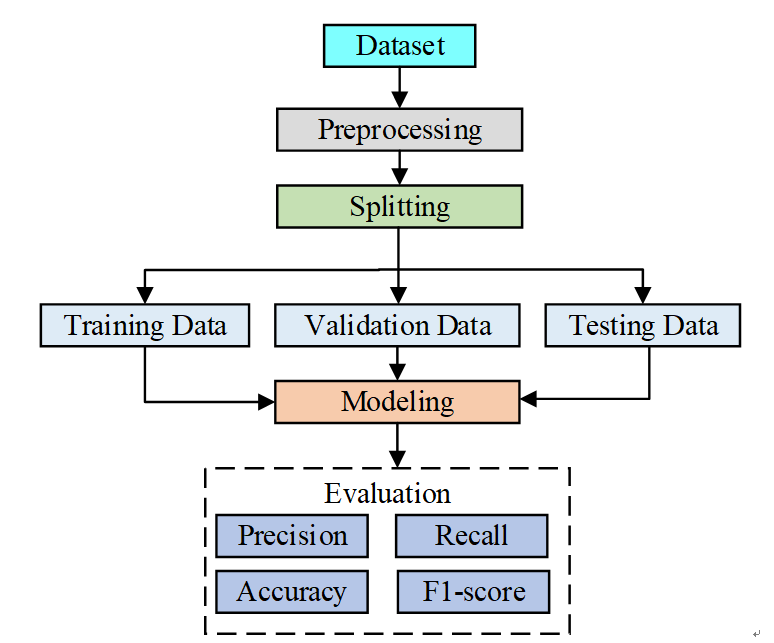
Depression is a prevalent mental health condition, where early detection using the analysis of patients' feelings contributes to preventing and treating the exacerbation of symptoms. This work aims to detect depression in Arabic tweets using convolutional neural networks (CNN) trained on a dataset generated from the Arabic_Dep_tweets_10,000 dataset. Two datasets are generated using the stripping and captioning process to improve the generalization of the proposed CNN model. The stripping process removes punctuation marks from Arabic tweets, while the captioning process types the Arabic tweet on a white background to generate an image. Experimental results demonstrate that the proposed CNN model achieves up to 100% accuracy on the generated dataset treated with stripping and the captioning process.
References
T. Anbesaw, M. A. Kassa, W. Yimam, A. B. Kassaw, M. Belete, A. Abera, et al., “Factors Associated with Depression Among War-Affected Population in Northeast, Ethiopia,” BMC Psychiatry, vol. 24, no. 1, article no. 376, 2024.
Z. Ning, H. Hu, L. Yi, Z. Qie, A. Tolba, and X. Wang, “A Depression Detection Auxiliary Decision System Based on Multi-Modal Feature-Level Fusion of EEG and Speech,” IEEE Transactions on Consumer Electronics, vol. 70, no. 1, pp. 3392-3402, 2024.
V. Vandana, N. Marriwala, and D. Chaudhary, “A Hybrid Model for Depression Detection Using Deep Learning,” Measurement: Sensors, vol. 25, article no. 100587, 2023.
F. Hönig, A. Batliner, E. Nöth, S. Schnieder, and J. Krajewski, “Automatic Modelling of Depressed Speech: Relevant Features and Relevance of Gender,” Proceedings of the Annual Conference of the International Speech Communication Association (INTERSPEECH), pp. 1248-1252, 2014.
V. Tejaswini, K. S. Babu, and B. Sahoo, “Depression Detection from Social Media Text Analysis Using Natural Language Processing Techniques and Hybrid Deep Learning Model,” ACM Transactions on Asian and Low-Resource Language Information Processing, vol. 23, no. 1, article no. 4, 2024.
F. Liu, Q. Ju, Q. Zheng, and Y. Peng, “Artificial Intelligence in Mental Health: Innovations Brought by Artificial Intelligence Techniques in Stress Detection and Interventions of Building Resilience,” Current Opinion in Behavioral Sciences, vol. 60, article no. 101452, 2024.
M. M. Najafabadi, F. Villanustre, T. M. Khoshgoftaar, N. Seliya, R. Wald, and E. Muharemagic, “Deep Learning Applications and Challenges in Big Data Analytics,” Journal of Big Data, vol. 2, article no. 1, 2015.
S. K. Salim, M. M. Msallam, and H. Ismail, “Design Novel CNN Architecture to Protect Personal Devices from Unauthorized Access Using Face Recognition,” Nanotechnology Perceptions, vol. 20, no. 3, pp. 82-93, 2024.
B. Verma, S. Gupta, and L. Goel, “A Neural Network Based Hybrid Model for Depression Detection in Twitter,” Communications in Computer and Information Science, vol. 1244, pp. 164-175, 2020.
A. M. Helmy, R. Nassar, and N. Ramdan, “Depression Detection for Twitter Users Using Sentiment Analysis in English and Arabic Tweets,” Artificial Intelligence in Medicine, vol. 147, article no. 102716, 2024.
A. Leis, F. Ronzano, M. A. Mayer, L. I. Furlong, and F. Sanz, “Detecting Signs of Depression in Tweets in Spanish: Behavioral and Linguistic Analysis,” Journal of Medical Internet Research, vol. 21, no. 6, article no. e14199, 2019.
J. Younes, E. Souissi, H. Achour, and A. Ferchichi, “Language resources for Maghrebi Arabic dialects’ NLP: A Survey,” Language Resources and Evaluation, vol. 54, no. 4, pp. 1079-1142, 2020.
I. Boulesnam and R. Boucetti, “Arabic Language Characteristics that Make its Automatic Processing Challenging,” The International Arab Journal of Information Technology, vol. 22, no. 4, pp. 814-831, 2025.
S. Lyu, X. Ren, Y. Du, and N. Zhao, “Detecting Depression of Chinese Microblog Users Via Text Analysis: Combining Linguistic Inquiry Word Count (LIWC) With Culture and Suicide Related Lexicons,” Frontiers in Psychiatry, vol. 14, article no. 1121583, 2023.
M. E. Villa-Pérez, L. A. Trejo, M. B. Moin, and E. Stroulia, “Extracting Mental Health Indicators from English and Spanish Social Media: A Machine Learning Approach,” IEEE Access, vol. 11, pp. 128135-128152, 2023.
J. Cha, S. Kim, and E. Park, “A Lexicon-Based Approach to Examine Depression Detection in Social Media: The Case of Twitter and University Community,” Humanities and Social Sciences Communications, vol. 9, article no. 325, 2022.
K. M. Broczek, M. C. Gely-Nargeot, and P. Gareri, “Editorial: Depression Across Cultures and Linguistic Identities,” Frontiers in Psychology, vol. 15, article no. 1538489, 2024.
S. Khan and S. Alqahtani, “Hybrid Machine Learning Models to Detect Signs of Depression,” Multimedia Tools and Applications, vol. 83, no. 13, pp. 38819-38837, 2023.
S. Zhou and M. Mohd, “Mental Health Safety and Depression Detection in Social Media Text Data: A Classification Approach Based on a Deep Learning Model,” IEEE Access, vol. 13, pp. 63284-63297, 2025.
A. Abdulsalam, A. Alhothali, and S. Al-Ghamdi, “Detecting Suicidality in Arabic Tweets Using Machine Learning and Deep Learning Techniques,” Arabian Journal for Science and Engineering, vol. 49, no. 9, pp. 12729-12742, 2024.
E. M. Rabie, A. F. Hashem, and F. K. Alsheref, “Recognition Model for Major Depressive Disorder in Arabic User-Generated Content,” Beni-Suef University Journal of Basic and Applied Sciences, vol. 14, article no. 7, 2025.
S. S. Khalil, N. S. Tawfik, and M. Spruit, “Federated Learning for Privacy-Preserving Depression Detection with Multilingual Language Models in Social Media Posts,” Patterns, vol. 5, no. 7, article no. 100990, 2024.
M. Jogin, Mohana, M. S. Madhulika, G. D. Divya, R. K. Meghana, and S. Apoorva, “Feature Extraction Using Convolution Neural Networks (CNN) And Deep Learning,” Proceedings of the 2018 3rd IEEE International Conference on Recent Trends in Electronics, Information & Communication Technology, Bangalore, India, 2018.
X. Yang, J. Yan, W. Wang, S. Li, B. Hu, and J. Lin, “Brain-Inspired Models for Visual Object Recognition: An Overview,” Artificial Intelligence Review, vol. 55, no. 7, pp. 5263-5311, 2022.
L. Zhao and Z. Zhang, “An Improved Pooling Method for Convolutional Neural Networks,” Scientific Reports, vol. 14, article no. 1589, 2024.
X. Zhang, Y. Zhang, and F. Yu, “HiT-SR: Hierarchical Transformer for Efficient Image Super-Resolution,” Lecture Notes in Computer Science, vol. 15098, pp. 483-500, 2025.
A. Rajanand and P. Singh, “ErfReLU: Adaptive Activation Function for Deep Neural Network,” Pattern Analysis and Applications, vol. 27, no. 2, article no. 68, 2024.
M. M. Alnaddaf and M. S. Basarslan, “Sentiment Analysis Using Various Machine Learning Techniques on Depression Review Data,” Proceedings of 8th International Artificial Intelligence and Data Processing Symposium, Malatya, Turkey, 2024.
H. Alkasem, A. Alsalamah, L. Alhussan, N. Alzahrani, and S. Aba-alkhail. "Machine Learning Methods for Detecting Depression in Arabic Tweets: A Comprehensive Performance Analysis with Enhanced Evaluation Metrics." Discover Artificial Intelligence, vol. 6, article no. 120, 2026.
A. Helmy, R. Nassar, and N. Ramdan. "Cross-Lingual Depression Detection for Twitter Users: A Comparative Sentiment Analysis of English and Arabic Tweets.", Preprint, 2023, doi: 10.21203/rs.3.rs-3197428/v1.
Downloads
Published
Issue
Section
License
Copyright (c) 2026 Mohammed Majid Msallam, Esraa Yahia Tarkan, Sarah Kareem Salim

This work is licensed under a Creative Commons Attribution-NonCommercial 4.0 International License.
Submission of a manuscript implies: that the work described has not been published before that it is not under consideration for publication elsewhere; that if and when the manuscript is accepted for publication. Authors can retain copyright of their article with no restrictions. Also, author can post the final, peer-reviewed manuscript version (postprint) to any repository or website.

Since Oct. 01, 2015, PETI will publish new articles with Creative Commons Attribution Non-Commercial License, under The Creative Commons Attribution Non-Commercial 4.0 International (CC BY-NC 4.0) License.
The Creative Commons Attribution Non-Commercial (CC-BY-NC) License permits use, distribution and reproduction in any medium, provided the original work is properly cited and is not used for commercial purposes
How to Cite