Self-Recovering Crosslinked Natural Rubber Sensors for Vascular Simulation in Wireless Electro-Syringe Injection
DOI:
https://doi.org/10.46604/peti.2026.16290Keywords:
natural rubber vulcanization, self-recovering crosslinked network, vascular simulation sensor, injection training device, Fick’s second lawAbstract
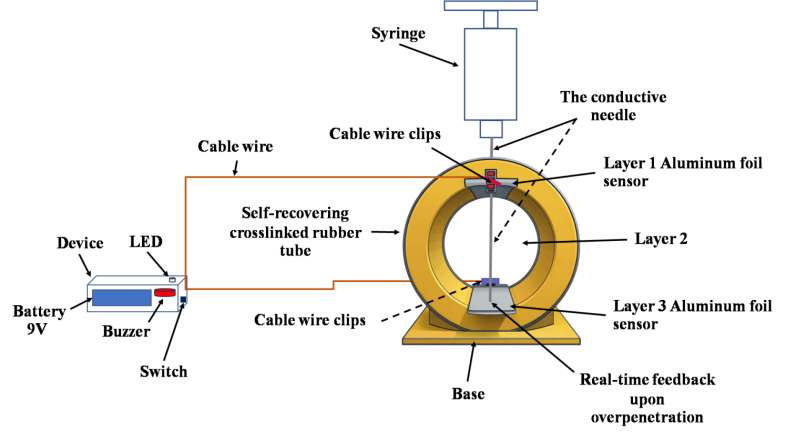
Safe injection technique is recognized as a critical competency in medical training, yet access to realistic and affordable simulators remains limited. This study aims to develop a wireless electro-syringe system that incorporates a self-recovering crosslinked natural rubber sensor for vascular tissue response. The sensor is fabricated from natural rubber latex via controlled sulfur vulcanization, enabling autonomous structural recovery after repeated needle penetrations. A closed-circuit detection system delivers immediate feedback upon overpenetration, providing real-time performance guidance. Fourier transform infrared spectroscopy (FTIR) analysis confirms a reduction of carbon-carbon double bonds and the formation of carbon-sulfur crosslinks. Increasing vulcanization temperature and curing time enhances crosslinking density and improves mechanical performance and self-recovery properties. Diffusion analysis confirms Fickian behavior (n ≈ 0.5) with an activation energy of 31.244 kJ·mol-1. The elastic modulus gradually recovers after disruption, suggesting effective network reformation. Overall, this work provides a low-cost, reusable, and mechanically realistic solution for injection training.
References
J. Micallef, A. Arutiunian, and A. Dubrowski, “The Development of an Intramuscular Injection Simulation for Nursing Students,” Cureus, vol. 12, no. 12, article no. e12366, 2020.
L. Lioce, S. Gunter, G. Maddux, I. Fogle, and B. Schroer, “Development of a Needle Injection Pad Trainer for Simulating Intradermal, Subcutaneous and Intramuscular Injections: Used in Student Nurse Training,” Proceedings of the 33rd European Modeling and Simulation Symposium (EMSS 2021), pp. 253-259, 2021.
B. R. Bhagat, M. Khairnar, P. P. Waknis, and B. M. Rudagi, “Innovative Pre-Clinical Learning in Oral Surgery: Injection on Tomato-AQuasi-Experimental Study,” Journal of Maxillofacial and Oral Surgery, vol. 24, no. 1, pp. 8-12, 2025.
A. M. Salameh Khraisat, H. Hapidin, N. S. H. Nik Ahmad, M. D. Mohammad Yusoff, M. S. Nurumal, and K. W. Pardi, “A Virtual Learning Environment for Teaching Intramuscular Injection: A Focus Group Discussion Analysis,” Indian Journal of Forensic Medicine and Toxicology, vol. 14, no. 4, pp. 705-709, 2020.
G. Avşar, Ş. Çelik, S. Doğan, and B. Çiftçi, “Virtual Reality Technology in Nursing Education: A Qualitative Study,” European Journal of Education, vol. 59, no. 4, article no. e12780, 2024.
K. Hanfati, S. Sukaridhoto, D. K. Basuki, R. P. N. Budiarti, E. D. Fajrianti, and I. A. Al Hafidz, “Design and Implementation of WebXR Health Learning Module Application,” Proceedings of the 2022 International Electronics Symposium (IES), pp. 632-637, 2022.
N. Soto-Ruiz, P. Escalada-Hernández, A. Bujanda-Sainz de Murieta, T. Ballesteros-Egüés, A. Larrayoz-Jiménez, y L. San Martín-Rodríguez, “Augmented Reality for Intramuscular Injection Training: A Cluster Randomized Controlled Trial,” Teaching and Learning in Nursing, vol. 20, no. 3, pp. e869-e876, 2025.
B. Terzi and A. Ilgaz, “The Effect of Flipped Classroom Model and Kahoot for Intramuscular Injection Training on Nursing Students' Knowledge, Skills and Self-Efficacy Levels,” Journal of Nursology, vol. 27, no. 3, pp. 237-247, 2024.
B. Terzi and S. Darıcı, “The Effect of Ventrogluteal Intramuscular Injection Training with Animated Video Containing Subliminal Messages: A Randomized Controlled Study,” Journal of Nursing Effect, vol. 16, no. 3, pp. 304-316, 2023.
Ö. Doğu and Ö. Tiryaki, “The Effect of the Interactive Workshop, E-Learning and Practice Training Given to Nurses on Injection to the Ventrogluteal Region on the Knowledge and Practices of Nurses,” Karya Journal of Health Sciences, vol. 4, no. 1, pp. 60-64, 2023.
E. Y. Coskun and M. Sendir, “Effectiveness of Computer-Based and Hybrid Simulation in Teaching Intramuscular Medication Administration,” International Journal of Caring Sciences, vol. 15, no. 2, pp. 1565-1575, 2022.
K. Fujimoto, T. Kanamoto, S. Otani, R. Miyazaki, K. Ebina, and K. Nakata, “Basic Research for Ultrasound-Guided Injection into Skeletal Muscle Lesions in an Experimental Animal Model,” Bone and Joint Research, vol. 14, no. 1, pp. 33-41, 2025.
A. J. S. McCartan and R. J. Mrsny, “In Vitro Modeling of Intramuscular Injection Site Events,” Expert Opinion on Drug Delivery, vol. 21, no. 8, pp. 1155-1173, 2024.
R. Uppuluri, A. Bhattacharjee, S. Anwar, and Y. She, “SeeBelow: Sub-Dermal 3D Reconstruction of Tumors with Surgical Robotic Palpation and Tactile Exploration,” Proceedings of the IEEE/RSJ International Conference on Intelligent Robots and Systems (IROS), IEEE Press, pp. 6961-6968, 2024.
ASTM D3616-95, Standard Test Method for Rubber-Determination of Gel, Swelling Index, and Dilute Solution Viscosity, ASTM International, 1995.
C. Xu, L. Cao, B. Lin, X. Liang, and Y. Chen, “Design of Self-Healing Supramolecular Rubbers by Introducing Ionic Cross-Links into Natural Rubber via a Controlled Vulcanization,” ACS Applied Materials and Interfaces, vol. 8, no. 27, pp. 17728-17737, 2016.
C. Kumnuantip and N. Sombatsompop, “Dynamic Mechanical Properties and Swelling Behaviour of NR/Reclaimed Rubber Blends,” Materials Letters, vol. 57, no. 21, pp. 3167-3174, 2003.
P. J. Flory and J. Rehner, “Statistical Mechanics of Cross-Linked Polymer Networks II. Swelling,” The Journal of Chemical Physics, vol. 11, no. 11, pp. 521-526, 1943.
ASTM D471-16, Standard Test Method for Rubber Property-Effect of Liquids, ASTM International, 2016.
J. Crank, The Mathematics of Diffusion, 2nd ed., Oxford, U.K.: Oxford University Press, 1975.
W. D. Callister and D. G. Rethwisch, Materials Science and Engineering: An Introduction, 10th ed., Hoboken, NJ: Wiley, 2020.
R. W. Korsmeyer, R. Gurny, E. Doelker, P. Buri, and N. A. Peppas, “Mechanisms of Solute Release from Porous Hydrophilic Polymers,” International Journal of Pharmaceutics, vol. 15, no. 1, pp. 25-35, 1983.
J. D. Ferry, Viscoelastic Properties of Polymers, 3rd ed., New York: Wiley, 1980.
M. Akiba and A. S. Hashim, “Vulcanization and Crosslinking in Elastomers,” Progress in Polymer Science, vol. 22, no. 3, pp. 475-521, 1997.
S. Muroga, Y. Takahashi, Y. Hikima, S. Ata, M. Ohshima, T. Okazaki, et al., “New Evaluation Method for the Curing Degree of Rubber and Its Nanocomposites Using ATR-FTIR Spectroscopy,” Polymer Testing, vol. 93, article no. 106993, 2021.
ASTM D412-21, Standard Test Methods for Vulcanized Rubber and Thermoplastic Elastomers-Tension, ASTM International, 2021.
D. Roylance, Stress-Strain Curves, Cambridge, MA: Massachusetts Institute of Technology, 2001.
P. J. Flory, Statistical Mechanics of Chain Molecules, New York: Wiley, 1969.
B. Stuart, Infrared Spectroscopy: Fundamentals and Applications, Chichester, UK: Wiley, 2004.
A. Y. Coran, Vulcanization in Science and Technology of Rubber, 2nd ed., B. Erman and J. E. Mark, Eds. San Diego, CA, USA: Academic Press, pp. 339-385, 1994.
Published
Issue
Section
License
Copyright (c) 2026 Korn Taksapattanakul, Panisara Wanmahamart

This work is licensed under a Creative Commons Attribution-NonCommercial 4.0 International License.
Submission of a manuscript implies: that the work described has not been published before that it is not under consideration for publication elsewhere; that if and when the manuscript is accepted for publication. Authors can retain copyright of their article with no restrictions. Also, author can post the final, peer-reviewed manuscript version (postprint) to any repository or website.

Since Oct. 01, 2015, PETI will publish new articles with Creative Commons Attribution Non-Commercial License, under The Creative Commons Attribution Non-Commercial 4.0 International (CC BY-NC 4.0) License.
The Creative Commons Attribution Non-Commercial (CC-BY-NC) License permits use, distribution and reproduction in any medium, provided the original work is properly cited and is not used for commercial purposes
How to Cite