
Dietary Supplement Products Registration Verification Application Using Thai FDA Number Images with OpenAI Vision API
DOI:
https://doi.org/10.46604/peti.2026.15693Keywords:
Thai FDA number, dietary supplement products verification, OpenAI vision API, optical character recognitionAbstract
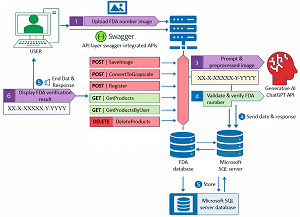
Thai Food and Drug Administration (FDA) registration numbers displayed on product labels are essential for verifying the authenticity of dietary supplements. This study aims to develop a Dietary Supplement Verification Application (DSVAPP) that enables consumers to upload images of product labels containing FDA registration numbers to authenticate products. The system uses the OpenAI vision Application Programming Interface (API) to extract registration numbers, thereby reducing error propagation between object detection and Optical Character Recognition (OCR). DSVAPP is evaluated using 118 images and nine combinations of object detection and OCR methods. The results demonstrate that the DSVAPP incorporating the GPT-5.2 vision model achieves superior performance compared to most evaluated methods.
References
S. T. Thota, “Thailand Probiotic Food Supplements Market Share Analysis, Demand, Trends, Industry and Market 2024-2027,” https://www.datamintelligence.com/research-report/thailand-probiotic-food-supplements-market, 2024.
D. Kalman, “Dietary Supplements: Popular vs. Validated?” https://www.researchgate.net/publication/385682129_Asia_Fitness_Conference_2024_Dietary_Supplements_Popular_vs_Validated, 2024.
S. Limsuwan, N. Awaeloh, P. Na-Phatthalung, T. Kaewmanee, and S. Chusri, “Exploring Antioxidant Properties of Standardized Extracts from Medicinal Plants Approved by the Thai FDA for Dietary Supplementation,” Nutrients, vol. 17, no. 5, article no. 898, 2025.
N. Hamelin, S. Nwankwo, and R. El Hadouchi, “‘Faking Brands’: Consumer Responses to Counterfeiting,” Journal of Consumer Behaviour, vol. 12, no. 3, pp. 159-170, 2013.
L. Mhando, M. B. Jande, A. Liwa, S. Mwita, and K. J. Marwa, “Public Awareness and Identification of Counterfeit Drugs in Tanzania: A View on Antimalarial Drugs,” Advances in Public Health, vol. 2016, no. 1, article no. 6254157, 2016.
P. Karungamye, “Counterfeit and Substandard Drugs in Tanzania: A Review,” Forensic Science International: Reports, vol. 7, article no. 100302, 2023.
C. Inthong, S. Lerkiatbundit, S. Mekruksavanich, and P. Hanvoravongchai, “Assessing Dietary Supplement Misinformation on Popular Thai E-Marketplaces: A Cross-Sectional Content Analysis,” Thai Journal of Pharmaceutical Sciences, vol. 48, no. 4, article no. 4, 2024.
Food Division, “Food Labeling and Examples,” https://food.fda.moph.go.th/for-entrepreneurs/food-labeling-and-examples, accessed in 2025. (In Thai)
T. Aung, Y. K. Thu, and M. N. Oo, “myOCR: Optical Character Recognition for Myanmar Language with Post-OCR Error Correction,” 19th International Joint Symposium on Artificial Intelligence and Natural Language Processing, pp. 1-6, 2024.
A. Mishra, J. Sikdar, and S. U. Kumar, “Deep Learning-Based Optical Character Recognition for Robust Real-World Conditions: A Comparative Analysis,” 15th International Conference on Computing Communication and Networking Technologies, pp. 1-7, 2024.
A. Singh, S. Jangra, and G. Aggarwal, “EnvisionText: Enhancing Text Recognition Accuracy through OCR Extraction and NLP-Based Correction,” 14th International Conference on Cloud Computing, Data Science & Engineering (Confluence), pp. 47-52, 2024.
V. Atmakuri and M. Dhanalakshmi, “Improving Text Recognition in Natural Scenes Using Optimized OCR Techniques,” 3rd International Conference on Automation, Computing and Renewable Systems, pp. 943-950, 2024.
Y. T. Hsiao, J. S. Sheu, and H. Ma, “Efficient Object Detection and Intelligent Information Display Using YOLOv4-Tiny,” Advances in Technology Innovation, vol. 9, no. 1, pp. 42-49, 2024.
Y. Liu, J. Zhu, and H. Ma, “Improving the Vehicle Small Object Detection Algorithm of Yolov5,” International Journal of Engineering and Technology Innovation, vol. 15, no. 1, pp. 57-67, 2025.
H. Moussaoui, N. E. Akkad, M. Benslimane, W. El-Shafai, A. Baihan, C. Hewage, et al., “Enhancing Automated Vehicle Identification by Integrating YOLO v8 and OCR Techniques for High-Precision License Plate Detection and Recognition,” Scientific Reports, vol. 14, article no. 14389, 2024.
R. Shashidhar, A. S. Manjunath, R. S. Kumar, M. Roopa, and S. B. Puneeth, “Vehicle Number Plate Detection and Recognition Using YOLO- V3 and OCR Method,” IEEE International Conference on Mobile Networks and Wireless Communications, pp. 1-5, 2021.
A. K. Kavita, V. T. Nileshsingh, S. Khonde, P. Marodkar, and H. Jadhao, “AI Powered Nutritional Label Analysis Using Vision Transformer and GNN for Ingredient Standardization and Regulatory Compliance,” 7th International Conference on Artificial Intelligence and Speech Technology, pp. 1-5, 2025.
S. I. SP, L. Karthikeyan, P. Bhoomika, K. Tejaswi, L. S. Khande, and N. S. Vemishetti, “Automating Nutritional Claim Verification: The Role of OCR and Machine Learning in Enhancing Food Label Transparency,” International Conference on IoT Based Control Networks and Intelligent Systems, pp. 1164-1171, 2024.
X. Zhou, C. Yao, H. Wen, Y. Wang, S. Zhou, W. He, et al., “EAST: An Efficient and Accurate Scene Text Detector,” IEEE Conference on Computer Vision and Pattern Recognition, pp. 2642-2651, 2017.
Y. Baek, B. Lee, D. Han, S. Yun, and H. Lee, “Character Region Awareness for Text Detection,” IEEE/CVF Conference on Computer Vision and Pattern Recognition, pp. 9357-9366, 2019.
S. Long, J. Ruan, W. Zhang, X. He, W. Wu, and C. Yao, “TextSnake: A Flexible Representation for Detecting Text of Arbitrary Shapes,” Computer Vision – ECCV 2018: 15th European Conference, pp. 19-35, 2018.
N. Khan, A. A. H. Ab Rahman, S. M. Rizvi, I. Y. Alshareef, M. N. Marsono, M. P. Bakht, et al., “Systematic Literature Review of Machine Learning Models and Applications for Text Recognition,” IEEE Access, vol. 13, pp. 177647-177670, 2025.
A. Kumar, A. Goyal, B. K. Rai, and S. Sharma, “OCR Based Medical Prescription and Report Analyzer,” AIP Conference Proceedings, vol. 2424, no. 1, article no. 070006, 2022.
M. Ponnuru, S. P. Ponmalar, A. Likhitha, T. B. Sree, and G. G. Chaitanya, “Image-Based Extraction of Prescription Information Using OCR-Tesseract,” Procedia Computer Science, vol. 235, pp. 1077-1086, 2024.
S. K. J. Urumarudappa, C. Tungphatthong, J. Jaipaew, N. Pornputtapong, D. Pakdeesattayapong, S. Vimolmangkang, et al., “Development of a DNA Barcode Library of Plants in the Thai Herbal Pharmacopoeia and Monographs for Authentication of Herbal Products,” Scientific Reports, vol. 12, article no. 9624, 2022.
P. K. Pal and M. Kule, “A New Approach to Pharmaceutical Product Verification Using Barcode and QR Code,” Proceedings of International Conference on Frontiers in Computing and Systems, pp. 223-229, 2023.
S. Kavin and C. P. Shirley, “OCR-Based Extraction of Expiry Dates and Batch Numbers in Medicine Packaging for Error-Free Data Entry,” 7th International Conference on Circuit Power and Computing Technologies, pp. 278-283, 2024.
P. Goyal, N. Goyal, P. Singh, N. Mittal, N. Jindal, and K. Kaur, “Pharmaceutical Drugs Expiry Date Tracking: A Visionary Approach,” Concurrency and Computation: Practice and Experience, vol. 34, no. 28, article no. e7358, 2022.
K. P. Sinaga and M. S. Yang, “Unsupervised K-Means Clustering Algorithm,” IEEE Access, vol. 8, pp. 80716-80727, 2020.
Published
Issue
Section
License
Copyright (c) 2026 Arnon Phongrusamepane, Nattapat Thongkaew, Teetach Chuenkamonrat, Chalothon Chootong, Chatchai Kasemtaweechok

This work is licensed under a Creative Commons Attribution-NonCommercial 4.0 International License.
Submission of a manuscript implies: that the work described has not been published before that it is not under consideration for publication elsewhere; that if and when the manuscript is accepted for publication. Authors can retain copyright of their article with no restrictions. Also, author can post the final, peer-reviewed manuscript version (postprint) to any repository or website.

Since Oct. 01, 2015, PETI will publish new articles with Creative Commons Attribution Non-Commercial License, under The Creative Commons Attribution Non-Commercial 4.0 International (CC BY-NC 4.0) License.
The Creative Commons Attribution Non-Commercial (CC-BY-NC) License permits use, distribution and reproduction in any medium, provided the original work is properly cited and is not used for commercial purposes
How to Cite